

Key Takeaways
- An outdoor furniture return isn’t a US$30 problem — it’s US$300–US$400. Bidirectional LTL freight on an 80–150 lb product, plus packaging damage and reprocessing, can erase the margin on three other sales.
- Most large-item returns aren’t defects — they’re unmet expectations in the first 48 hours. Curbside-freight surprises, assembly frustration, and minor transit scuffs drive the return decision, and all three are preventable with the right contact at the right moment.
- The prevention system runs in three phases: proactive pre-delivery outreach (hours 0–12), specific step-by-step assembly guidance (12–24), and proactive retention with partial-compensation offers (24–48).
- A tiered compensation authorization matrix plus AI monitoring of 100% of interactions keeps agents resolving instead of refunding-to-close — or avoiding compensation entirely — reliably, at scale.

A hundred-pound patio set just landed in the driveway. What happens in the next 48 hours determines your return rate.
Outdoor furniture returns in North America don’t cost US$30 to process. They cost US$300 to US$400 — bidirectional freight on a product that weighs more than a person, plus packaging damage, plus the margin on two or three other orders gone to cover the loss. The 48 hours after delivery determine whether that cost happens. Here’s the system that stops it.
Why outdoor furniture returns are a different category of problem
Patio swings, outdoor sofas, shade structures, pergola kits — these are high-ticket, high-margin products for brands that have built North American distribution. They’re also products where a single return can erase the profit from multiple successful sales. Returns are a structural cost across US retail — the National Retail Federation expects nearly US$850 billion in returns in 2025, about 16% of sales — but for outdoor furniture the freight math makes a single return far more punishing than the category average.
The economics are straightforward and painful. A product that sells for US$500 to US$800, shipped via less-than-truckload (LTL) freight because it weighs 80 to 150 pounds, costs US$150 to US$250 to deliver. If the customer returns it, the reverse freight is similar. The packaging that arrived intact doesn’t arrive intact the second time. By the time the product is back in the warehouse and assessed, the total cost of that return — freight out, freight back, packaging damage, inspection and reprocessing — frequently exceeds US$400. That’s not a return. That’s a loss on the sale plus a loss on three other sales to compensate.
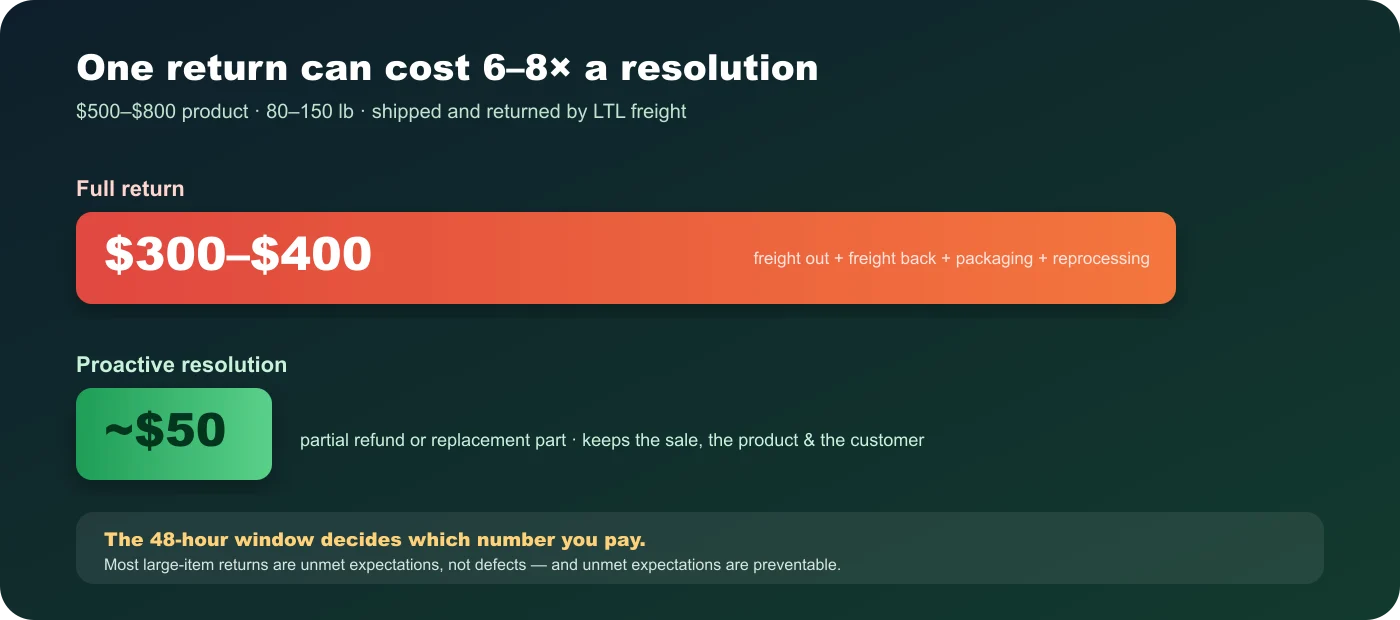
The frustrating reality is that most outdoor furniture returns in North America aren’t driven by product defects. They’re driven by unmet expectations — expectations that could have been managed, questions that could have been answered, and frustration that could have been prevented by the right communication at the right moment.
The right moment is the 48 hours after delivery. That window is when the return decision gets made — and it’s a window most brands have no systematic approach to winning.
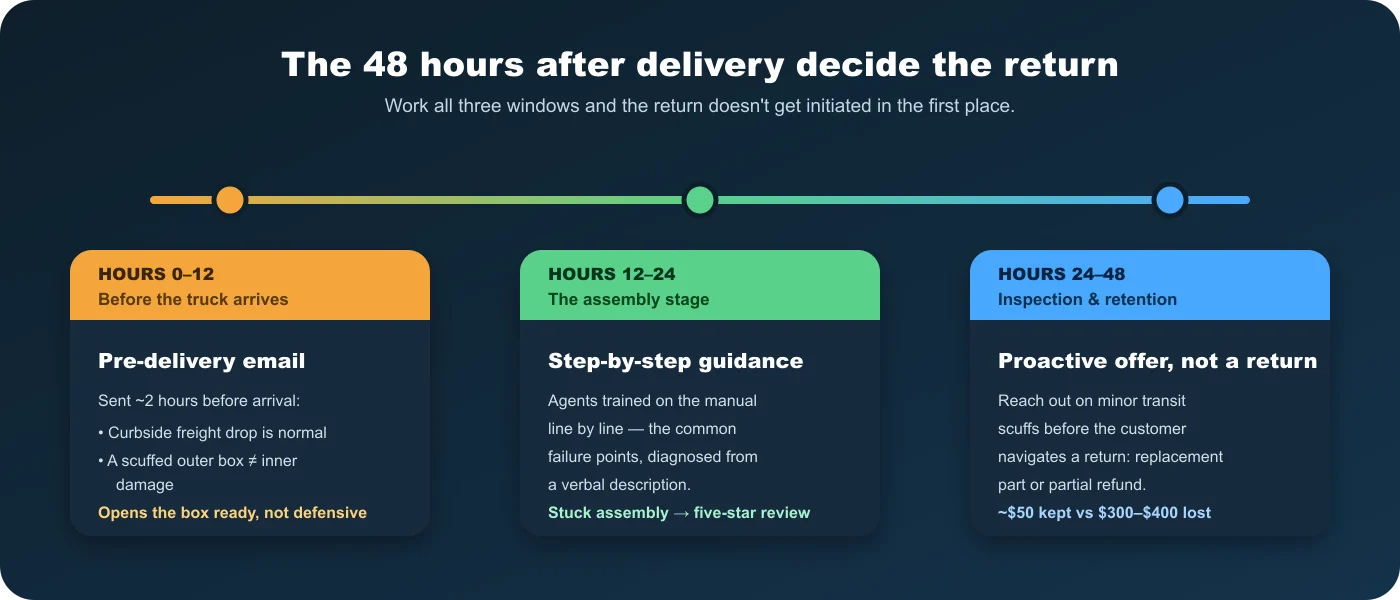
Phase one: hours 0–12 — before the truck arrives
The first critical moment isn’t when the customer opens the box. It’s when the truck pulls up.
Large freight delivery in North America operates differently from standard parcel delivery — and most customers don’t know this until the truck arrives. LTL freight drivers deliver to the curb or the end of the driveway. They don’t bring it inside. They don’t help with placement. A customer who expected door delivery stands at the end of their driveway looking at a 150-pound box that they now have to figure out how to get into the house themselves.
The box itself doesn’t help the situation. Long-distance freight transit scuffs outer packaging — corner compression, surface dirt, moisture marks from warehouse handling. The product inside is typically fine. The box looks like it had a difficult journey. A customer who wasn’t prepared for this sees a damaged-looking box sitting in their driveway and immediately wonders whether the product inside is also damaged. That reaction — anxiety, frustration, a reflex toward rejection — happens before the box is even opened.
Callnovo’s support team monitors logistics tracking in real time. When the system shows “Out for Delivery,” an outreach email goes to the customer approximately two hours before estimated arrival — before the truck gets there. The message isn’t a logistics notification. It’s a human-tone delivery guide:
Hi John — your patio sofa is scheduled to arrive within the next two hours. As is standard for large freight deliveries in North America, the driver will unload to your driveway or garage entrance. We’d recommend clearing a path in advance to make it easier to move inside.
We use double-layer professional waterproof packaging, so even if the outer box shows some scuffing or light moisture from transit, it won’t have affected the furniture inside. Please go ahead and open it up — we think you’ll be happy with what you find.
Three specific things happen in that message. The curbside-delivery expectation is set before the customer discovers it themselves and feels surprised. The outer-packaging concern is addressed before the customer sees the box and assumes the worst. And the customer is guided from a defensive, potentially rejecting mindset toward an open, ready-to-inspect one.
The return that would have been initiated because a customer felt blindsided by a damaged-looking box at the end of their driveway doesn’t happen — because the customer was prepared for what they were going to see.
Phase two: hours 12–24 — the assembly stage
North American consumers are generally comfortable with self-assembly. Outdoor furniture assembly is a weekend project — something they plan for, make time for, and expect to complete in an afternoon. When the assembly goes smoothly, the product is installed, they’re pleased with how it looks, and the purchase is complete.
When the assembly doesn’t go smoothly, the emotional trajectory is steep and fast. A customer who has been working on assembly for two hours and gets stuck on a step — or who discovers what they believe is a missing component — experiences frustration that compounds with every additional minute they spend unable to move forward. By the time they decide to contact support, they’re not neutral. They’re already leaning toward return as the path of least resistance.
What converts that moment from a return to a completed assembly is an agent who can provide genuine, specific, step-by-step technical guidance — not a generic “please refer to the instruction manual.”
Callnovo’s training protocol for outdoor furniture accounts goes significantly further than standard product orientation. Agents read the physical instruction manual line by line, with physical reference to the actual components — distinguishing M6 from M8 hardware, identifying left-arm versus right-arm brackets by their physical characteristics, not just their labels. From that process, the training team extracts a common-failure-point guide: the specific steps where customers most frequently get stuck or make mistakes, with the explanation for why the mistake happens and the most direct path to correcting it.
The result is agents who can identify what’s actually happening on a call: “If the holes on step five aren’t aligning, you’ve likely installed the armrests reversed at step three — it’s a common spot. Let’s go back and I’ll walk you through that part.” An agent who can say that with confidence — who can diagnose from the customer’s description, explain what went wrong without making the customer feel blamed, and provide a specific correction — is not a customer service representative in the generic sense. They’re the person who saves the sale at the moment the customer is closest to abandoning it.
Guidance language is trained specifically for North American natural speech — concrete, visual, directional. “The beam with the blue round sticker on the end — turn it so the holes face toward you.” Not terminology that works in a printed manual but falls apart on a phone call where the customer is looking at parts spread across the floor. This is the kind of specialist, English-language support team that converts a stuck assembly into a five-star review about the support experience.
Phase three: hours 24–48 — inspection and retention
Once a customer has assembled their furniture and is using it, they inspect it closely. Outdoor furniture that ships in large boxes across long distances will sometimes arrive with minor surface imperfections — light scuffs from packaging contact, small marks from transit vibration. These don’t affect function. They do affect customer perception.
A customer who paid US$700 for a patio sofa and is now examining a small scuff on one of the armrests is making a decision: is this acceptable, or do I return it? That decision is significantly influenced by whether someone from the brand contacts them proactively, acknowledges what they’re looking at, and offers a reasonable resolution — versus whether the customer has to initiate contact themselves and navigate a return process.
The resolution at this stage is rarely a return. It’s partial compensation — a discount on a future purchase, a replacement component for a specific damaged piece, a partial refund that acknowledges the imperfection without requiring the product to come back. The math strongly favors resolution over return: a US$50 partial refund on a product that arrived with minor transit damage costs US$50. The return of the same product costs US$300 to US$400 in freight and processing.
The challenge is managing this well at scale — ensuring agents are actively pursuing resolution at this stage, and that the resolution offers stay within bounds that protect margin. This is where the authorization and monitoring system matters.
The authorization matrix and AI monitoring that makes it work
Callnovo operates a tiered compensation authorization structure for outdoor furniture accounts. The tiers give agents the authority to resolve situations quickly — without escalating every minor compensation — while preventing the two failure modes that cost sellers most.
The structure exists to give agents the authority to resolve situations quickly while preventing the two failure modes that cost sellers most: agents who avoid offering any compensation because they’re uncertain about authorization (resulting in preventable returns), and agents who offer large compensations as the path of least resistance because it closes the contact quickly (resulting in unnecessary margin loss).
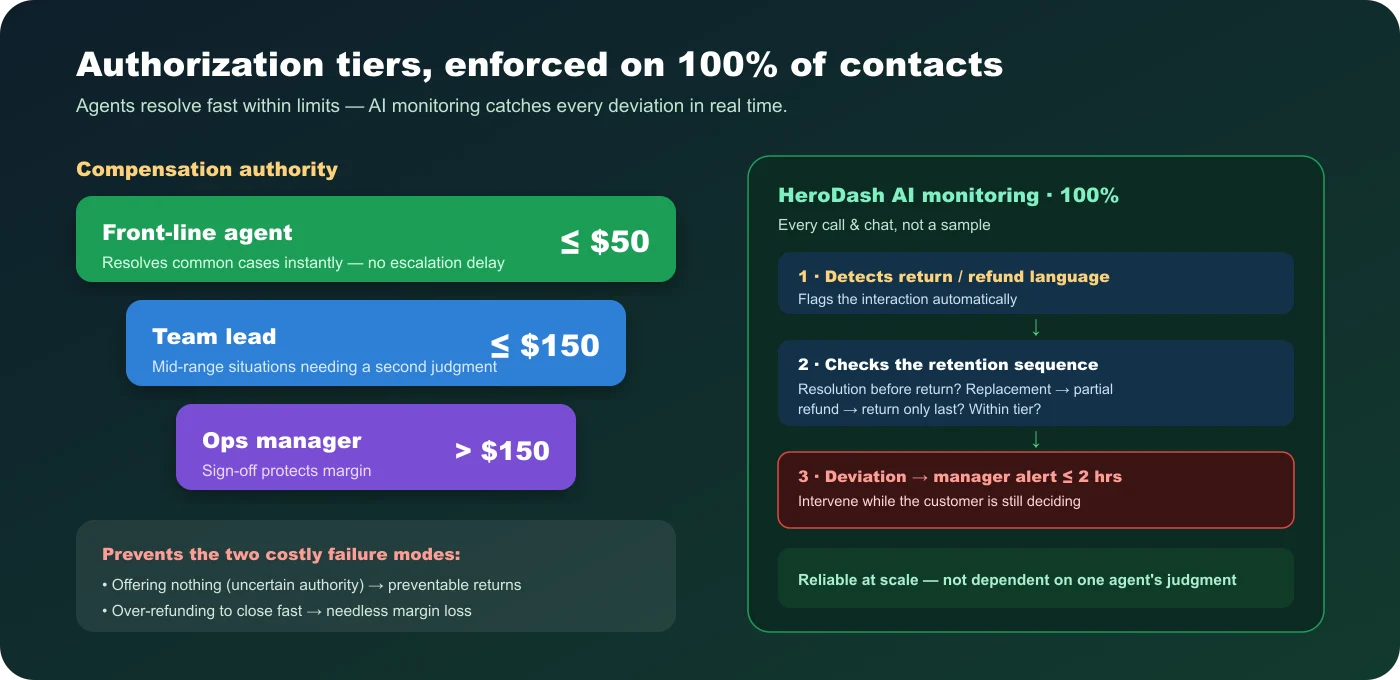
HeroDash’s AI quality monitoring enforces the structure across 100% of interactions — not a sampled subset.
When a customer uses return or refund language in a call or chat, the system flags the interaction automatically and monitors what the agent does next. The monitoring checks: did the agent attempt resolution before offering a return? Did they follow the escalation sequence — replacement component first, partial refund second, return authorization only as a last resort? Did the compensation offered fall within the agent’s authorization tier?
If an agent accepts a return request without going through the retention sequence, or offers compensation above their authorization level without escalating, an alert goes to the operations manager within about two hours. The manager can intervene — call the customer back, offer an alternative resolution, or handle the escalation directly — while the customer is still within the decision window.
This is the answer to the question of how outsourced agent quality is managed at scale. Not periodic audits of a sample of calls after the fact — real-time monitoring of every interaction, with automated escalation triggers that catch deviations while there’s still time to correct them.
What outdoor furniture brands operating in North America should take from this
The 48-hour window after delivery is not a customer service problem in the conventional sense. It’s a profit-protection problem — one where the right support infrastructure converts returns that cost US$300 into resolutions that cost US$50, at scale, across every order.
Three things determine whether a brand wins or loses in this window:
- Proactive outreach before the truck arrives. A customer who is prepared for curbside delivery and understands that an outer-box scuff doesn’t mean inner damage makes a different decision than one who is surprised by both. The outreach happens two hours before delivery — not after the customer contacts support because they’re upset about what they found.
- Assembly guidance that actually works. Generic product knowledge isn’t enough. Agents who know the specific failure points in the assembly process — where customers get stuck, what mistakes look like, how to diagnose from a verbal description — convert stuck customers into completed assemblies. That’s the difference between a return and a five-star review about the support experience.
- A monitored retention protocol with clear authorization boundaries. Resolution offers need to happen consistently and within margin-protecting limits. AI monitoring of 100% of interactions — with real-time alerts when agents deviate from the retention sequence or exceed authorization — is what makes the protocol reliable at scale rather than dependent on individual agent judgment.
A US$400 return that was preventable is the most expensive possible outcome of a delivery that went slightly wrong. The system that prevents it costs significantly less — and runs on every order, not just the ones where the customer happened to reach a particularly skilled agent on a good day.
FAQ
Why are outdoor furniture returns so expensive in North America?
A patio set weighing 80–150 lbs ships by LTL freight, so delivery costs US$150–US$250 and the reverse leg costs about the same. Add packaging that doesn’t survive a second trip, plus inspection and reprocessing, and a single return frequently exceeds US$400 — enough to erase the margin on several other sales.
How can brands reduce outdoor furniture return rates?
Most large-item returns are driven by unmet expectations, not defects — so the fix is communication timed to the 48 hours after delivery: proactive outreach before the freight truck arrives, specific step-by-step assembly guidance, and a proactive retention offer when a customer spots minor transit scuffs. Each moment is a return that doesn’t get initiated.
What happens in the 48 hours after a large-item delivery?
The return decision gets made. Hours 0–12 cover the freight delivery itself (curbside drop, scuffed outer box); hours 12–24 are the assembly stage where frustration peaks; hours 24–48 are close inspection, where minor imperfections trigger a keep-or-return choice. A brand that works all three windows changes the outcome.
How does a tiered compensation authorization structure work?
Front-line agents approve compensation up to US$50 without escalation, team leads up to US$150, and anything higher needs operations-manager sign-off. The tiers let agents resolve small issues instantly while protecting margin from refund-to-close behavior. Thresholds are illustrative — actual limits are set per client account.
How is outsourced agent quality monitored at scale?
HeroDash’s AI quality monitoring reviews 100% of calls and chats — not a sampled subset. When a customer uses return or refund language, the interaction is flagged automatically and checked: did the agent attempt resolution first, follow the escalation sequence, and stay within their authorization tier? Deviations trigger an operations-manager alert within about two hours.
Operational details reflect Callnovo’s standard approach for large-item outdoor furniture accounts in North American markets. Compensation-authorization figures are illustrative of the tiered structure; actual thresholds are set per client account.