

Key Takeaways
- The problem wasn’t too few agents — it was broken system logic. At tripled peak-season sales, a parts query took 8 minutes of manual spreadsheet lookup. More agents would have meant more errors, faster.
- Three system fixes did what headcount couldn’t. Fault-code parts lookup, serial-number validation, and structured exportable data replaced manual guesswork with a system that makes the right answer accessible.
- After-sales data is a product-quality asset. A structured export revealed a 23% oscillation-gear fault rate in one batch — which the factory then fixed.
- Complaint rate fell from 18% to 3.2%; satisfaction rose from 71% to 96%. The difference was thirty seconds instead of eight minutes, and a serial field that refuses errors.
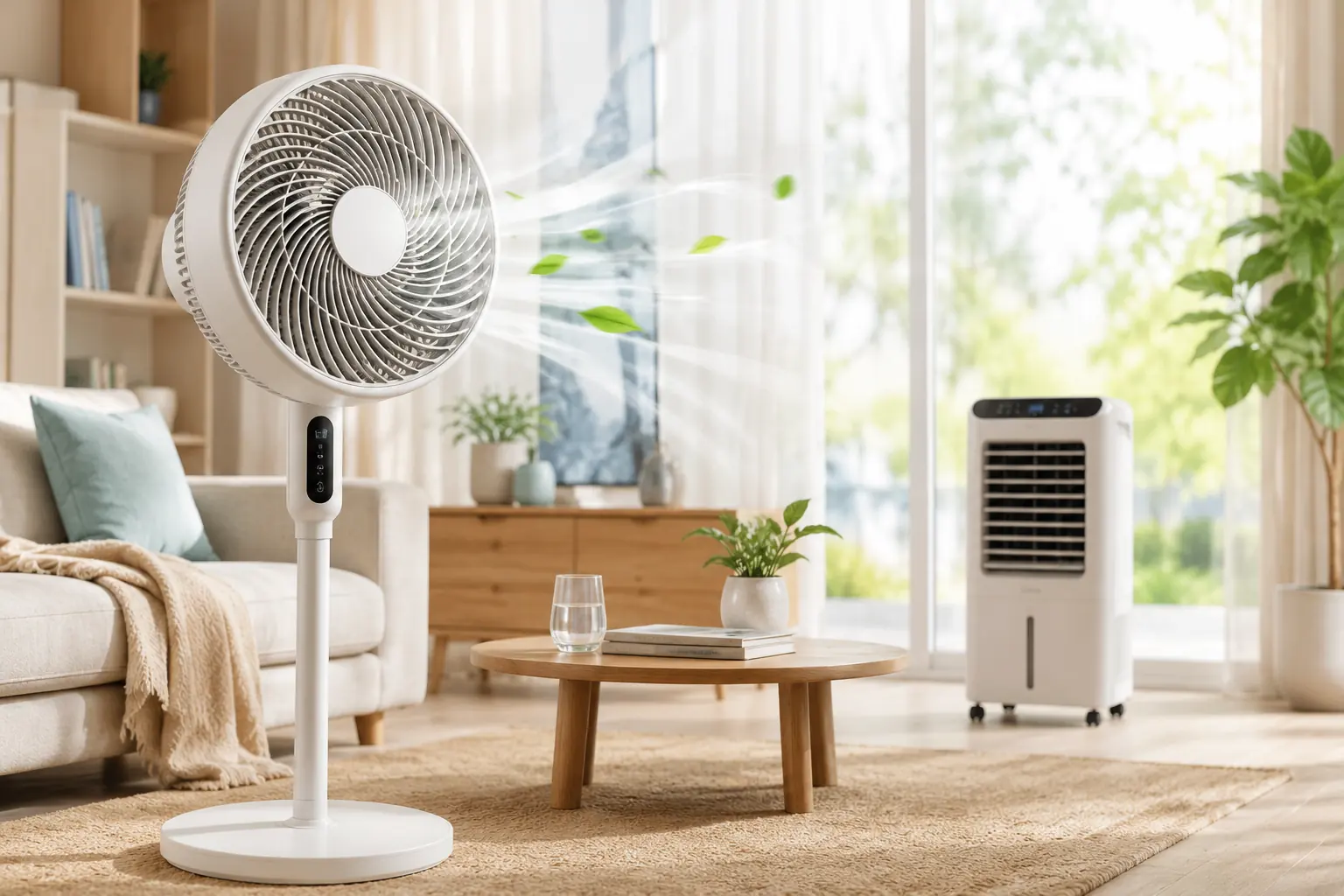
LF brand was selling out in France and the UK. Sales tripled in peak season. Then the after-sales department nearly dragged the whole operation under — not because they didn’t have enough people, but because the system underneath those people wasn’t built for what they were actually trying to do.
The European summer that created a parts nightmare
In the summer of 2025, temperatures across France broke 40°C in multiple regions, and the UK hit record highs for the time of year. European households — where air conditioning penetration is low and installation costs run €3,000 to €4,000 with weeks-long wait times — turned to electric fans instead.
For fan brands selling into France and the UK, this was the demand spike they’d been waiting for. LF brand’s sales tripled during peak season. Stock moved fast. The revenue numbers looked good.
Then the after-sales queue started building.
Electric fans have a specific parts complexity that catches brands off guard. Motors, capacitors, blades, blade guards, charging PCBs, lithium batteries, oscillation gears, switches — and critically, USB variants, rechargeable variants, and direct-plug variants whose parts are not interchangeable. The SKU count for replacement parts ran into the hundreds. A customer asking “can you send me a replacement blade?” was asking a question that required an agent to identify the exact model, find the corresponding part number, verify the right SKU, and confirm stock — a process taking eight minutes per query when the system required manual lookup across multiple spreadsheets.
At tripled sales volume, eight minutes per parts query was not sustainable. The complaint rate climbed to 18%. Return processing costs alone cost the brand more than €300,000 in that peak period — because returning a mid-to-large fan from France or the UK typically costs more in reverse logistics than the product itself is worth.
Three problems that were compounding each other
Hundreds of parts SKUs with no intelligent lookup. Parts queries were handled entirely through agent memory and manual spreadsheet lookup. When a customer reported a broken blade, the agent had to identify which of dozens of blade variants matched the customer’s model, cross-reference the right SKU, and manually verify availability. The process was slow, error-prone, and completely dependent on individual agents knowing the product range well enough to make the right call — which, at tripled volume with a French-language outsourced team, they often didn’t.
Cross-border parts replenishment that couldn’t keep up with summer demand. Sea freight from the manufacturing base to Europe takes approximately a month. Air freight is viable for high-value parts but economically irrational for a replacement motor on a €40 fan. The result: customers waiting weeks for parts that arrived after the summer was over, or brands eating the cost of full replacements and absorbing return logistics on items where the return shipping exceeded the product value.
After-sales data that existed nowhere except individual agents’ memories. Which models generated the most fault reports? Which fault types were most common by SKU? Which batch had the oscillation gear problem? None of this was tracked systematically. Agents filled in free-text notes. Nothing aggregated. The product team had no visibility into what the after-sales data could have been telling them about manufacturing quality — and the same problems recurred batch after batch because no one had structured data showing which problems were systemic.
What Callnovo actually changed — three system fixes
When LF brand came to Callnovo, the industry instinct is to add agents. More French-speaking staff, more coverage hours, more hands on the queue. Callnovo’s assessment went in a different direction: the problem wasn’t staffing capacity. It was system logic. More agents working inside a broken system would produce more errors at higher speed.
Fix one: model → fault code → parts list, automatically
Callnovo redesigned the after-sales ticket workflow using HeroDash’s custom field functionality. The new flow: customer reports a fault → agent selects the product model from a structured dropdown → agent selects the fault code (for example, “E03” indicating motor failure) → the system automatically surfaces the corresponding parts list, including the exact part number and model specification.
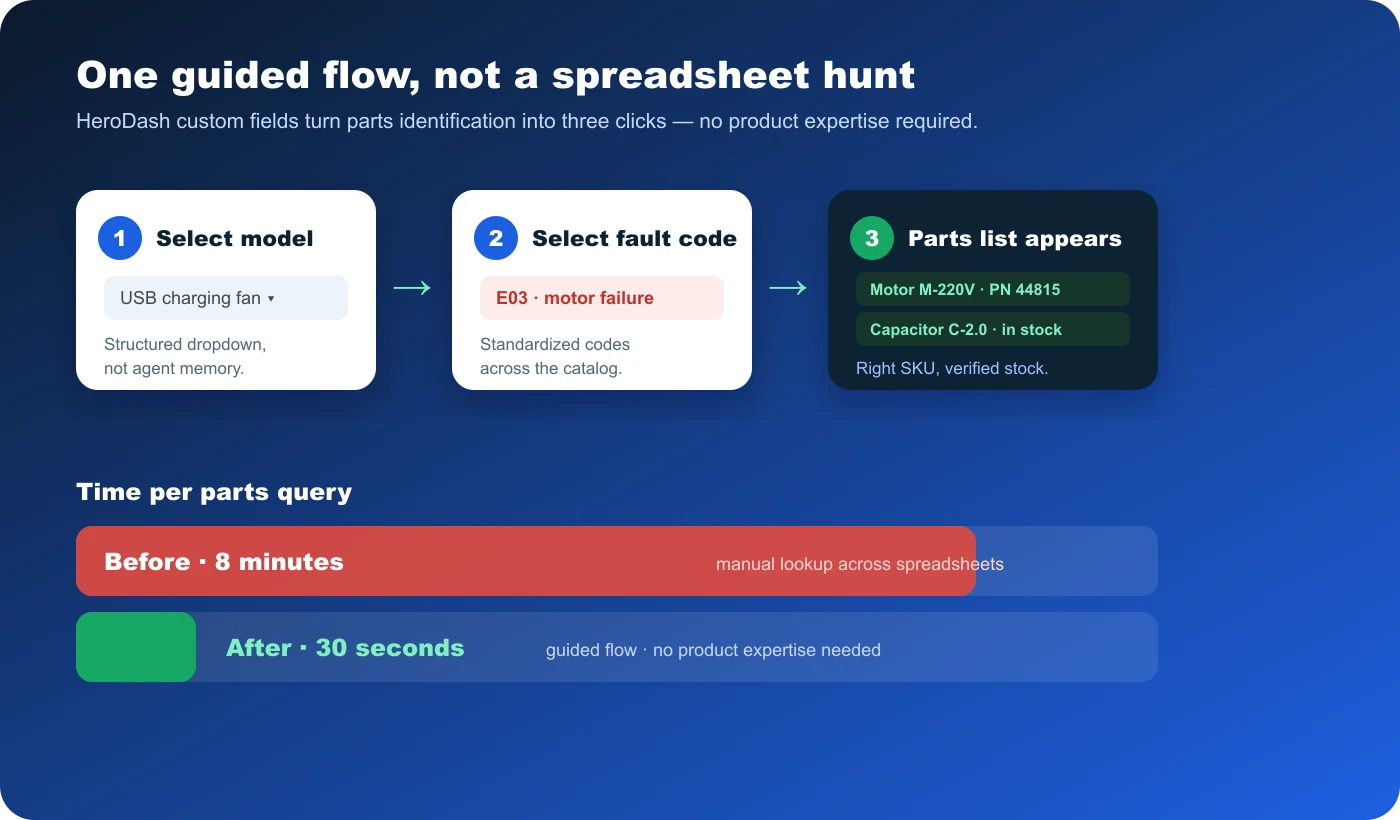
No spreadsheet lookup. No cross-referencing. No agent needing to know from memory that the 220V motor in the French-market USB charging variant is model M-220V rather than M-110V.
Parts query time: from 8 minutes to 30 seconds. The French-language support team — which had been one of the primary sources of parts errors because they were working with a product range they’d handled for only one season — could now reliably identify and dispatch the correct part without product expertise that would have taken months to build through experience.
Fix two: serial number validation at the point of entry
LF brand’s product serial numbers follow a fixed format: two letters followed by ten digits. Agents were routinely entering incorrect serial numbers — transposed characters, wrong length, format errors — which caused parts to be dispatched to incorrect records or against the wrong product variant. The parts error rate was running at 12%.
Callnovo implemented regex validation on the serial number field in HeroDash. When an agent enters a serial number that doesn’t match the defined format, the system immediately returns an error: “Format incorrect — submission blocked.” The ticket cannot proceed until a valid serial number is entered.
Parts dispatch error rate: from 12% to 1.5%. LF brand’s French support team lead noted that before this change, incorrect dispatches generated a specific category of complaint that required a second dispatch, a second wait, and a customer now writing a review about receiving the wrong part after already waiting a week. That complaint category essentially disappeared.
Fix three: structured after-sales data, exportable for the product team
Every ticket now captures model, fault code, part dispatched, resolution type, and outcome in structured fields rather than free-text notes. The data is exportable in full with one click.
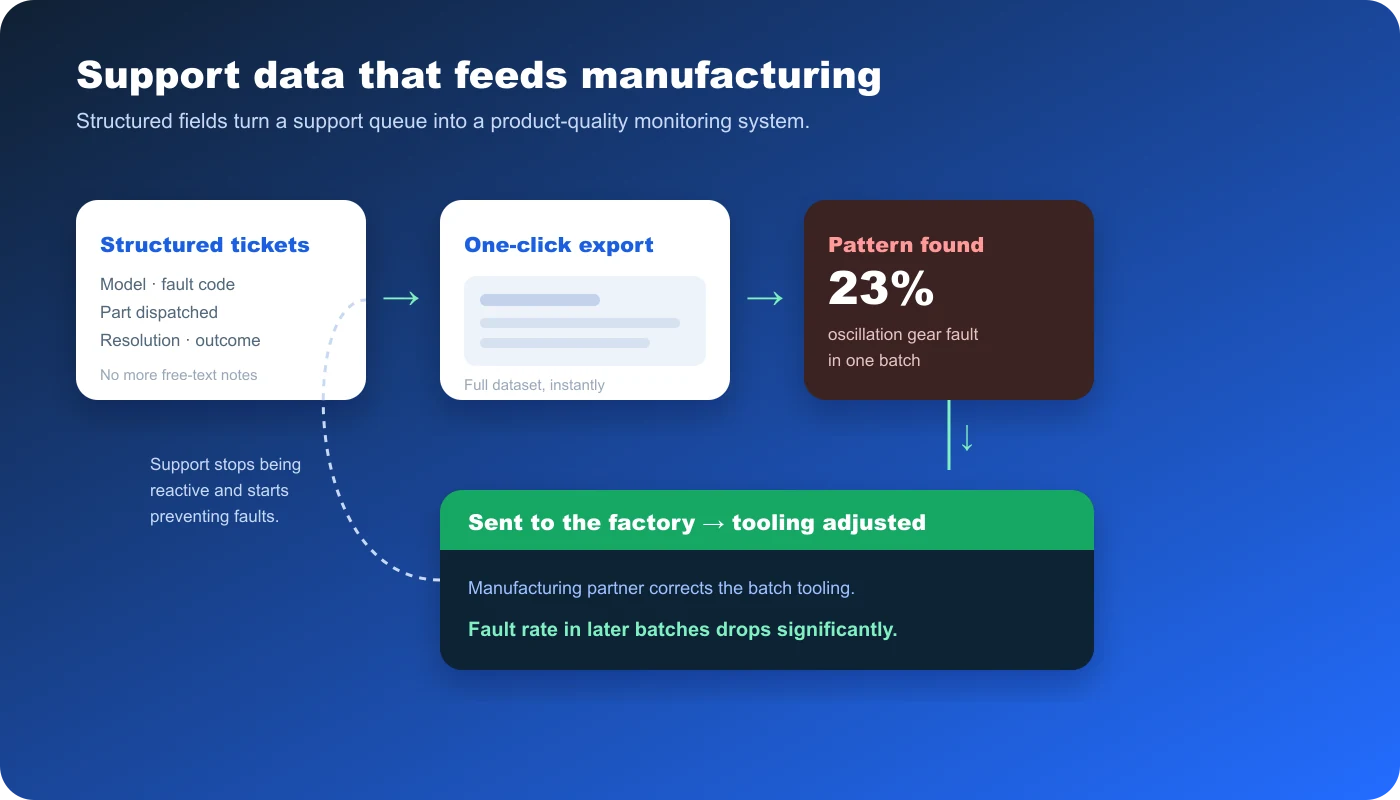
Within the first month of the new system running, LF brand’s product manager pulled the export and found something the brand hadn’t known: a specific production batch had an oscillation gear fault rate of 23%. That information went directly to the manufacturing partner — tooling was adjusted, and the fault rate in subsequent batches dropped significantly.
This is the part of after-sales support most brands treat as cost rather than asset. A structured ticket system that captures fault patterns is a product-quality monitoring system. The support operation stopped being purely reactive and started feeding information forward into manufacturing decisions.
Results across the 2025 peak season
LF brand after-sales, 2025 European peak season
None of these numbers came from adding people. Every one came from changing what the system did with the people already there.

The French-language support team now handles parts dispatch almost entirely independently, because the system tells them what to send. And HeroDash’s real-time QA monitoring keeps the quality bar consistent across the whole operation, rather than depending on any one agent’s product knowledge.
What Mr. Lin said about it
We'd tried other European customer service providers before. They all just added headcount — the problems kept piling up. Callnovo's approach was to fix the system logic first.
Mr. Lin, After-Sales Director, LF Brand
“Now our French-language outsourced team handles parts dispatch almost entirely independently. The system tells them what to send. They don’t need to ask me.”
Last summer, complaint rate went from 18% down to 3.2%. Customer satisfaction moved from 71% to 96%. French-language outsourced after-sales support is not something you solve by hiring two more people.
Mr. Lin, After-Sales Director, LF Brand
What fan and seasonal appliance brands should take from this
Electric fans, air circulators, and portable cooling products share a specific after-sales characteristic: they fail during the period when customers most need them to work, and the cross-border parts logistics timeline is almost always longer than the season itself.
This creates an after-sales environment where the quality of the support system — not the quantity of the support team — determines outcomes. An agent who can identify and dispatch the correct replacement part in 30 seconds rather than 8 minutes isn’t more experienced or better trained. They’re working inside a system that makes the right answer accessible rather than requiring them to find it manually.
Three questions worth asking about your current after-sales setup before next summer:
- How long does a parts query take from fault report to correct part identification? If the answer is more than two minutes and requires an experienced agent to do it correctly, the system is creating a dependency on individual knowledge that won’t scale under peak-season volume.
- What is your parts dispatch error rate? If you’re not tracking it, you don’t know — and an untracked error rate in parts dispatch is generating a specific category of complaint that’s preventable with input validation.
- Is your after-sales data structured well enough to tell you which batch has the highest fault rate? If the answer lives in free-text ticket notes that no one is aggregating, your support operation is absorbing cost from manufacturing quality problems your product team doesn’t know exist.
The 2026 European summer is already running warmer than average. Fan and cooling-product demand will follow the pattern it followed in 2025. The brands that enter peak season with system logic that supports their after-sales team — rather than systems the team has to work around — are the ones that come out with a 3% complaint rate instead of 18%.
The difference between those two numbers isn’t more people. It’s thirty seconds instead of eight minutes, and a serial number field that doesn’t accept errors.
FAQ
Why do electric fan brands face an after-sales spike in European summers?
Fans fail during the exact heatwave weeks when customers most need them, and cross-border parts logistics from Asia to Europe take about a month — longer than the season itself. With hundreds of non-interchangeable replacement-part SKUs, parts queries overwhelm support teams the moment sales spike.
How did the brand cut its complaint rate from 18% to 3% without adding staff?
By fixing system logic instead of headcount. HeroDash custom fields turned parts lookup into a guided model → fault-code → parts-list flow (8 minutes to 30 seconds), regex validation blocked malformed serial numbers (dispatch errors from 12% to 1.5%), and structured ticket data exposed manufacturing faults for the product team to fix.
What is a fault-code parts lookup in HeroDash?
It’s a structured after-sales workflow: the agent selects the product model from a dropdown, selects the fault code (for example, E03 for motor failure), and HeroDash automatically surfaces the correct parts list with exact part numbers and verified stock — no spreadsheet cross-referencing or product-expert memory required.
Can after-sales data improve product quality?
Yes. When every ticket captures model, fault code, part dispatched, and outcome in structured fields, one-click export reveals fault patterns by batch. In this case the product manager found a 23% oscillation-gear fault rate in one batch, sent it to the factory, and the fault rate dropped in later batches.
Selling seasonal consumer products in European markets and dealing with after-sales complexity at peak-season volume? Explore HeroDash — Callnovo’s after-sales management platform — or talk to our team about what the right system setup looks like for your product and markets.
Client surname used with permission. Brand identity partially anonymized. Performance metrics reflect results from an active Callnovo partnership during the 2025 European peak season.