

Privacy note: To protect customer confidentiality, identifying details have been removed.
Key Takeaways
- Premium products create premium service expectations. A customer who pays $150 for shoes will not tolerate the same vague, slow support they might forgive on a low-cost purchase.
- BL’s support gaps were becoming financial problems. The brand was dealing with inconsistent hiring, weak training, poor accountability, and a return workflow that leaked inventory.
- Callnovo rebuilt the operation around category-fit recruiting and closed-loop training. Agents were selected for premium consumer-product experience, assessed before go-live, and coached on real tickets after launch.
- Ticket error rate dropped by more than 50%, first response time fell below one minute, and the returns policy started being applied correctly.

Premium price. Premium expectation. Zero tolerance for mediocre service.
A $150 shoe is not just a purchase. It is a statement about quality, taste, and what a customer values. When someone spends that much on footwear, they are not only buying the product. They are buying into a brand experience that is supposed to justify every dollar of the price tag.
That expectation extends directly to customer support.
High-end customers have a lower tolerance for service failures than mass-market buyers. Someone who paid $30 for a pair of shoes might accept a slow reply or a vague answer. Someone who paid $150 will not. They expect faster responses, more accurate information, and communication that reflects the brand’s aesthetic and tone.
When the support experience does not match the product experience, the dissonance is immediate. The customer does not just feel let down. They start questioning whether the premium they paid was worth it. Once that question forms, it is very hard for the brand to answer it back.
BL understood this. What they had not yet built was the support operation to deliver on it.
Four problems were quietly eroding the brand
BL was entering North America and Europe with strong products and weak support. The damage was not limited to customer satisfaction. It was showing up in returns, lost inventory, and a brand perception problem that no marketing spend could fix.
Talent supply could not keep pace with growth. BL’s previous support provider was delivering only six to eight candidate CVs per month, and the quality was inconsistent. As the brand expanded into new markets, the existing team was stretched beyond capacity. Volume was rising. Coverage was falling. There was no pipeline of qualified candidates ready to fill the gap.
Training did not produce capable agents. New agents were going live before they were ready. The training process lacked a closed-loop assessment, so there was no mechanism to verify that an agent had actually absorbed the material before handling real customer interactions. Agents who had not retained product knowledge or workflow logic were making errors from day one.
For a brand at this price point, a new agent’s first week of errors is not an acceptable learning curve.
The team lacked service culture. This was not about individual agents being unkind. It was about a team that had not developed a sense of ownership over the customer experience they were part of. Unplanned absences were common. The connection between an agent’s daily behavior and the brand’s reputation in the market was not felt or understood.
Agents were completing tasks rather than representing a brand. At the premium end of the market, customers can feel that difference immediately.
A returns policy was being executed incorrectly and costing real money. This was the problem that deserved the most attention, because it showed how support failures at the operational level can create financial consequences far beyond the support team’s budget.
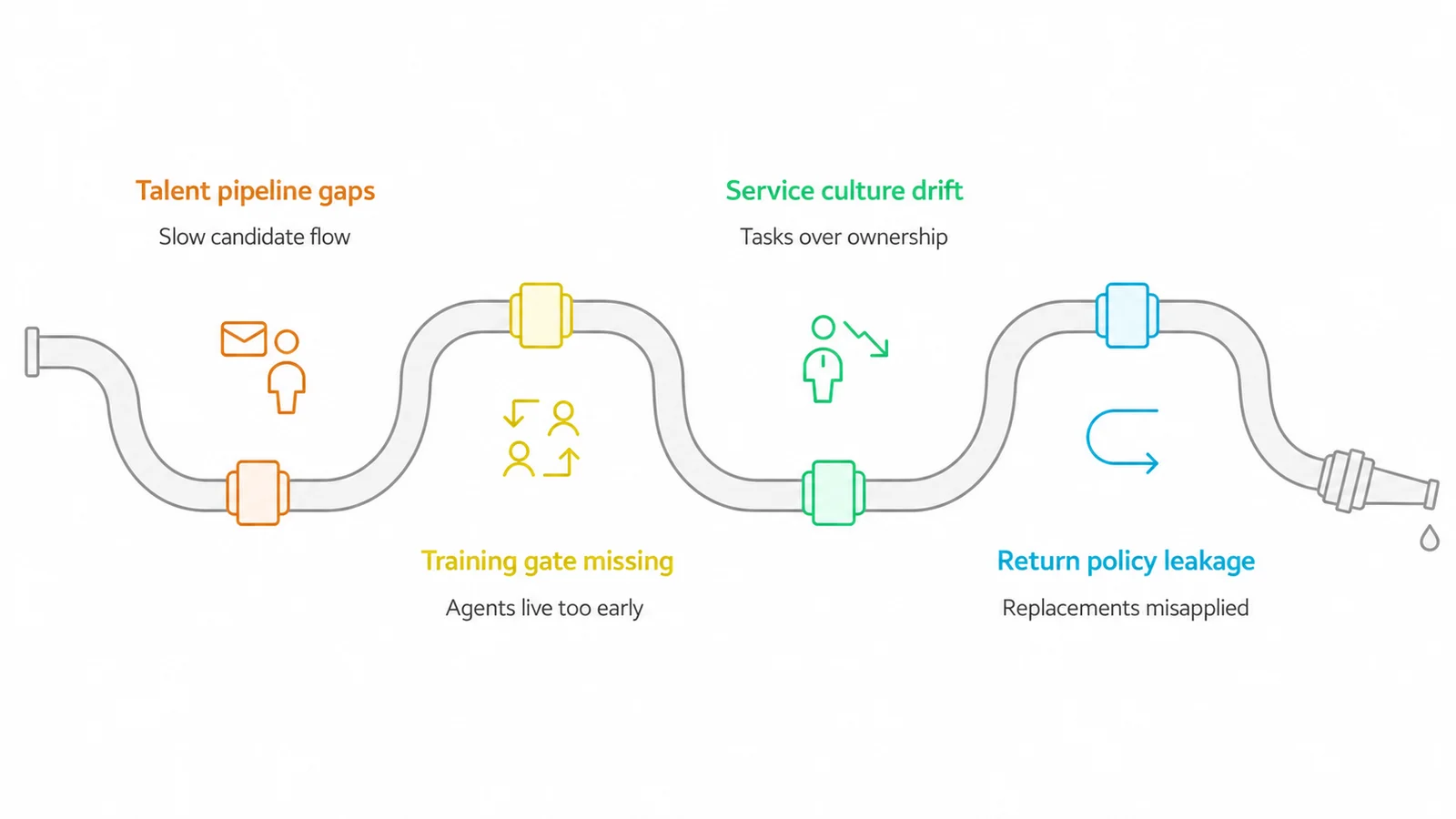
The return policy problem: a loyalty tool had become an inventory leak
BL had a specific returns policy: send the replacement first, receive the old item back afterward.
The intent was customer-friendly. The buyer gets a resolution immediately rather than waiting through a return-and-reship cycle. Done correctly, it is a strong loyalty tool for premium customers who expect frictionless service.
Done incorrectly, it is an inventory leak.
That risk sits inside a much larger retail pattern. The National Retail Federation reported that U.S. retailers expected nearly $850 billion in merchandise returns in 2025, and that 71% of consumers were less likely to shop with a retailer again after a poor returns experience. For BL, return-policy execution was not a back-office detail. It was a loyalty and inventory-control issue at the same time.
Agents who did not fully understand the policy’s conditions were applying it inconsistently. They were unclear on when it applied, what verification was required, and which circumstances should trigger a different resolution path. Some agents applied it when they should not have. Others did not apply it when they should have.
Replacements went out on cases that did not qualify. Returns were not collected correctly. The brand was losing product inventory on interactions where the policy had been misapplied, with no clear audit trail explaining why decisions had been made.
The support team’s error rate looked like a quality problem. The financial impact was a real cost: product value lost on interactions that a properly trained agent would have handled differently. At premium price points, even a small percentage of incorrectly processed returns compounds into meaningful losses quickly.
How Callnovo rebuilt the operation
Callnovo’s work started from a simple premise: the support team needed to be built around the brand, not just the language.
English fluency was table stakes. The real selection criteria went further. Callnovo screened candidates for experience in fashion, footwear, beauty, or high-ticket consumer products - categories where agents are more likely to understand how premium customers think and communicate.
Beyond category experience, the assessment covered familiarity with Western European and North American communication styles, the patience and aesthetic sensitivity that premium brand interactions require, and demonstrated service orientation rather than task-completion ability alone.
On candidate availability, Callnovo maintains active talent pipelines across its global network. Qualified candidates can typically be surfaced more quickly than a cold search would allow, although the exact timeline depends on role requirements. The infrastructure exists to move faster than most brands expect.
A three-stage training loop that did not end at onboarding
The second part of the rebuild was training. BL did not need a longer orientation deck. It needed a quality gate.
Stage one: knowledge assessment before go-live. Agents completed product and policy training, then were tested before handling real interactions. Anyone who did not clear the benchmark went back through the material. No agent went live on the strength of attendance alone.
Stage two: simulated practice on real scenarios. Before touching the live queue, agents worked through simulated pre-sale consultations, intent qualification calls, returns, and exchange workflows, including the specific policy that had been generating errors. The simulation was not abstract. It used the actual cases and edge conditions agents would encounter.
Stage three: ongoing ticket review with individual coaching. After launch, agent interactions were reviewed regularly. For complex workflows like the send-first returns policy, one-on-one sessions worked through real decisions: why this case qualified, why that one did not, and what information should have been collected before processing.
The goal was genuine understanding of the logic, not just correct execution of the most common case.
Accountability created professional standards
Callnovo also changed the management structure around the team.
A dedicated customer success manager coordinated staffing continuity and team performance. Attendance tracking with early-warning alerts meant absences were anticipated and covered instead of creating sudden service gaps. Individual metrics were tracked and reviewed regularly, including ticket error rate, response time, escalation accuracy, and customer tone standards.
The cultural dimension mattered too. Agents were positioned explicitly as brand representatives - people whose daily work directly shaped how BL’s customers experienced the brand in the market.
That framing changed the relationship between the agent and the work. The job was no longer “answer the ticket.” The job was “protect the customer’s belief that this brand is worth what they paid for it.”
What improved and why it mattered beyond the numbers
Operational Results
The operational results were measurable. Ticket error rate dropped by more than 50%. First response time fell to under one minute. The returns policy started being applied correctly and consistently, which meant the inventory losses from misprocessed replacements stopped.
But for a premium brand, the numbers that matter most are further downstream: return rate, repeat purchase rate, and long-term customer lifetime value.
That downstream impact is not abstract. In PwC’s 2025 Customer Experience Survey, 29% of consumers said they stopped using or buying from a brand because of poor customer experience, either online or in person. A support operation that protects the post-purchase experience is therefore protecting revenue, not only satisfaction.
A support interaction that resolves correctly, quickly, and in a tone that reflects the brand’s positioning does more than close a ticket. It confirms to the customer that the brand they chose takes them seriously. That confirmation is what converts a first-time buyer into a repeat customer.
At $150 per pair, the lifetime value difference between a customer who repurchases and one who does not is significant. It often traces back to a single support interaction that went well or badly.
The policy execution improvement had a direct financial dimension too. Correctly applied, the send-first returns policy is a competitive advantage. It creates a customer experience that mass-market brands struggle to match. Incorrectly applied, it is a cost center.
The training investment that fixed the execution paid for itself in recovered inventory value within the first months of the new operation.
What premium brands should ask before choosing a support partner
The questions that matter for high-end fashion and footwear brands are different from the questions that matter for mass-market ecommerce.
Before choosing a support partner, evaluate the operating model behind the agents:
- Do candidates have experience in fashion, footwear, beauty, or high-ticket consumer products? Category experience is not just a nice-to-have. It determines whether an agent understands why customers pay premium prices and what they expect in return.
- Does the assessment go beyond language testing? Product knowledge testing, simulated interactions, real ticket review, and ongoing coaching produce different agents than language screening alone.
- Is there a closed-loop training process with a clear go-live threshold? If agents can go live after completing training regardless of assessment performance, the training is not a quality gate. It is a formality.
- How are attendance, error rate, response time, escalation accuracy, and customer tone standards tracked? Individual-level accountability produces consistent quality. Team-level averages hide variation.
- When volume increases, what is the process for sourcing additional qualified candidates? The answer reveals whether the provider has an active talent pipeline or starts from scratch each time.
Premium products earn their price through the full customer experience, including what happens after the purchase. The support team is the part of that experience many brands underinvest in, and the part customers remember longest when something goes wrong.
Support is a brand function, not just an operating cost
BL’s results came from treating support as a brand function rather than an operational cost.
That reframe is available to any premium brand willing to ask the right questions of the right partner. The work is practical: recruit agents who understand the category, test before go-live, coach on real cases, track individual performance, and make policy execution auditable.
Callnovo helps premium fashion, footwear, and consumer-product brands build that structure through specialist support teams, managed customer support, HeroDash visibility, and HeroScore quality monitoring.
If you are building customer support for a premium fashion or footwear brand, the real question is not whether customers will notice the difference between strong and weak service.
They already do.
The question is whether your support operation is built to protect the price, promise, and brand experience you worked so hard to create.
FAQ
What should premium footwear brands look for in a customer support partner?
Look for category-aware recruiting, a tested training gate before go-live, individual QA accountability, return-policy decision logic, and a proven way to add qualified agents as volume grows. For premium footwear, language fluency is only the starting point.
How can return-policy mistakes create inventory loss?
When agents apply a replacement-first policy without verifying eligibility, replacements can ship on non-qualified cases or old items may not be collected. The result is product value leaving the business without a clean audit trail.
Why does category experience matter for premium support agents?
Agents with fashion, footwear, beauty, or high-ticket consumer-product experience are more likely to understand premium expectations, sizing and fit concerns, tone, and the emotional stakes behind a purchase. That context helps them resolve issues without weakening the brand experience.
What does category-aware recruiting mean for premium brand support?
Category-aware recruiting selects support agents with prior experience in fashion, footwear, beauty, or other high-ticket consumer-product categories. For BL, this meant agents who already understood why a $150 shoe customer expects faster responses, more aesthetic sensitivity, and policy answers that protect the brand premium — instead of generic ticket-closure behavior.