

Arabic customer support
Arabic BPO: Arabic Call Center Services for Customer Support
Arabic BPO gives your business an external team for customer service in Arabic. Callnovo.ai scopes Arabic call center services around your customer markets, phone and digital channels, service hours, and the actions representatives can take on your behalf.
Start with the contacts your team needs help handling: product questions, order updates, setup problems, or messages from marketplace buyers. Then agree on how unresolved cases reach your staff. This page covers business service arrangements; recruitment inquiries belong with the provider's hiring team.
Plan your Arabic support queue
Arabic call center services: what you can hand over
An Arabic call center handles customer contacts within an agreed scope. Phone, email, chat, and messaging can form a dedicated Arabic queue or a bilingual Arabic and English service. Decide which requests representatives can finish themselves and which need your approval.
| Contact type | Channels | The external team may | Return to your team |
|---|---|---|---|
| Pre-sale questions | Phone, chat, messaging | Explain approved product information and capture buying intent | Exceptions, discounts, or policy decisions |
| Orders and delivery | Phone, email, messaging | Check the approved order workflow and record the issue | Refunds, changes outside policy, or carrier disputes |
| Product support | Phone, chat, email | Follow approved L1 troubleshooting steps | Safety, technical, warranty, or product decisions outside the script |
| COD confirmation | Outbound calls | Confirm the order and delivery details before dispatch | Disputes, payment decisions, or collection activity |
| Returns and complaints | Phone, email, social messages | Capture the reason and follow the approved process | Exceptions, compensation, or legal complaints |
The purchase is therefore a defined chain of information, permission, action, and ownership. BPO is the broader practice of outsourcing business processes; a call center is one type of customer-contact operation inside that broader category.
Which Arabic your customers speak, and how to test it
For an Arabic-speaking call center, specify the spoken variety your customers use and the written style your business approves. Include Modern Standard Arabic (MSA) and dialect requirements in the brief. Test a Saudi inquiry and a Moroccan inquiry separately if both are part of your market.
Before launch, prepare sample conversations for each important market and score them on four points:
- Did the agent understand the customer’s meaning?
- Did the agent use terms that fit the market and product?
- Was the tone appropriate for the channel?
- Did the agent identify the correct resolution or escalation path?
Agree on dialect coverage and any native-speaker requirement in the staffing proposal. Arabic reads from right to left, so test templates, ticket fields, emails, and mixed Arabic-English product names in the systems your team will use. Give reviewers examples of acceptable greetings, product terminology, and ways to explain a delay.
Use a market worksheet for Saudi Arabia, the UAE, Kuwait, Egypt, Jordan, Morocco, or whichever destinations you actually serve. Record the customer’s preferred variety, local hours, channel, and a sample inquiry in each row. Use the sample results to decide which markets can share a team.
What Arabic-speaking customers contact you about
Arabic customer service can include delivery questions, cash-on-delivery confirmation, setup and troubleshooting, returns, warranty-policy questions, and marketplace messages. The scope should name the work and the systems representatives will use.
| Workstream | Common contact | Scope to define |
|---|---|---|
| Order and delivery | “Where is my order?” or address confirmation | What agents may check, change, or escalate |
| Setup and troubleshooting | Device setup or approved product steps | The L1 script and the point where your team takes over |
| Returns | Return reason, status, and next step | Policy wording, evidence, and exception owner |
| Marketplace support | Amazon, eBay, or AliExpress buyer messages | Which store accounts and response templates are in scope |
| Social messages | Your account replies and comment handling | Channels, moderation rules, and escalation triggers |
| Sales, cross-selling, and upselling | Product comparisons or an approved additional offer | Eligible products, scripts, consent, and discount authority |
| Back office and data entry | Updating agreed order fields or recording inquiry details | Required fields, access permissions, and review of corrections |
| Market surveys | Calling approved contacts with a questionnaire | Contact permissions, survey questions, and how answers are recorded |
| Customer retention | Following up on a complaint or cancellation request | Approved remedies and the person who decides exceptions |
| Seasonal volume | Ramadan, White Friday, Singles’ Day, or your own campaign | Staffing lead time and overflow plan |
For cash on delivery (COD), specify calls that confirm the order and address before dispatch; debt collection is outside this workflow. For technical support, choose an Arabic speaker with customer service training who can follow your approved first-line (L1) troubleshooting steps. Deeper issues return to your specialists with a record of what the representative tried.
For appliances or connected devices, that might mean guiding a customer through an approved Wi-Fi setup sequence, finding the relevant manual, or explaining the next step in a warranty request. Representatives use Arabic instructions that your team supplies or approves. They shouldn’t improvise repairs or decide whether an exception is covered.
For Facebook, Instagram, X, or other agreed channels, define which of your accounts the team monitors and when a public complaint moves to a private conversation. Record the issue and follow up on the promised action. Review repeat contacts, return reasons, and customer feedback to see whether the process is helping; don’t assume a faster reply guarantees fewer returns.
Data handling for an outsourced Arabic team
An Arabic call center outsourcing arrangement may involve customer records moving between countries or systems. The contract and operating plan should state where records are stored, who can access them, which subprocessors are involved, how deletion works, and how an international transfer is covered.
For example, Article 29 of Saudi Arabia’s Personal Data Protection Law sets purposes and conditions for transfers or disclosures outside the Kingdom, with further rules and exceptions addressed in regulations (SDAIA, 2023). Have your legal team assess the proposed data flow against the rules that apply to your customers and processing locations. Read the official English text.
Callnovo implements SOC 2 framework practices and builds its systems to GDPR requirements. Use the data-handling information to discuss access, storage, and deletion requirements for your project. Give the provider a concrete list of systems and record types so the contract reflects how the work will run.
How an Arabic support queue runs: routing, handoffs, and hours
Test what happens when an Arabic contact reaches an English queue, arrives outside the agreed hours, or needs help from your product team. Each situation needs an assigned owner and a clear next action.
A workable flow looks like this:
- A customer contacts the approved local number or digital channel.
- The system or intake form identifies the market and preferred Arabic variety.
- The contact is routed to Arabic-speaking agents trained on the product.
- The agent resolves the approved request or records an escalation.
- Your team receives the customer’s request, order details, attempted steps, evidence, and required decision.
- The first operating period is reviewed against response, unresolved-case, repeat-contact, and quality findings.
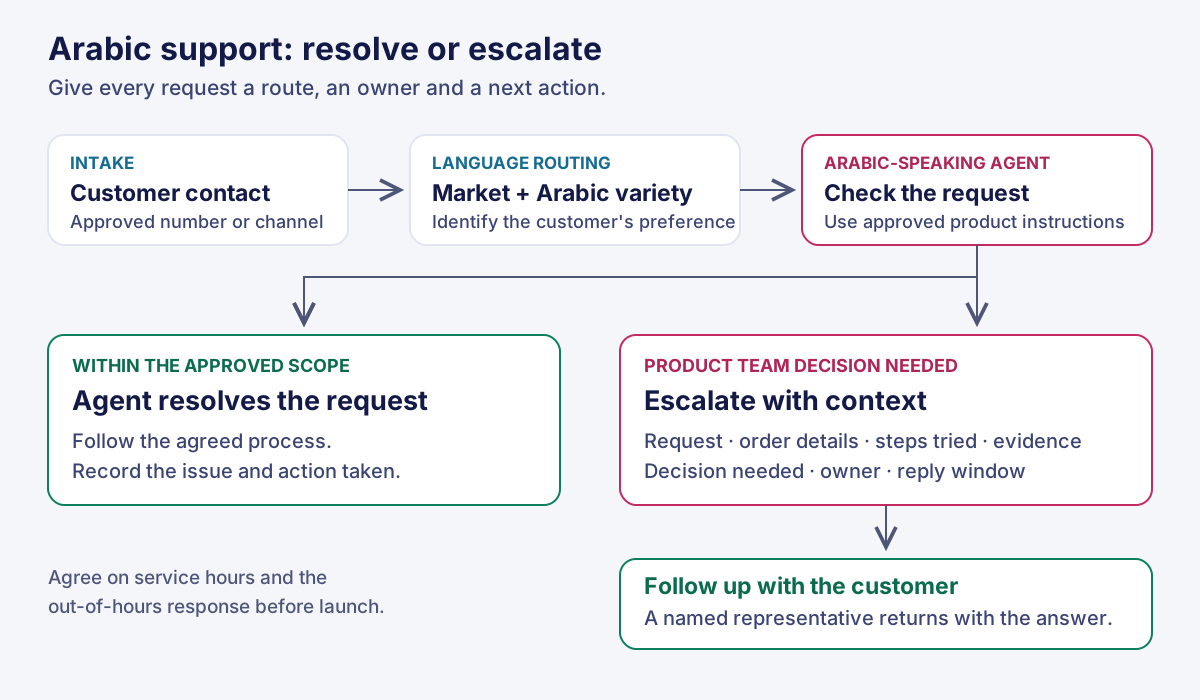
Agree on Arabic service hours, holiday coverage, and an out-of-hours response. Write the schedule in both the customer’s time zone and your escalation team’s time zone. Check local phone-number availability for each destination before including a number in customer instructions.
HeroDash supports the work with translation and AI quality tools alongside the Arabic-speaking team. In Callnovo’s 30+ language after-sales project, Arabic was among the supported languages. The project used local numbers, routing by language and urgency, and transfers to on-duty teams in another time zone.
Consider this workflow example: a customer can’t connect a smart coffee machine to Wi-Fi. The representative checks the model, uses the approved Arabic setup instructions, and records the steps tried. If the problem persists, the ticket goes to the product team with the error message and the decision needed. A named representative then contacts the customer with the answer.
Before taking live contacts, train the team on product terms, your response templates, and escalation decisions. Review sample conversations together, including polite forms of address and explanations of warranty policy. During the first operating period, check whether customers repeat the same question or have to explain their issue again after a transfer.
Use a handoff template with these fields: customer request, market and preferred variety, order or account reference, steps already tried, screenshots or evidence, action needed from your team, urgency, owner, and reply window.
What Arabic support costs and what the quote depends on
Request an Arabic BPO quote in US dollars against a written scope. The main inputs are:
| Input | Why it changes the quote |
|---|---|
| Markets and Arabic variety | Different markets may need different samples, staffing, and review |
| Channels | Phone, email, chat, and messaging create different workloads |
| Service hours | Longer coverage requires more staffed hours and handoff planning |
| Expected volume | Contact volume determines queue capacity and overflow needs |
| Agent permissions and systems | More actions require more training, access, and QA |
| Escalation rules | Faster or more involved handoffs need clear owners and coverage |
Callnovo’s company-wide Hire Your Team model ranges from half a seat to 200+ seats. The Arabic staffing proposal specifies the resources available for your markets and hours. Standard projects use dedicated representatives; low-volume or backup arrangements can be assessed separately.
For a planning example, assume you need one person continuously available for 12 hours a day, seven days a week. That requires 84 staffed hours. At an assumed 40 working hours per person, the starting estimate is 2.1 full-time equivalents before leave, breaks, training, or additional people needed for simultaneous contacts. It isn’t a finished rota: someone still has to cover every hour, including absences.
Ask the quote to separate staffing, supervision, training, system access, and any extra setup work. Agree on how capacity can increase for a campaign and decrease afterward. Outsourcing changes who arranges workspace and manages recruitment, but you still need to supply product knowledge, approve scripts, and own escalations. Confirm the recruitment and training schedule for the Arabic team before announcing a service start date.
How to compare Arabic call center providers
When comparing an Arabic BPO company or an Arabic call center outsourcing proposal, ask for evidence that matches your customer conversations and workflow. Relevant industry experience should show up in the sample: can the representative explain your product, recognize a policy exception, and send it to the right person?
| Dimension | Ask the provider to show | Red flag |
|---|---|---|
| Language fit | Written or recorded samples using your product terms | “All dialects” with no sample test |
| Routing | One real path from contact to Arabic queue | Language listed but no routing owner |
| Handoff | A completed escalation example | The next team receives only a short note |
| Permissions | Actions agents may and may not take | “Full support” without an approval boundary |
| Quality | Review criteria and calibration method | A language count used as the only QA proof |
| Data | Storage, access, deletion, and transfer terms | A generic compliance badge with no contract detail |
| Capacity | Peak-season staffing and overflow plan | A 24/7 claim with no Arabic schedule |
Callnovo.ai supports 65+ languages through human agents across its multilingual operation. Company-wide resources include 26 delivery countries and 2,500+ team members, with more than 90% of agents office based. Callnovo has operated since 2004 (Callnovo, 2026). Your Arabic proposal should identify the team, dialect requirements, and service schedule for the work you’re assigning.
FAQ
Is BPO the same as a call center?
BPO is the broader practice of outsourcing a business process. A call center is one type of customer-contact operation within BPO. An Arabic call center may handle calls only, or a wider set of approved phone and digital support workflows.
Can outsourced call center solutions handle technical support effectively?
Yes, when the scope is limited to approved L1 steps and the escalation path is explicit. Record the customer’s issue, attempted steps, evidence, and required decision, then return deeper product, safety, warranty, or policy questions to your team.
Is social media monitoring part of Arabic customer service outsourcing?
It can cover messages and comments on your own accounts. Define channels, moderation rules, response templates, escalation triggers, ownership, review timing, and approval boundaries; do not assume full community management or campaign work is included.
Does the UAE have call centers?
Yes. Providers serve UAE customers through local and offshore arrangements. Ask where your representatives will work and where customer records will be processed. Then compare dialect fit, opening hours, escalation ownership, and the data terms for your proposed service.
Define the Arabic queue before hiring a team
Do not start with an outsourced queue if you have not decided which markets you serve, what agents may do, who owns escalations, or how customer records may be handled. A language label cannot repair an unclear process. First write the scope, prepare sample conversations, and assign an internal owner.
Before you request an Arabic support proposal
- List the customer markets and time zones.
- Specify the Arabic variety and written-versus-spoken requirements.
- Prepare sample conversations from real products and customer questions.
- Define the channels and service hours.
- Write what agents may resolve and what must return to your team.
- Provide the escalation fields, owner, and expected reply window.
- Confirm data storage, access, deletion, and transfer terms with counsel.
- Estimate normal volume, peak volume, and the staffing buffer you need.
With those eight items, providers can quote the same workload. Discuss your Arabic support requirements when the scope is ready.
For the wider outsourcing decision, see customer service outsourcing. For a dedicated staffing model, review hire your team. For multilingual routing and language coverage, see multilingual support.