

Privacy note: To protect customer confidentiality, identifying details have been removed.
Key Takeaways
- A strong product can struggle in Japan if the wording, service, or sizing does not match local expectations.
- Native Japanese support turned returns into fixes, trust, and product insight.

A beautiful product met a market that read it differently
The product was worth being proud of.
The brand sold mugwort-filled pillows and bedding built around wellness positioning, natural materials, and Suzhou kesi silk craftsmanship. On paper, it looked like a strong fit for Japan: quality materials, traditional craft, quiet design, and a health-conscious story.
In early 2024, the brand launched on Yahoo Japan and Rakuten. The founder expected a careful but receptive market.
Instead, returns piled up.
Within months, the return rate reached 37%. Customer complaints increased. Reviews became harder to recover. The brand had a product it believed in, but the Japanese market experience around that product was breaking down.
For scale: the National Retail Federation puts online returns at roughly 19.3% of ecommerce sales. This brand was running at nearly double the industry rate — in a market whose B2C ecommerce sector METI values at ¥26.1 trillion. A return rate that far above baseline is rarely a manufacturing problem. It usually means buyers are receiving something other than what they believed they ordered.
The product did not fail first. The surrounding operation did.
What was actually going wrong
When the team looked beyond the return numbers, three problems stood out. None of them looked dramatic from outside Japan. All of them mattered once Japanese buyers were the ones reading, using, and complaining about the product.
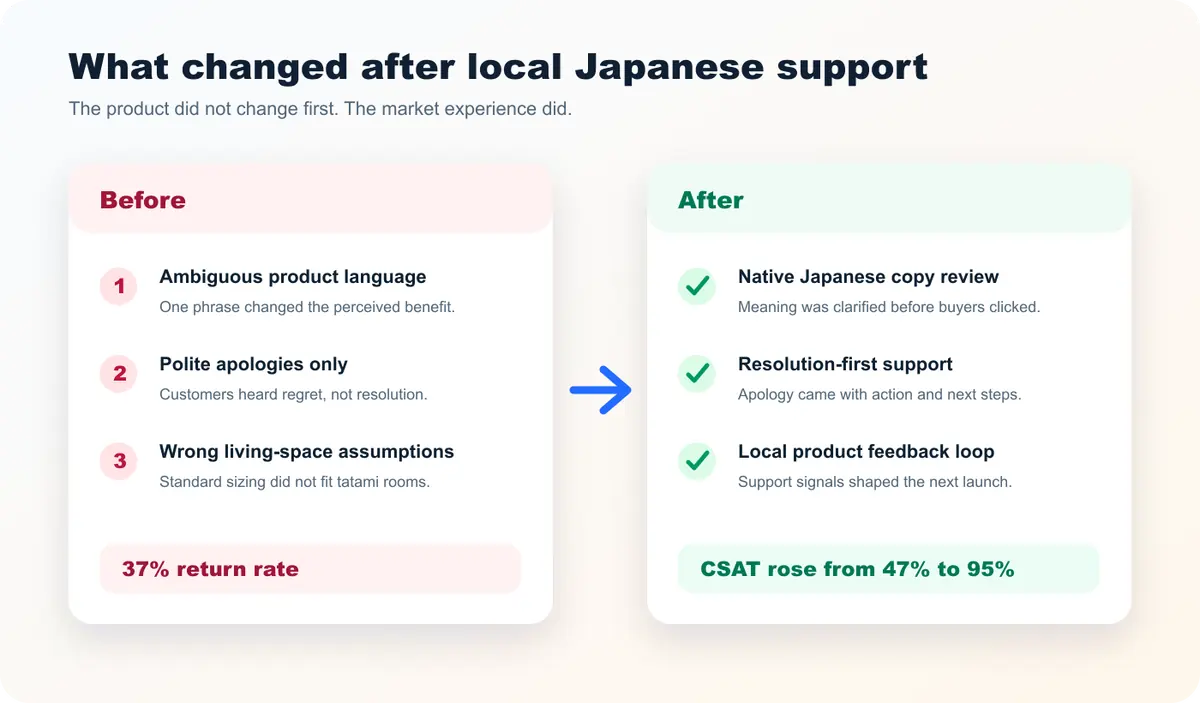
1. One phrase changed the product meaning
The packaging used the term “防だに” to communicate anti-dust-mite properties.
That was the intended meaning. But many Japanese consumers parsed it differently, closer to protection against moisture-related insects. The result was simple and damaging: customers bought the product expecting one benefit, then felt the product did not match what they had purchased.
This was not a basic translation mistake. It was a native-language nuance problem.
The original support team could speak Japanese, but they were not equipped to catch the kind of ambiguity a native Japanese consumer would feel immediately. The issue sat in the gap between literal meaning and market meaning.
2. The apologies were polite, but incomplete
When Rakuten customers complained, the support team leaned on formal apologies like:
大変申し訳ございません
In isolation, that sounds appropriate. In practice, it made some customers more frustrated.
For a premium product, Japanese customers do not only want acknowledgment. They want to know what happened, what the brand will do next, and how the issue will be prevented. An apology with no clear action can feel like avoidance.
The brand was saying sorry. Customers were hearing: “They know there is a problem, but they are not fixing it.”
3. The product did not fit the room
This was the hardest problem to spot from outside the market.
Many Japanese homes still include tatami rooms and compact sleeping spaces. Bedding produced around standard Chinese domestic dimensions did not always fit how the product would actually be used in Japan.
Customers bought the bedding, brought it home, discovered that it felt oversized or awkward in their space, and returned it.
No script could fix that. The brand needed local feedback that connected support complaints to product usage.
The 2 AM complaint that changed the operation
During Japan’s rainy season, a customer in Tokyo contacted support late at night. Her mugwort pillow had developed mold spots.
Handled badly, this was exactly the kind of complaint that could become a public warning: a premium wellness pillow, visible mold, and a frustrated customer posting online.
By then, the brand had brought in Callnovo to build a dedicated Japanese-language support operation. The agent who handled the case did not just send an apology. She followed a resolution-first process.

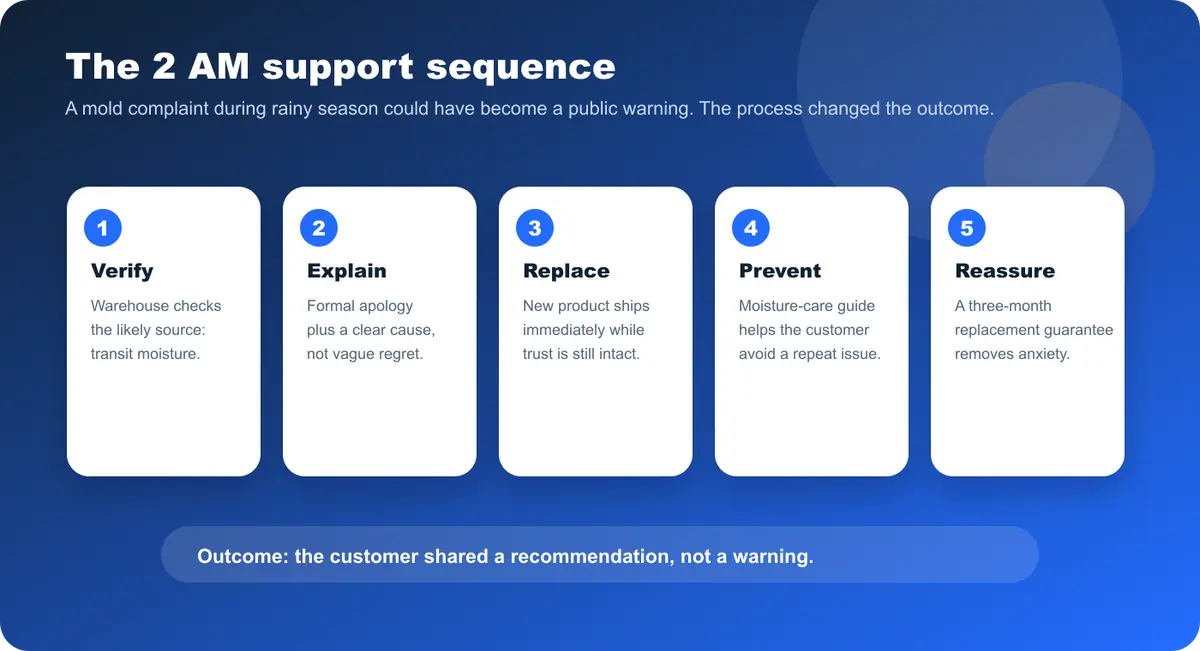
Within hours:
- the warehouse confirmed transit moisture exposure as the likely cause;
- a formal apology with a clear explanation was sent;
- a replacement product was dispatched immediately;
- a moisture-care guide was included for Japan’s humid season;
- a three-month free replacement guarantee was extended.
The customer posted about the experience. Not as a complaint. As a recommendation.
One support interaction became organic marketing because the customer felt taken seriously. Under the previous model, the same complaint could have become the reason other buyers stayed away.
The team rewrote the product language
The “防だに” issue needed more than a wording tweak. It needed someone to ask: how will a Japanese buyer actually read this?
The native-speaking team reviewed customer messages, studied where confusion appeared, and worked with the brand to revise the product copy. The new version made the anti-dust-mite benefit explicit, removed the phrase that caused misreadings, and added context based on the questions buyers were asking before purchase.
The product itself did not need a redesign. The way the product was explained did.
This is where multilingual support becomes more than language coverage. For cross-border ecommerce brands, native-language support can become a market-risk detector: it catches meaning, tone, and expectations before they turn into returns.
Support became product research
Then something more interesting happened.
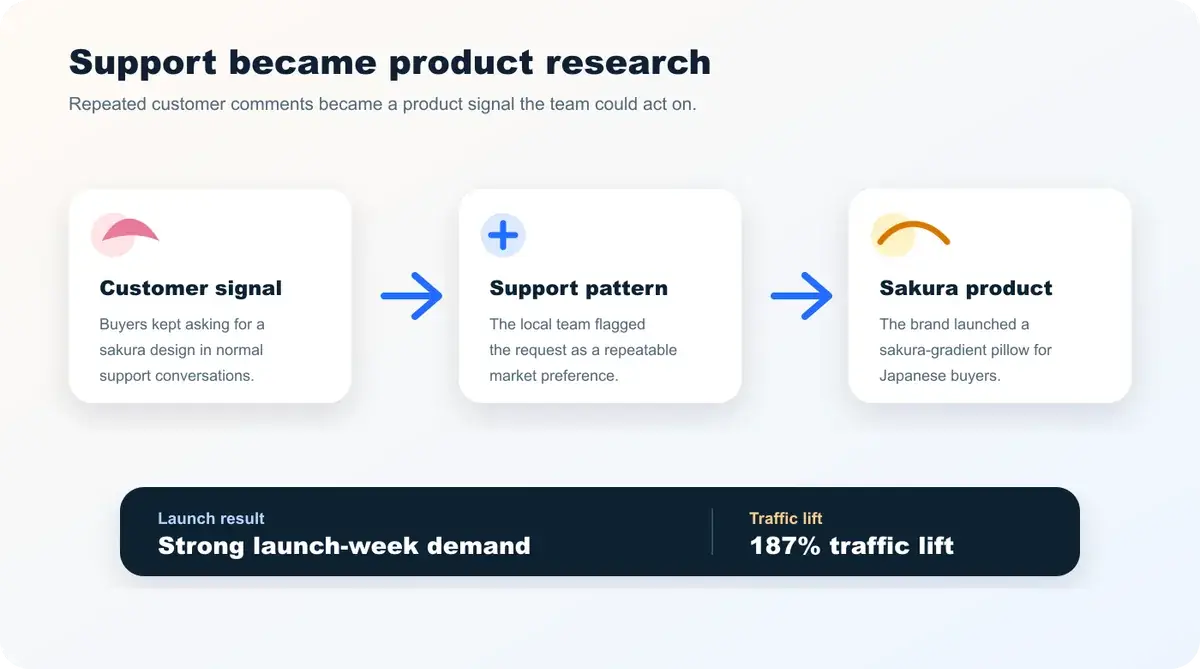
During cherry blossom season, support agents noticed a recurring comment. Customers liked the wellness positioning, but wished the pillow felt more visually connected to Japanese aesthetics. Several mentioned a sakura design.
In many support operations, that kind of comment gets closed with the ticket. Here, the local team flagged it.
Three months later, the brand launched a new pillow with botanical dyeing, a sakura gradient pattern, and mugwort filling enhanced with cherry blossom extract.
The launch generated strong early demand. The first pre-sale batch sold out on day one, and website traffic increased by 187% during launch week.
What changed after localization
The improvement was not instant, but it was measurable.
After the Japanese-language support operation went live:
- customer satisfaction rose from 47% to 95%;
- the 37% return rate dropped significantly;
- repeat buyers increased;
- the brand built a more loyal customer base in Japan;
- a support-led product idea contributed to stronger launch-week demand.
The founder later summarized the lesson this way:
“We were not just selling bedding. We were telling a story that brought together traditional craft and modern life. We just needed people on the ground who understood how to tell it in Japanese.”
What this means for brands entering Japan
Japan is not an impossible market. It is a precise one.
Small mismatches create large consequences: a phrase with unintended meaning, an apology without a fix, a product size that does not fit the room, or a support team that closes tickets without feeding insights back to the business.
But the reverse is also true. When brands get the details right, Japanese customers can become deeply loyal.
Before scaling in Japan, ask four questions:
- Is your product copy reviewed by native Japanese speakers, not only translated?
- Does your support team move from apology to resolution?
- Have you tested the product in real Japanese usage environments?
- Is your support operation capturing product feedback, or only closing tickets?
If the answer is no to any of those, your support setup may be limiting growth more than your product is.
Expanding into Japan?
Callnovo helps ecommerce and consumer product brands build native-language support teams that can reduce returns, protect trust, and surface local growth opportunities. With HeroDash, QA-led operations, and dedicated agents across 65+ languages, support becomes more than a response channel. It becomes part of your market-entry strategy.
For brands entering Japan, Korea, Southeast Asia, or another high-context market, the support model should be designed before returns start telling the story.
If you are weighing the build-versus-partner decision, how ecommerce sellers outsource customer service covers the cost structure, the usual switching triggers, and what to ask a provider before signing.