

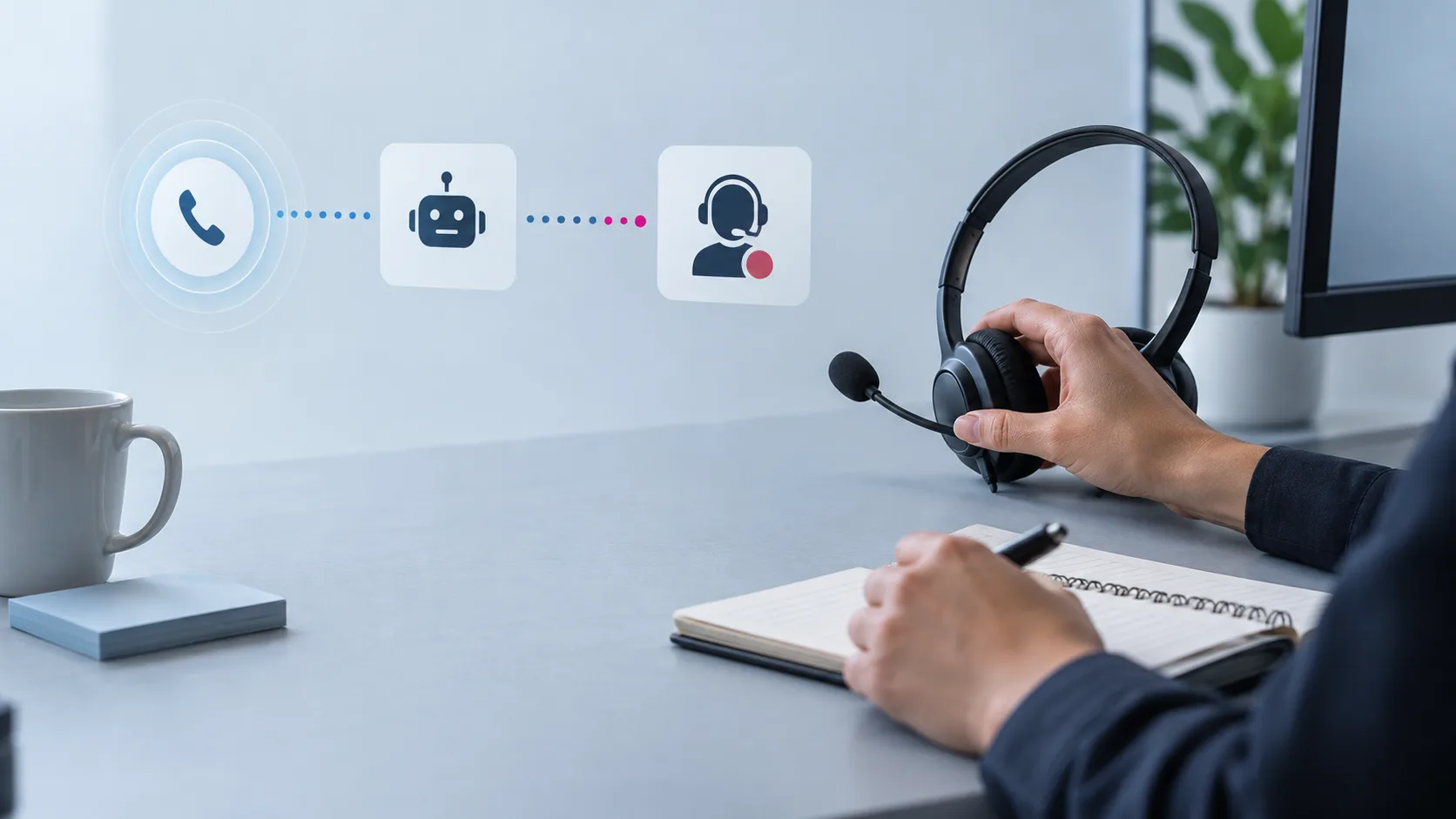
Answering Service: Live Agents, AI & How to Choose
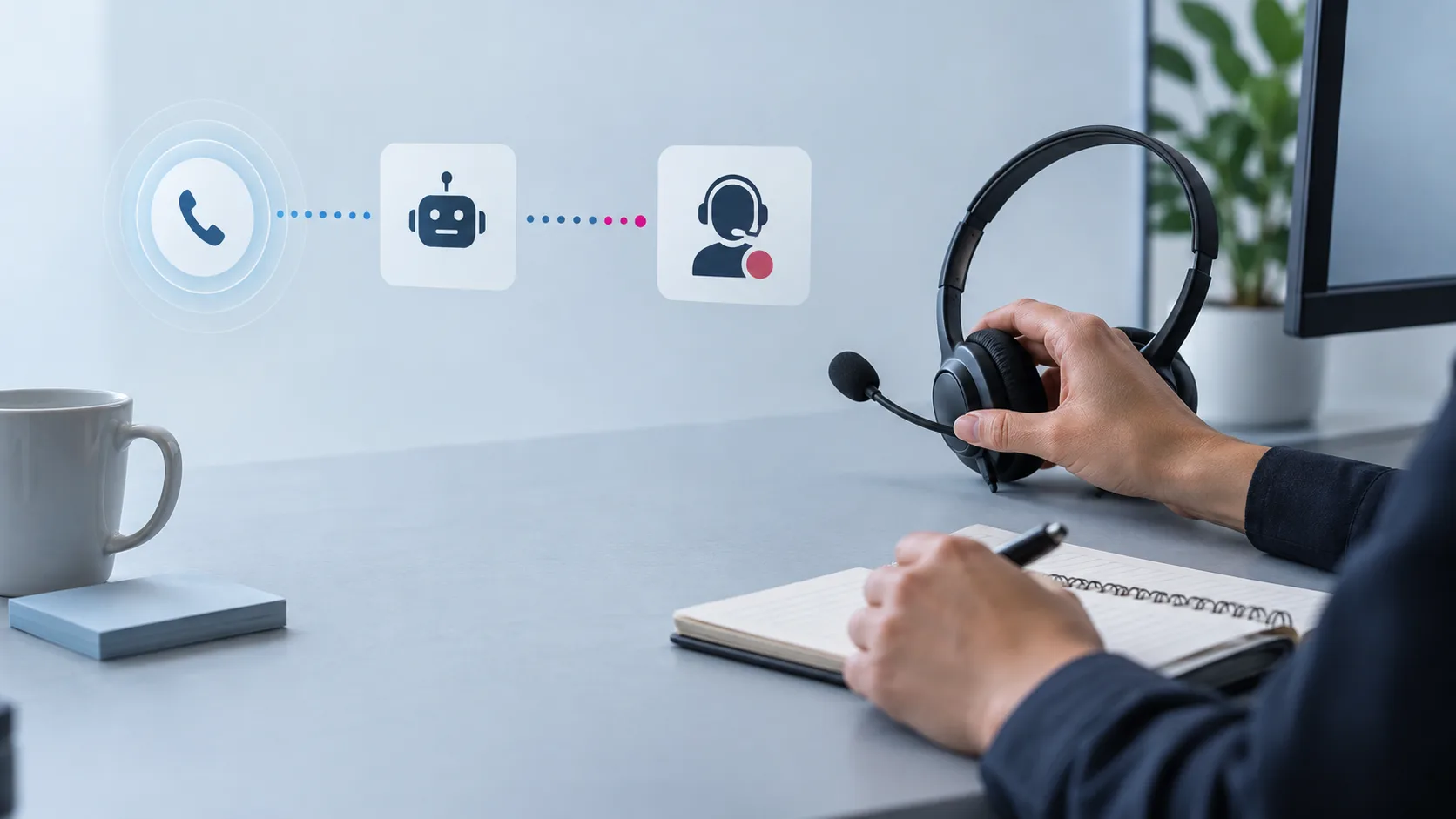
An answering service is an external operation that receives business calls, captures the information your team needs, and routes each conversation according to the rules you approve. The service may use live agents, AI, or a combination of both. The important comparison is not whether someone answers. It is what happens after the greeting: what gets recorded, what the agent can do, who receives the escalation, and how the business knows the call was handled correctly.
On this page
- What the service includes
- How the models differ
- What happens when a call comes in?
- Live agents, AI, or a hybrid model?
- How to compare providers
- Pricing models and what the rate includes
- Which model fits your situation?
- When this model is not the right first step
- FAQ
What the service includes
This operation handles some or all of a business’s inbound calls. Depending on the agreed workflow, the team may greet callers, identify the reason for the call, take a message, schedule or change an appointment, provide an approved answer, create a ticket, transfer the call, or escalate it to a person inside the business.
The purchase is not a greeting. It’s a defined chain of information, permission, action, and ownership.
That definition matters because “answering calls” can describe very different purchases. A message-taking service may only record the caller’s name, number, and reason for calling. A managed operation may follow scripts, verify information, update a system, and send urgent cases to an on-call person. An AI receptionist may handle routine questions first and transfer exceptions to an operator.
The scope should be written before a provider starts. At minimum, define:
| Decision | What to specify |
|---|---|
| Coverage | Hours, holidays, languages, channels, and supported numbers |
| Call handling | Greeting, identity checks, questions agents may answer, and actions they may complete |
| Recording | Caller details, reason, urgency, appointment window, and required notes |
| Routing | Queue, skill group, transfer rule, callback owner, and escalation contact |
| Control | Knowledge-base owner, script owner, quality reviewer, and access permissions |
If the scope says only “handle our calls,” the provider and the business will eventually disagree about what a successful call means.
How the models differ
These terms overlap in marketing, but they usually describe different operating models.
| Term | Usually means | Question to ask |
|---|---|---|
| General phone support | A third party handles defined inbound call work | Which actions are included after the greeting? |
| Virtual receptionist | A remote receptionist answers, screens, routes, and may schedule calls | Can the receptionist complete the workflow or only take a message? |
| AI voice reception | An AI voice system handles routine calls and routes exceptions | What happens when the request is uncertain or the caller asks for a person? |
| Live phone coverage | Human agents answer calls under an approved script and escalation model | Who reviews quality and updates the script? |
The terms are not mutually exclusive. A business can use an AI voice system during predictable periods and people for complex or sensitive calls. It can also use a virtual receptionist model for appointment requests while sending policy exceptions to an internal team.
The right comparison is therefore the workflow, not the label. Ask what the caller experiences, what the agent or AI can change, and what context accompanies a handoff.
What happens when a call comes in?
A reliable answering operation has a visible sequence. The exact implementation varies, but the buyer should be able to map the call from the number dialed to the person responsible for the next action.
1. The call enters a number and queue
The service may use a business number, a hosted number, a local number, or a web-based calling entry point. The number and queue should be associated with the correct business line, language, hours, and escalation policy.
2. The caller is identified and classified
The greeting should establish which business or team the caller reached. The next step is not always a full conversation. It may be a short classification: sales, support, appointment, existing customer, delivery issue, emergency request, or callback.
The information captured should match the next action. A callback queue may need a name, number, preferred time, reason, and account identifier. A dispatch workflow may need location and urgency. A law-firm intake workflow has different boundaries and should route to the dedicated law-firm intake page rather than copy a generic script.
3. The call follows a transfer rule
Phone systems commonly distribute calls through a queue, keypress choices, and skill groups. A business may separate sales and support, English and Spanish, or routine questions and urgent cases. The transfer rule should name the destination and the fallback when nobody is available.
4. The agent or AI performs only approved actions
An agent may answer a published FAQ, create a case, schedule an appointment, or record a request. It should not invent a policy, approve an exception without authority, or make a medical, legal, or safety judgment on behalf of the customer.
The same boundary applies to AI. An AI system can be useful when the answer is stable, the workflow is repeatable, and the cost of an incorrect action is low. The business still needs a rule for uncertainty, repeated failure, sensitive information, and a caller who requests a person.
5. The outcome and next owner are recorded
“Answered” is not the same as “handled.” A useful record says what the caller wanted, what was checked, what action was completed, what remains open, and who owns the next step. This is where quality review and repeat-contact analysis become possible.
Human agents, AI, or a hybrid model?
Live agents are useful when judgment matters
People are generally the better fit when the call requires context across systems, empathy during a complaint, language nuance, exception handling, or a decision that depends on company policy. Human support is also useful when the business wants a trained team to follow a detailed script and escalate according to a named list.
The question is not whether an operator can sound friendly. It’s whether the agent has the right information and permission to complete the next step. A people-led team without a current knowledge base can transfer confusion instead of resolving it.
AI is useful when the rules are stable
AI answering is a reasonable fit for routine status questions, basic information, appointment requests, simple routing, and other workflows with clear answers and low-risk actions. The setup still requires a knowledge base, prompt or response rules, a voice configuration, a maximum call or timeout policy, an ending strategy, and a connection between the AI instance and the phone number or entry point.
Creating an AI voice assistant is not the same as activating it. The system must be bound to the number or route where callers will reach it. That implementation detail should appear in a launch checklist, because a configured assistant that isn’t connected to an inbound entry point isn’t serving callers (Callnovo internal telephone configuration guide, 2026).
For a deeper comparison of AI-first voice platforms and handoff behavior, see Best Voice AI Platforms 2026. For workflows that need explicit trigger rules and human ownership, see AI-led escalation handling.
Hybrid models handle the boundary between routine and exceptional
A hybrid model uses AI for predictable work and people for context, judgment, or exceptions. The design succeeds only when the handoff carries enough information for the next person to avoid asking the caller to repeat everything.
At minimum, define the handoff payload:
- caller identity and contact details;
- reason for the call and relevant classification;
- information already checked;
- action already attempted;
- rule that triggered the escalation;
- person, queue, or team responsible for the next step.
If the business can’t define those fields, it’s not ready to buy “AI plus human” as a complete operating model. It’s buying two disconnected greetings.
How to compare providers
Use the same questions for every provider. The answers should describe an operating model, not just a feature list.
| Area | Questions to ask |
|---|---|
| Coverage | Which hours, holidays, languages, and numbers are included? |
| Script | Who writes, approves, and updates the greeting and decision rules? |
| Permissions | What can an agent view, change, schedule, refund, or submit? |
| Escalation | What triggers a transfer, callback, urgent alert, or internal handoff? |
| Systems | Which CRM, ticket, calendar, or knowledge base does the team actually use? |
| Quality | Who reviews calls, how often, and how are recurring failures returned to the script? |
| Reporting | Can the business see volume, reason, transfer, callback, repeat-contact, and outcome data? |
| Exit | How are recordings, notes, open cases, and workflow documentation returned? |
Three reference models to place on the shortlist
These examples represent different buying models, not a ranking. The descriptions below summarize each vendor’s own public product pages retrieved on October 14, 2026; they are not independent performance claims.
| Example | Model represented | What the public page describes | What to verify before choosing |
|---|---|---|---|
| PATLive | Human phone operation | Human receptionists, message taking, screening and transfers, appointment scheduling, emergency dispatch, and bilingual support | Whether the available workflow, hours, integrations, and escalation rules fit your call types |
| Smith.ai | AI-plus-human receptionist model | AI reception, human virtual receptionists, appointment booking, lead qualification, human escalation, and CRM or calendar integrations | Which tasks remain with AI, when a person takes over, how handoff context is passed, and which integrations are included |
| Aircall | Cloud phone and contact-center software | IVR, call distribution, call tags, live monitoring, analytics, and reporting for inbound and outbound calls | Whether you need software for your own team or an outsourced operation that supplies the people and workflow |
This comparison is useful because the three examples are not interchangeable: PATLive represents a people-powered answering operation, Smith.ai represents a hybrid receptionist model, and Aircall represents the software layer. Vendor feature pages change, so confirm the current plan, geography, data handling, and contract terms before treating any feature as available to your account.
Also map the system where the call outcome will land. An order question may end in Shopify, a sales lead may need to be recorded in Salesforce, and a support request may belong in Zendesk. Those names are examples of workflow destinations, not claims that every answering provider integrates with every system.
For an industry-specific comparison, the same framework can be narrowed to phone support for funeral homes, restaurants, medical practices, real-estate teams, HVAC companies, plumbers, or contractors. A page targeting funeral home answering service or restaurant answering service should own those exact industry terms; this page should link to it when the operating rules are materially different.
The provider should be able to demonstrate one realistic call path. Give the same scenario to every vendor and compare the resulting record, action, escalation, and report. A generic statement such as “we handle all calls” is not enough to evaluate permissions or accountability.
Before comparing quotes, write down three things:
- The hours, languages, numbers, and queues that need coverage.
- The actions an agent or AI may complete without approval.
- The person or team that owns every escalation and callback.
Pricing models and what the rate includes
These services may be priced by minute, interaction, productive hour, monthly team, or verified outcome. The unit is only useful when the included work is clear.
| Pricing unit | Questions behind the number |
|---|---|
| Per minute | Are waiting, transfers, recording, and carrier costs included? |
| Per interaction | Are follow-ups and reopened conversations included? |
| Productive hour | Does the price include supervision, QA, training, and coverage gaps? |
| Monthly team | What happens when volume is below or above the planned capacity? |
| Verified outcome | What counts as resolved, and how are reopened cases handled? |
Callnovo’s current public pages show AI voice pricing from US$0.15 per minute, phone answering from US$300 per month, and dedicated support from US$5.80 per hour (Callnovo public pricing, 2026). Treat these as published starting points, not a universal quote. The final model depends on volume, languages, hours, channels, system access, workflow complexity, and escalation requirements. Compare dedicated team support, pay-per-resolution support, and multilingual support before checking the published pricing page and making a buying decision.
Price should be normalized against the work. A low per-minute number can become expensive if every exception is transferred. A low monthly number can be misleading if the business still needs to supervise, retrain, and resolve every incomplete record. Ask for a sample calculation using the same monthly call volume and call mix for each provider.
Which service model fits your situation?
This category page should help the reader choose a next page rather than repeat every scenario.
- Need routine calls handled by AI with people as backup? See AI reception with human backup.
- Need nights, weekends, holidays, or emergency rules? See after-hours phone coverage.
- Need English and Spanish in one queue? See bilingual phone support.
- Need to know whether the model fits a small operation? See small business phone support.
- Need legal intake, existing-client routing, or no-legal-advice boundaries? See law-firm intake support.
- Need broader customer service across phone, chat, email, and ticket workflows? Start with customer service outsourcing.
These links are not interchangeable. The destination page should answer the scenario-specific question while this page remains responsible for the category-level choice.
When this model is not the right first step
This model is not the right first project when the business has no stable policy, no internal owner, no usable knowledge base, or no agreement about what an agent may do. It’s also a poor fit when every call requires a product specialist whose knowledge changes daily and can’t yet be documented.
In those cases, start with a limited workflow. Choose one queue, one language, one customer segment, or one after-hours window. Write the actions and escalation rules, test the record and handoff, and review repeat contacts before expanding. A smaller pilot creates a reversible decision instead of a large commitment based on a forecast.
Where Callnovo.ai fits
Callnovo.ai provides human support in 65+ languages, alongside AI voice and managed support workflows. The exact fit depends on whether the business needs routine information, human judgment, language coverage, after-hours routing, or a wider customer service operation.
The useful next step is not to choose a model from a feature list. It is to provide a representative call path: the number or queue, the caller’s goal, the information agents may use, the actions they may complete, the escalation contact, and the record the business expects afterward. That path can then be matched to the appropriate product or managed support model. If you need to discuss a real queue, use the contact page or request a quote after reviewing the published pricing.
References
- Callnovo internal telephone system and AI voice configuration guide, 2026 — internal source, used for mechanism descriptions only.
- Callnovo public pricing — https://callnovo.ai/pricing/
- Callnovo AI voice reception page — https://callnovo.ai/ai-answering-service/
- Callnovo after-hours phone coverage page — https://callnovo.ai/after-hours-answering-service/
- Callnovo bilingual phone support page — https://callnovo.ai/bilingual-answering-service/
- Callnovo small business phone support page — https://callnovo.ai/small-business-answering-service/
- Callnovo law-firm intake page — https://callnovo.ai/answering-service-for-law-firms/
- PATLive — 24/7 answering service and virtual receptionists, retrieved October 14, 2026.
- Smith.ai — AI receptionists and live human agents, retrieved October 14, 2026.
- Aircall — cloud phone and call-center product overview, retrieved October 14, 2026.