

Privacy note: To protect customer confidentiality, identifying details have been removed.
Key Takeaways
- The problem wasn’t the product — it was three channels that couldn’t see each other. Phone, chat, and email each had their own record, so a customer who chatted yesterday was a stranger on today’s call.
- Repetitive technical queries were eating human capacity. Installation and compatibility questions have the same answers for every customer — yet agents answered them one at a time while complaints queued behind.
- A distributed team had no real-time visibility. Quality was manual sampling; performance data lived in fragmented exports that were historical by the time anyone compiled them.
- HeroDash fixed the structure: one unified workspace (incl. Shopify), AI for the standardized volume, and AI quality inspection on 100% of interactions — run by 20 agents across two continents.

A smart lighting brand with an established presence in Europe and North America was hitting a wall — not in product, not in marketing, but in customer service. What the operation was missing was omnichannel customer support: not more channels, but the three it already ran finally able to see each other. Three structural problems were compounding at once. Here’s what they were, and what HeroDash changed.
When the product succeeds and the support operation doesn’t keep up
The brand makes smart LED strips, commercial lighting, and residential lighting systems, sold through an independent website and Shopify. In Europe and North America they have a real user base and a real reputation, built over years of product and market work.
Then order volume scaled — and the customer service operation, manageable at lower volume, started showing the gaps that scale reveals. The gaps weren’t new. They were structural problems that had always existed but were small enough to handle manually when the operation was smaller. At scale, they became the three dominant constraints on delivering consistent service in markets where expectations are high and alternatives are always one click away.
Problem one: three channels, three systems, no shared history
Customers reached the brand through web chat on the official site, phone calls to the support line, and email for order status and product questions. Each channel had its own backend. Each backend had its own record.
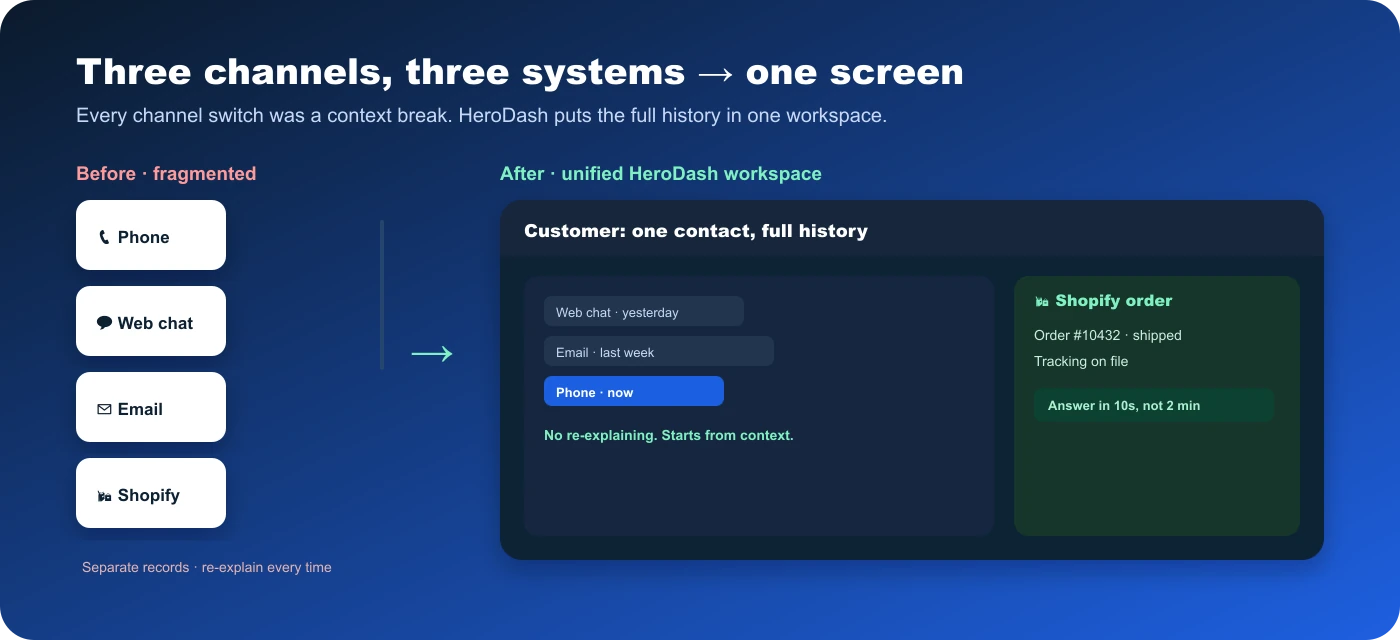
A customer who chatted online yesterday and called to follow up today was, from the phone agent’s perspective, a completely new contact. The agent had no visibility into the previous conversation and asked the customer to re-explain — and the customer, who had already explained it once, was frustrated before the current conversation even started. This isn’t a minor annoyance: industry surveys consistently find that most customers dislike re-explaining themselves across channels, and many read it as a sign of poor service.
Agents spent significant time each shift switching between the chat platform, the phone system, the email client, and a separate Shopify backend for order lookups. Every switch was a context break; every context break was time not spent resolving the issue. This wasn’t a training or staffing problem — it was an infrastructure problem. The channels ran in parallel rather than in integration, and no amount of agent effort could compensate for data that simply wasn’t visible across systems.
Problem two: high-frequency repetitive queries consuming agent capacity
Smart lighting generates a specific, predictable category of inquiry. Installation guidance — how to connect LED strips, configure zone control, wire commercial fixtures. Compatibility — which voltage standards apply in which markets, which smart-home systems integrate. Specifications — color-temperature ranges, dimmer compatibility, IP ratings for outdoor use.
These questions aren’t simple, but they are standardized. The answers don’t change between customers: the same installation question from a customer in Germany and one in California has substantially the same answer.
Human agents were answering these individually, one contact at a time, for every customer who asked. At scale, that is an enormous consumption of agent capacity on work that doesn’t require human judgment — just accurate product knowledge delivered consistently. Meanwhile the contacts that did need judgment — complaints, warranty disputes, high-value retention situations — queued behind the volume of repetitive technical queries.
Problem three: a distributed team with no management visibility
The support team was spread across time zones — covering European and North American hours meant agents on different shifts in different regions. Management in one location had limited visibility into other coverage windows.
Quality inspection was manual sampling — someone listening to a fraction of calls and making qualitative assessments. Attendance was self-reported. Performance data lived in fragments across system exports that had to be manually compiled into anything resembling a coherent picture. The questions management most needed answered — which issue types were most frequent, which agents were below standard, which periods generated the most complaints — took hours of manual data work, and the answers were always historical by the time they arrived. Problems that could have been caught early were discovered late, after they’d hardened into patterns.
How HeroDash addressed each problem specifically
Fix one: unified workspace — all channels, all history, one screen
HeroDash integrated phone, web chat, email, and Shopify into a single agent workspace. When an agent opens a contact, they see the complete interaction history across every channel — yesterday’s chat, last week’s email, the Shopify order status — in one place, without switching systems.
The Shopify integration is where this pays off most for an ecommerce operation. When a customer asks “when does my order ship,” the agent doesn’t log into a separate backend, search, and switch back — the order information displays in a panel next to the conversation. The answer takes ten seconds instead of two minutes. For the customer calling after a previous chat, the agent already knows what was discussed; the conversation starts from context rather than from zero. That difference is the difference between a customer who feels recognized and one who feels processed — and that instinct is well documented: industry research now treats personalized, context-aware service as a defining driver of customer loyalty.
Fix two: AI handles the standardized volume, humans handle everything else
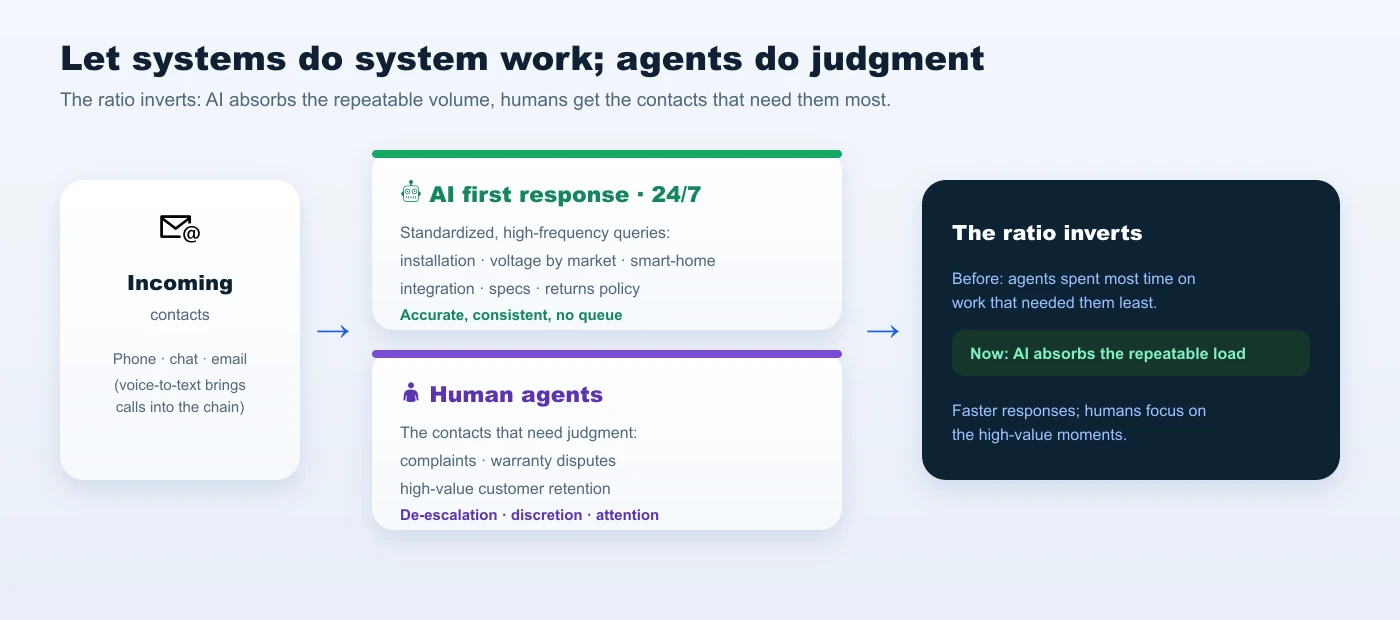
HeroDash deployed an LLM-powered AI assistant as the first-response layer. Its knowledge base was built from the brand’s product documentation, chat history, and installation guides — covering the full range of standardized queries that had been consuming agent time: installation, voltage compatibility by market, smart-home integration, returns and exchanges, specifications. The AI handles all of these accurately, consistently, and immediately — 24 hours a day, without a queue.
Voice-to-text transcription brings phone calls into the same processing chain: call content is transcribed automatically, making it available for AI analysis, quality review, and knowledge-base refinement. The phone channel stops being a separate, unanalyzed stream and becomes part of the unified operational data. Human agents, freed from the standardized volume, concentrate on the contacts that require their judgment — and the ratio inverts back to where it should be.
Fix three: AI quality inspection covers 100% of interactions — not a sample
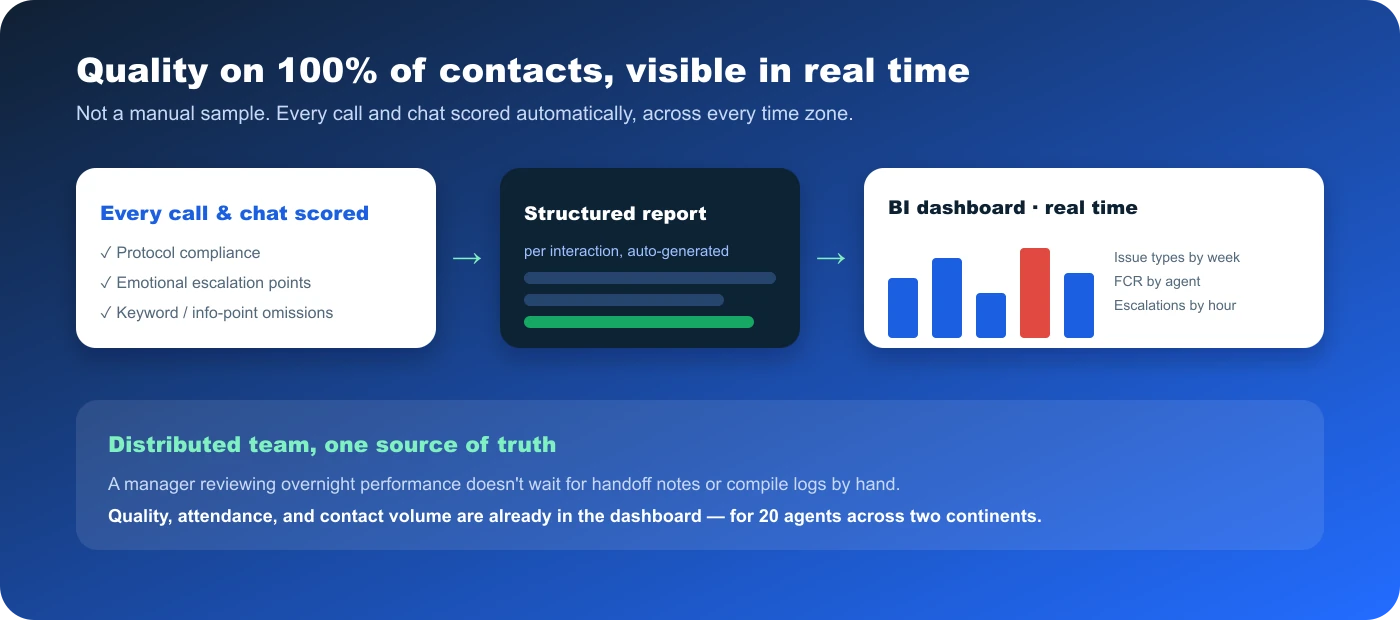
HeroDash’s AI quality module analyzes every call and every chat automatically. It checks service-standard compliance — did the agent follow the defined response protocol? It flags emotional-escalation points — where did the customer’s sentiment shift negatively? It catches keyword omissions — did the agent address the required information points for this contact type? The output is a structured quality report for every interaction, generated automatically.
Management sees quality data across the full operation — not a sample that may or may not reflect reality — and sees it in real time rather than in a weekly compilation. The BI dashboard makes performance visible across time zones, shifts, and issue categories without manual data work: which contact types are most frequent this week, which agents are below target on first-contact resolution, which hours generate the most escalations. The answers are there when management opens the dashboard — not two days later after someone compiles the exports.
What the operation looks like now

Twenty professional agents, supported by HeroDash’s full platform, now cover the brand’s European and North American customer base.
Response times improved immediately once AI began handling the high-frequency standardized queries — contacts that previously queued behind others now resolve without reaching the human queue at all. First-contact resolution improved because agents handling complex contacts have full conversation history and Shopify order data in the same view; they start from context, not from zero. The information gaps that defined the old operation — the agent who didn’t know about yesterday’s chat, the manager who couldn’t tell which issue types drove complaints — are gone. The data lives in one place, accessible in real time. These early improvements are directional at this stage: the deployment is recent, and quantified before-and-after baselines are being established as the operation stabilizes.
Twenty agents. One platform. Consistent service for customers across Europe and North America who expect a response quality that matches the product quality — and now get it.
What lighting and smart home brands building international operations should take from this
The three problems this brand hit — channel fragmentation, AI-suitable volume consuming human capacity, and management blind spots in a distributed team — are not specific to lighting. They appear in virtually every consumer-hardware category at the point where international distribution scale outpaces support infrastructure built for a smaller operation.
The structural fix is the same across categories: integrate the channels so history is unified, deploy AI where the work is standardized and repeatable, and build quality monitoring that covers the full operation rather than a sample.
If you are weighing whether to build this in-house or bring in a partner, the economics and the decision triggers are covered separately in how ecommerce sellers outsource customer service — hourly rates by region, what to ask a provider before signing, and which platform your agents should be working in.
The lighting brand’s logic was simple: let the system handle what systems are good at, let agents handle what agents are good at, and use data to make management decisions based on what’s actually happening rather than what’s assumed. Twenty agents running a global operation on that logic is what HeroDash makes possible.
FAQ
Why does channel fragmentation hurt customer service at scale?
When phone, chat, and email each have their own backend, a customer who chatted yesterday and calls today looks like a brand-new contact — the agent has no history and asks them to re-explain. Agents also lose time switching between systems, and every switch is a context break. It’s an infrastructure problem, not a training or staffing one.
How does HeroDash unify phone, chat, email, and Shopify?
HeroDash integrates all channels into a single agent workspace showing the complete cross-channel history in one place. The Shopify integration displays order status in a panel next to the conversation, so answering “when does my order ship” takes ten seconds instead of navigating to a separate backend.
How does AI reduce agent workload without lowering quality?
An LLM-powered AI assistant, built from the brand’s product docs and installation guides, handles standardized high-frequency queries — installation, voltage compatibility by market, smart-home integration, specifications, returns — accurately and 24/7. Human agents are freed to concentrate on complaints, warranty disputes, and high-value retention that actually need judgment.
How does 100% AI quality inspection work?
HeroDash’s AI quality module analyzes every call and chat automatically — checking protocol compliance, flagging emotional-escalation points, and catching keyword or information-point omissions. It produces a structured quality report per interaction and surfaces it on a real-time BI dashboard, instead of a manual sample compiled days later.
Building customer service infrastructure for a smart hardware brand in European or North American markets? Explore the full HeroDash platform, Callnovo’s specialist support teams, or talk to our team about what the right setup looks like for your product and markets.