

Key Takeaways
- Distribution outgrew the after-sales infrastructure. A medical device brand selling into 120+ countries was missing 3am calls in Germany and failing compliance audits across multiple jurisdictions at once.
- The rebuild had three pillars: language, coverage, and compliance. 30+ native, domain-trained languages; 24/7 cross-timezone routing; and AI quality inspection on 100% of calls.
- For medical devices, language fluency isn’t enough — domain precision is clinical. The wrong word for “probe” can send a technician down the wrong diagnostic path.
- The results were structural: IVR dwell time 3 min → 30 sec, first-contact resolution 58% → 87%, quality inspection coverage 5% → 100%.
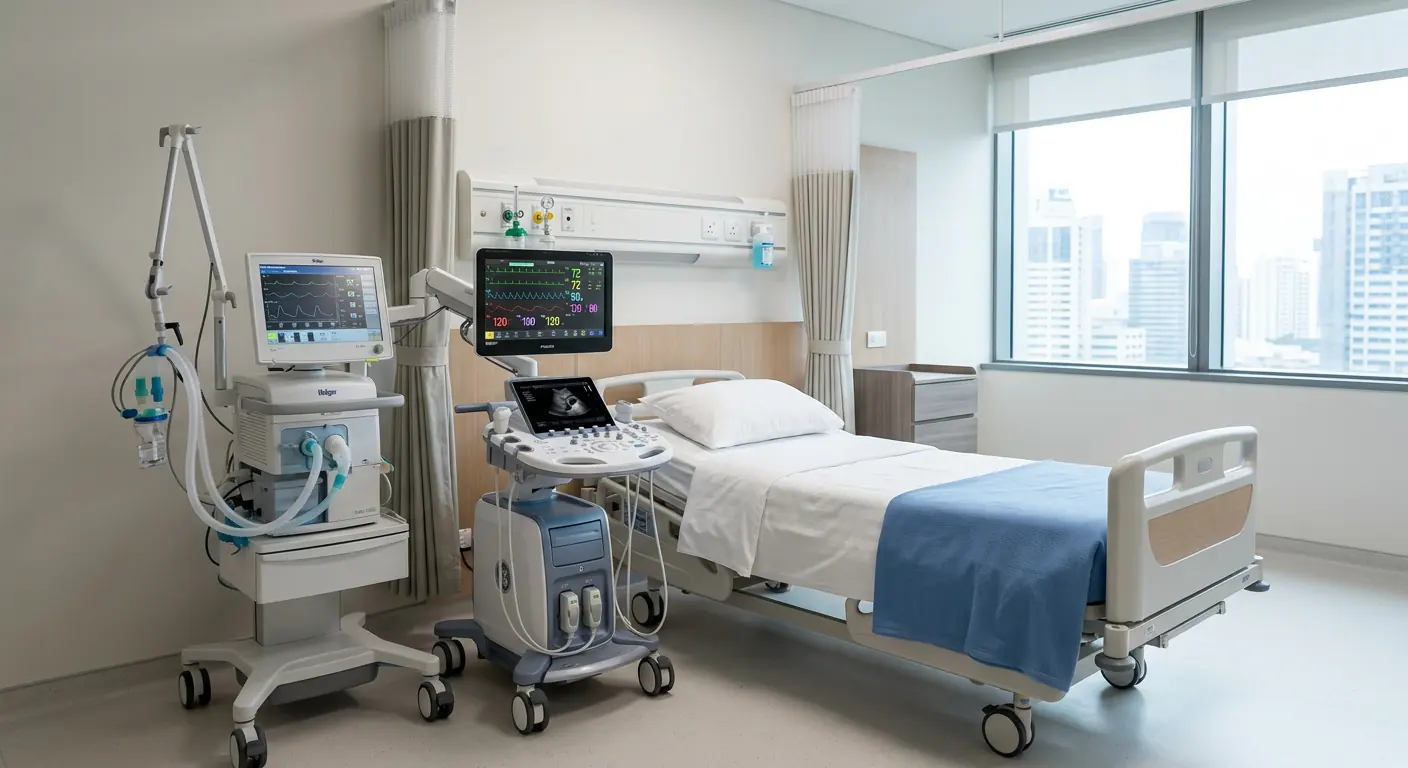
A leading medical device manufacturer — ventilators, patient monitors, ultrasound diagnostic equipment — was selling into 120+ countries. Their after-sales infrastructure wasn’t built for that scale. Here’s what a complete rebuild looked like across 30 languages, 12 countries, and a 24/7 coverage requirement with no margin for gaps.
Three words that described the problem: volume, distance, compliance
By 2024, product distribution had outgrown the after-sales infrastructure supporting it — not by a small margin, but by the kind of gap that produces missed calls at 3am in Germany, voicemails that don’t get returned until the next business day in Brazil, and compliance audit failures across multiple regulatory jurisdictions simultaneously.
Volume — language volume, specifically. 120+ markets means dozens of languages. English covers a meaningful share of global medical device support, but not the German hospital technician asking about transducer calibration, the Brazilian distributor troubleshooting an ultrasound gain adjustment, or the Indonesian clinic staff working through a ventilator alarm sequence. And the requirement isn’t just fluency — it’s domain precision. In ultrasound, “transducer” translates differently depending on context. Getting the technical vocabulary wrong can send a technician down the wrong diagnostic path.
Distance — time zone distance. A German customer needing support at 3pm local time is calling during the middle of the night in Asia. A Brazilian customer with an urgent issue at 9am São Paulo time is calling at the end of the working day elsewhere. Non-business-hours contacts were going to voicemail with no response-time guarantee. For consumer electronics that’s a satisfaction problem. For medical equipment it’s a clinical risk problem.
Compliance — regulatory compliance. EU MDR, US FDA, and Brazil’s ANVISA each have specific requirements for how after-sales service is documented, what records must be kept, and how quickly issues must be responded to and reported. Manual quality inspection was covering roughly 5% of calls — insufficient for any serious regulatory framework, and especially so for medical devices, where service documentation is subject to formal audit.
Building the language layer: 30+ languages, all domain-trained
The first and most foundational piece of the rebuild was a customer service team that could actually communicate with the full range of markets the brand was serving.
Callnovo built a 30+ language team for this account — German, French, Portuguese, Arabic, Turkish, Thai, Indonesian, and others. Every agent is a native speaker of the language they cover. That’s not a preference — it’s a requirement for medical device support, where the precision of technical communication matters in ways it doesn’t in consumer categories.
The domain training component was equally important. Medical device terminology doesn’t translate mechanically. “Transducer” in a general context becomes “sensor” in most translations — but in ultrasound the correct term is “probe,” and a technician who receives guidance using the wrong vocabulary may not recognize what they’re being asked to check. Every agent on this account went through specialized training in the specific terminology used in their language for ventilator operation, patient monitoring, and ultrasound diagnostics — “coupling gel,” “gain adjustment,” fault-code terminology — before handling a single support contact.
Local numbers in every market — and why that matters
For each of the 12 primary markets, Callnovo established a local phone number: German +49, French +33, Brazilian +55, Indonesian +62, and so on across the coverage footprint.
This is not cosmetic. A customer calling a local number has a fundamentally different experience from one navigating an international dialing sequence to reach a distant headquarters. The local number signals — before the call is even answered — that this is a brand with a real presence in their market.
For medical device distributors and clinical facilities, this matters for procurement decisions as well as support. A brand that can demonstrate local phone support is a more credible long-term partner — and that credibility affects renewals, referrals to other facilities, and the brand’s standing in regulatory conversations where local responsiveness is assessed.
IVR that routes in 30 seconds instead of 3 minutes
Traditional IVR systems for multi-product, multi-language operations become mazes: press 1 for English, 2 for patient monitors, 3 for technical support, wait, get transferred, re-identify yourself. Average time in IVR before reaching an appropriate agent: 3 minutes. During that time, a percentage of callers abandon.
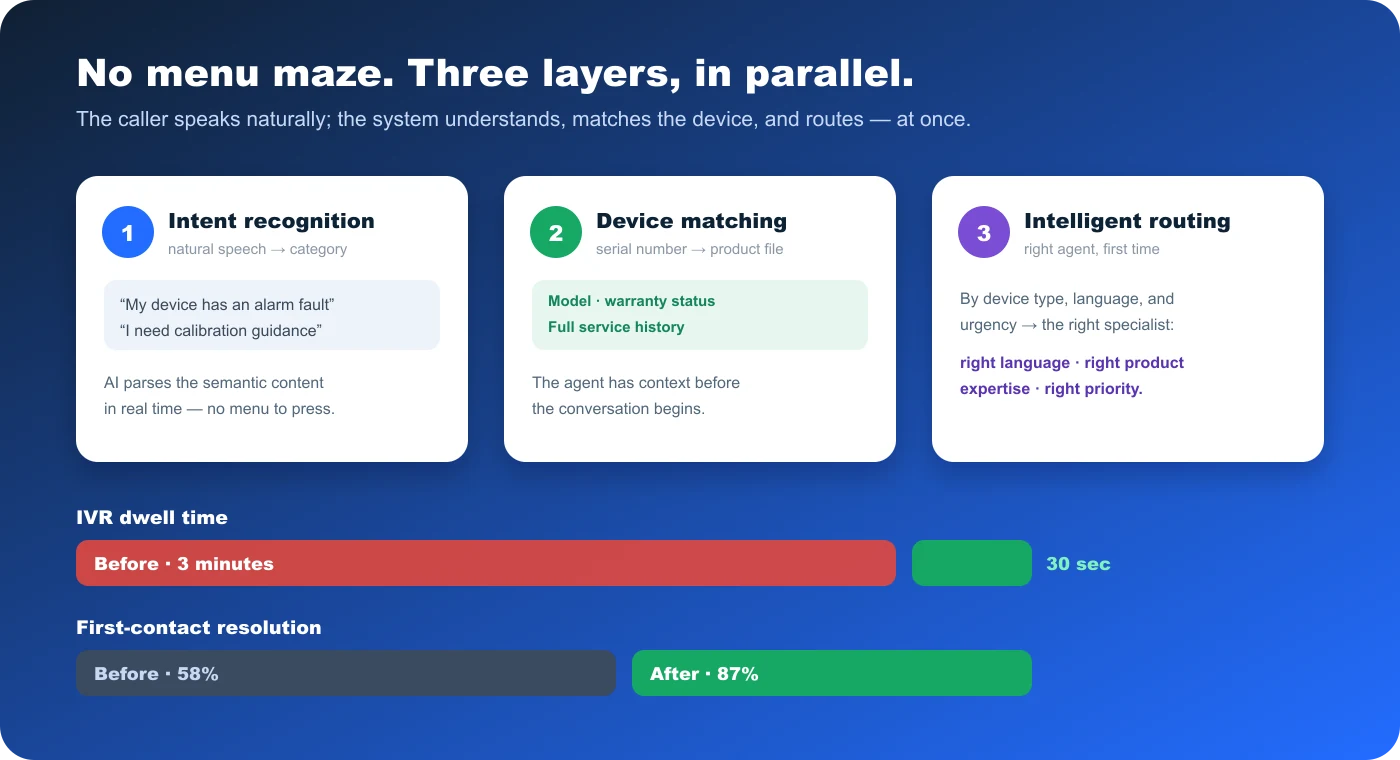
The intelligent IVR deployed for this account works in three layers that happen in parallel rather than in sequence.
- Intent recognition. The caller speaks naturally — “my device has an alarm fault” or “I need calibration guidance” — and the AI processes the semantic content in real time, categorizing the contact without a menu.
- Device matching. The caller speaks or enters their device serial number, and the system immediately retrieves the product file — model, warranty status, service history — so the agent has context before the conversation begins.
- Intelligent routing. Based on device type, language, and urgency, the call routes to the appropriate specialist — right language, right product expertise, right priority — automatically.
IVR dwell time: from 3 minutes to 30 seconds. First-contact resolution: from 58% to 87%. The agent who picks up already knows the device, its service history, and is a native speaker with domain training in the relevant product category. The call can start solving the problem from the first sentence.
24/7 coverage with seamless cross-timezone handoff
The Berlin 3am scenario isn’t hypothetical. Equipment failures in clinical settings don’t respect business hours. A patient monitor alarm that can’t be remotely diagnosed at 3am because no one is answering is a clinical problem, not just a customer-service one.
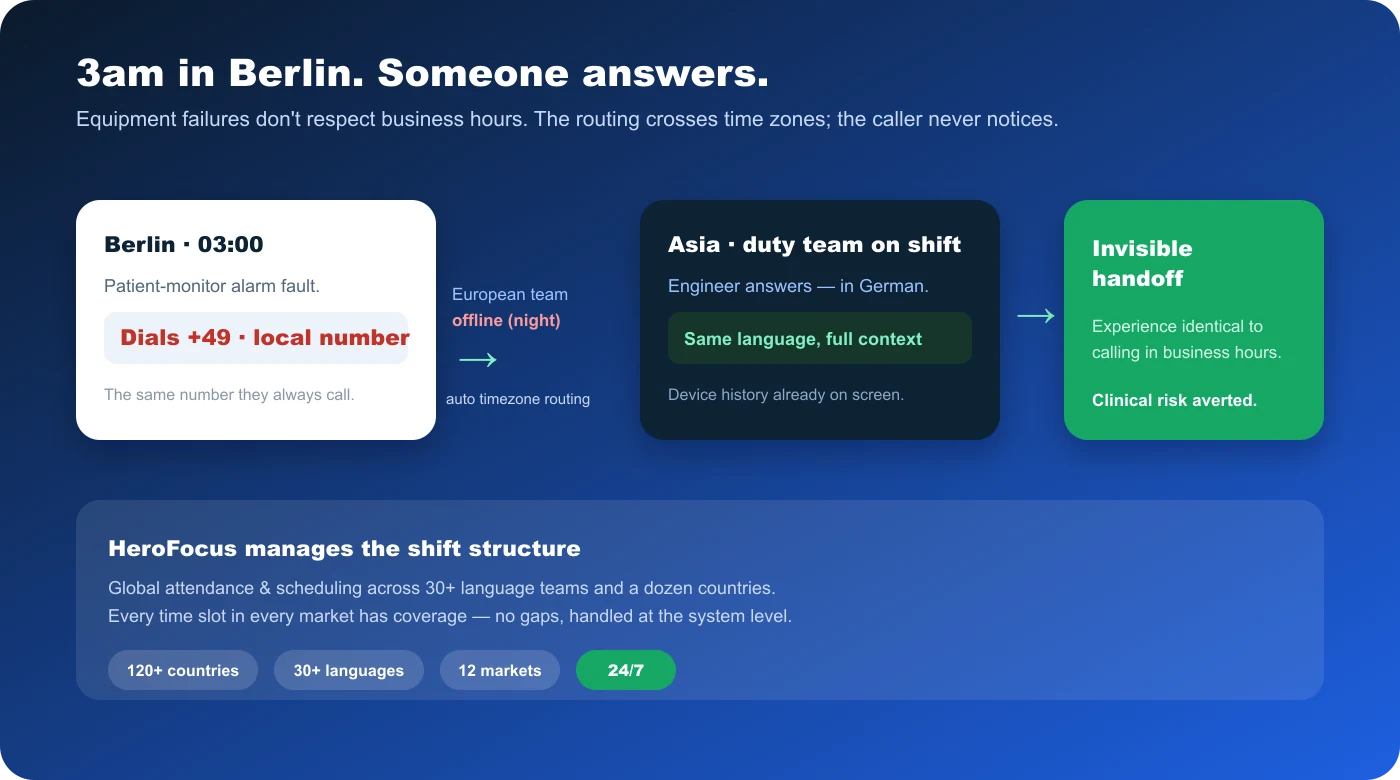
The coverage architecture works through automatic timezone-based routing. When a team in one timezone ends its shift, incoming calls route automatically to the duty team in the next timezone. The caller dials the same local number they always call; the routing happens invisibly, and call quality isn’t affected by the distance the call has traveled.
A call to the German +49 number at 3am Berlin time routes to the duty engineering team in Asia when the European team is offline. The duty engineer speaks German. The caller has no indication that this is a cross-timezone transfer — the experience is identical to calling during normal business hours.
HeroFocus — Callnovo’s global attendance and scheduling system — manages the shift structure across 30+ language teams, ensuring every time slot in every market has coverage without gaps. The complexity of maintaining 24/7 coverage across a dozen countries in 30 languages is handled at the system level rather than through manual coordination.
AI quality inspection: from 5% coverage to 100%
The compliance gap was the most serious structural problem in the original operation. Manual quality inspection at 5% coverage means 95% of calls are undocumented from a quality-assurance perspective. For EU MDR, FDA, and ANVISA audit standards, that isn’t a quality problem — it’s a liability problem. A regulatory audit that asks for documentation of service interactions will find that most have none.
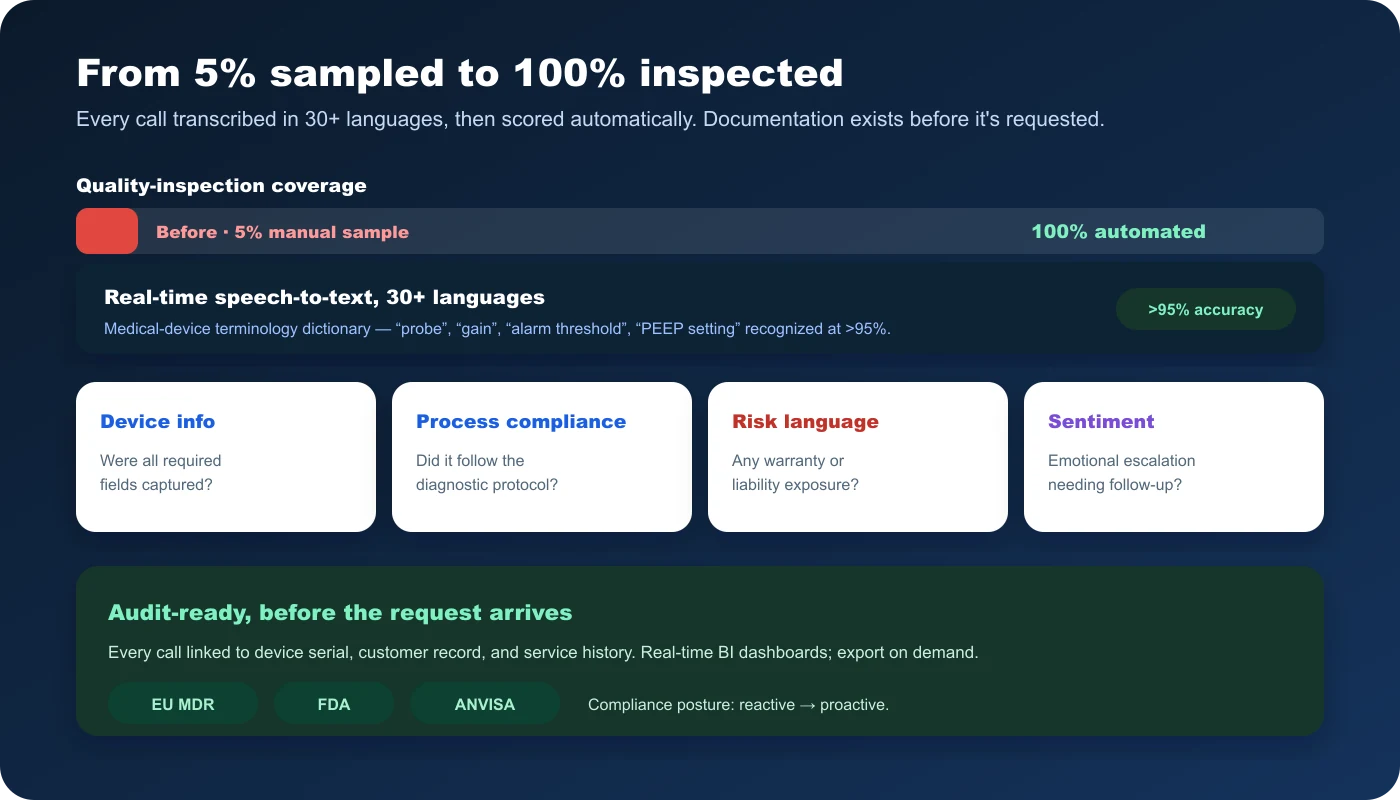
HeroDash’s AI quality inspection addresses this at the scale the problem requires.
- Real-time speech-to-text across 30+ languages. Every call is transcribed automatically, using a medical-device terminology dictionary where recognition accuracy for professional terms — “probe,” “gain,” “alarm threshold,” “PEEP setting” — exceeds 95%. The transcript is available immediately after the call, linked to the device serial number and full service history.
- 100% call coverage. Every transcript is analyzed against four dimensions: device-information completeness, process compliance (did the interaction follow the diagnostic protocol?), risk language (any statements creating warranty or liability exposure?), and customer sentiment. The 5% manual sample becomes 100% automated coverage; human reviewers focus on flagged cases rather than a random sample.
- Audit-ready documentation. Every call is linked to device serial, customer record, and service history. BI dashboards display compliance metrics in real time across all markets, and audit reports export on demand — not assembled from scattered records when a request arrives, but available immediately in the format regulators require.
What the data looks like after the rebuild
Each metric maps to a specific component: intelligent routing replaced menu navigation (dwell time), correct routing plus agent domain competency plus pre-populated device context lifted first-contact resolution, and automated transcription moved quality inspection from a random sample to full coverage — with human review redirected from sampling to flagged-case analysis.
After-sales service used to be a cost center. Now it's a competitive advantage. Customers know that wherever they are, whenever they need support, professional help is available immediately — in their language, for their specific device. That kind of trust can't be bought.
Global Operations Leadership, Medical device manufacturer (name withheld)
What medical device brands expanding internationally should take from this
Medical device distribution scales faster than most brands anticipate. A product in three markets becomes a product in twelve markets in two years, and the after-sales infrastructure that was adequate for three starts showing gaps at twelve. That gap — between distribution scale and service infrastructure — is where regulatory risk accumulates, customer relationships erode, and the product’s own differentiation gets undermined by the support experience around it.
Three questions worth asking about your current after-sales operation:
- What percentage of your support calls are answered during the local business hours of the market that generated them? If it’s significantly under 100%, the gap is producing missed contacts that don’t appear in your service data — they appear as churned customers and distributor-relationship problems.
- What percentage of your service calls are covered by quality-inspection documentation? For EU MDR, FDA, or equivalent frameworks, 5% sampling is not a defensible answer. The documentation needs to exist before it’s requested, not be assembled after an inquiry arrives.
- Are your multilingual agents domain-trained, or just language-fluent? For medical devices the distinction is significant: an agent who speaks the right language but uses incorrect technical terminology creates diagnostic confusion rather than resolving it.
The Berlin 3am call will happen. For a medical device company, the question isn’t whether to be reachable at that hour — it’s whether the infrastructure to be reachable already exists when it does.
FAQ
Why do medical device brands need native-language and domain-trained support agents?
Because medical terminology doesn’t translate mechanically. “Transducer” becomes “sensor” in most translations, but in ultrasound the correct term is “probe” — and an agent who uses the wrong vocabulary can send a technician down the wrong diagnostic path. Native fluency plus domain training in ventilators, patient monitoring, and ultrasound is what makes the interaction functional, not just comprehensible.
How does 24/7 cross-timezone medical device support work without gaps?
Through automatic timezone-based routing. When one region’s team ends its shift, calls to the same local number route invisibly to the duty team in the next timezone — who speaks the caller’s language. A 3am call to a German +49 number routes to a German-speaking duty engineer in Asia, with the experience identical to a business-hours call. HeroFocus manages the shift structure across 30+ language teams.
Why is 100% AI quality inspection important for medical device compliance?
Under EU MDR, FDA, and ANVISA, service interactions are subject to formal audit. Manual sampling at 5% leaves 95% of calls undocumented. AI speech-to-text transcribes every call in 30+ languages and scores it against device-info completeness, process compliance, risk language, and sentiment — moving coverage from 5% to 100% and making documentation audit-ready before it’s requested.
How does an intelligent IVR reduce resolution time for medical device support?
By replacing menu navigation with three parallel layers: intent recognition (the caller speaks naturally), device matching (serial number retrieves model, warranty, and service history), and intelligent routing (by device type, language, and urgency). IVR dwell time drops from 3 minutes to 30 seconds, and first-contact resolution rises from 58% to 87%.
Selling medical devices or regulated healthcare technology across multiple international markets? Explore Callnovo’s 30+ language specialist support teams, the HeroDash AI quality inspection and compliance platform, or talk to our team about what building global after-sales infrastructure looks like for your markets and regulatory requirements. See also our healthcare support capabilities.
Client identity withheld at their request. All operational metrics reflect results from an active Callnovo partnership. Regulatory references to EU MDR, FDA, and ANVISA are for informational purposes.