

First Call Resolution: How to Measure It and Reduce Repeat Calls
Define first call resolution, calculate it consistently, and investigate repeat calls. Use a measurement worksheet and a practical review process.

Illustrative support scene; the screen does not display real customer records or performance results.
A caller receives instructions, the agent closes the ticket, and the call ends. The next day, the customer calls again because the problem remains. The first interaction looked complete in the queue report, but it did not deliver a lasting answer.
First call resolution helps a support team examine that gap. To make the metric useful, you need a clear definition of resolution and a reliable way to connect later contact to the original issue. Otherwise, a higher score may reflect a change in counting rather than a better customer experience.
What counts as first call resolution?
First call resolution, or FCR, measures whether a customer’s issue was resolved during the first call without requiring another contact for that issue. First contact resolution extends the idea beyond voice to channels such as email and chat. Make clear which version your report measures. Salesforce’s FCR guide discusses the importance of defining the first interaction and what resolution means.
“Same issue” needs an operational definition. A customer calling about a delayed order and later asking about a different purchase has two issues. A customer who calls, then emails because the promised answer never arrives, has continued the original issue. A voice-only repeat-call report may miss that second contact.
Also decide how to handle a transfer within the original call. Your policy might allow a transfer if the issue is resolved before the customer hangs up. Another operation may separately track resolution by the first agent. Label these measures distinctly so a change in transfer handling does not silently change FCR.
Some work legitimately continues after a call. If the customer needs a repair that has not yet been performed, an accurate explanation and a repair appointment can still be good service. Record that outcome honestly rather than treating every closed interaction as a completed resolution.
How do you calculate FCR consistently?
A useful issue-based calculation is:
FCR = eligible issues resolved during their first contact ÷ all eligible first-contact issues in the same cohort × 100.
A cohort is the group of issues first received during the reporting period. Follow-up calls belong to those issues; they do not become extra first-contact entries in the denominator. Define eligibility before looking at the results and report any exclusions separately. NiCE’s FCR definition and formula emphasizes eligible first contacts, a defined repeat-contact window, and evidence of resolution.
For an illustrative calculation, suppose a team reviews 100 eligible issues after the agreed observation window has finished. It has evidence that 72 were resolved during the first interaction. Under this definition, FCR is 72 ÷ 100 × 100 = 72%. This is a teaching example, not a Callnovo.ai result or an industry target.
The other 28 issues need explanation. They might include known repeat contacts, unresolved work, or cases with insufficient evidence. Keep those categories visible. Missing evidence should not automatically count as success, and it should not disappear from the denominator simply because it lowers the score.
Use this measurement worksheet before comparing teams or periods:
| Decision | What to document |
|---|---|
| Unit of measurement | One issue and its first contact, including how duplicate records are linked. |
| Channel scope | Voice only, or a defined set of contact channels. |
| Eligible first contacts | Included reasons for contact and pre-agreed exclusions. |
| Resolution evidence | Customer confirmation, verified action, review evidence, or a specified combination. |
| Repeat-contact window | How long you check for the same issue to return. |
| Transfer policy | Whether resolution after an in-call transfer qualifies. |
| Unknown outcomes | How incomplete or missing evidence is reported. |
| Reporting date | When the cohort has had enough time to complete the observation window. |
Choose the repeat-contact window to suit the issue. A question answered immediately and a technical fix that needs time to verify may require different treatment. If you change the window, identify the change in the report; do not present the two rates as directly comparable.
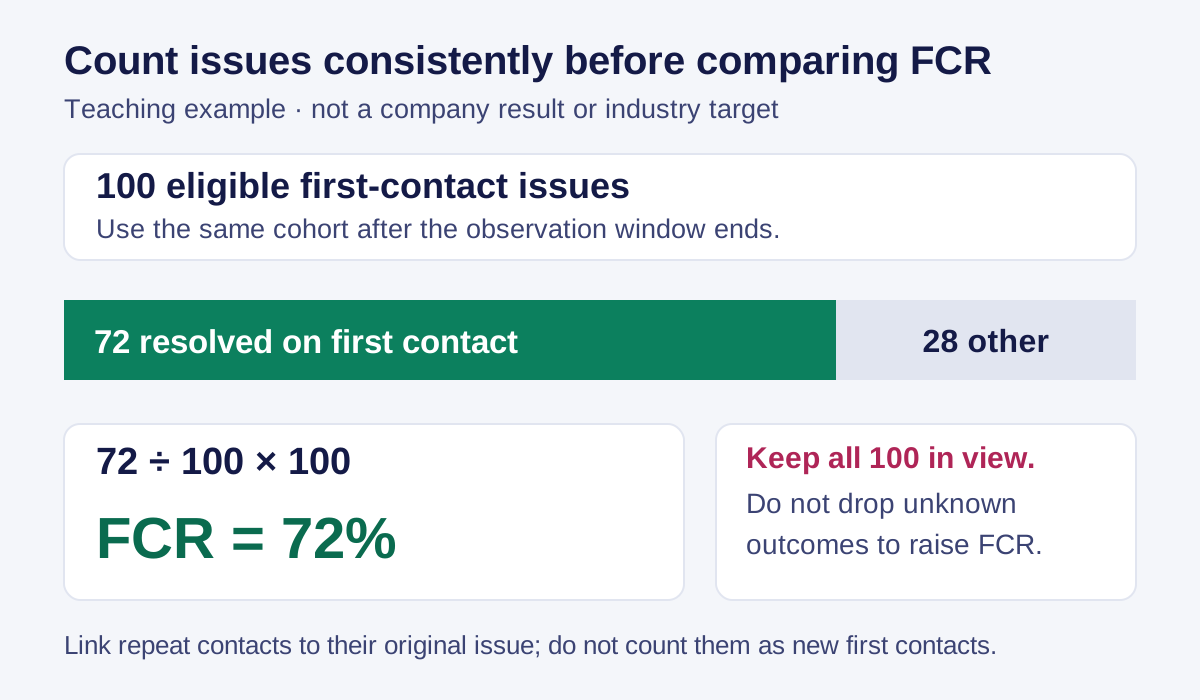
Illustrative calculation: 72 of 100 eligible issues resolved on first contact gives 72% FCR. Keep the other 28 outcomes visible.
Which measurement method fits your operation?
No single record captures every aspect of resolution. Choose a primary method that your team can apply consistently, then use another source to investigate its blind spots.
| Method | What it can show | What to check before relying on it |
|---|---|---|
| Agent disposition code | The outcome recorded at the end of the interaction. | A closed code may describe workflow status rather than the customer’s result. |
| CRM records and linked tickets | Whether the same issue returns through a known channel. | Missing links or duplicate customer records can hide follow-up. |
| Customer confirmation | Whether the customer considers the issue resolved. | Survey respondents may differ from customers who do not reply. |
| Quality review | Whether the conversation and recorded action support the stated outcome. | Reviewers need a shared definition and enough context. |
Start by reconciling a manageable sample. Choose cases marked resolved and look for related follow-up within the agreed window. Then check cases marked unresolved: was more work genuinely needed, or did the coding fail to reflect what happened?
For customer confirmation, use a question tied to the issue, such as “Was the problem you contacted us about resolved during this interaction?” A general satisfaction question measures something different. A polite conversation may leave an issue open; a resolved issue may still involve an experience the customer dislikes.
When voice, chat, and email are stored separately, document that limitation in the report. Do not assume a dashboard can identify the same issue across channels without checking the underlying records and matching method. Our call-center analytics guide covers the wider reporting context; FCR still needs its own measurement definition.
What does FCR tell you alongside average handle time?
Average handle time, or AHT, describes the handling effort per interaction under your chosen time definition. For voice, a common calculation divides total talk time, hold time, and after-call work by the number of handled calls. Check your platform’s definition before comparing reports. NiCE’s AHT guide explains these components.
FCR describes whether the issue needed further contact. Reading the two measures together helps you ask better questions about speed and outcomes.
Consider another hypothetical example. One issue takes a single interaction with nine minutes of handling time. Another takes three interactions with four minutes of handling time each. The second has a lower time per interaction, but its total handling time is 12 minutes. The arithmetic illustrates why a short call alone does not prove efficiency.
This does not mean longer calls are better. Compare similar contact reasons and case complexity. A difficult technical problem and a routine opening-hours inquiry require different work. Changes in that mix can move an average even when the underlying process is unchanged.
Use the combination as an investigation prompt:
| Pattern | A question worth investigating |
|---|---|
| FCR falls while AHT falls. | Are calls ending before the required troubleshooting or explanation is complete? |
| FCR improves while AHT rises. | Is additional work during the first call preventing repeat contact? |
| Both measures worsen. | Has case complexity changed, or is a dependency delaying resolution? |
| FCR improves but CSAT falls. | Are customers receiving the outcome they need, and has the definition stayed consistent? |
These are hypotheses to test, not automatic diagnoses. Read the records, listen to the relevant interactions where authorized, and check what happened after the call. Keep customer satisfaction (CSAT) alongside operational measures so that a technically correct closure does not obscure an unsatisfactory experience.
How do you find and fix the causes of repeat calls?
Group repeat contacts by contact reason before assigning a remedy. “Improve training” is too broad if the obstacle is a refund approval or an incomplete action in another department.
Trace the sequence from the customer’s original need to the next contact. What did the agent know? What could they do? What did they promise? Which action was still outstanding when the customer returned?
| Possible cause | Evidence to look for | A change to test |
|---|---|---|
| Knowledge gap | The required answer was missing, outdated, or difficult to find. | Correct the guidance and test retrieval with a realistic question. |
| Limited decision authority | The agent understood the issue but could not authorize the next action. | Clarify the approval route and the information required. |
| Troubleshooting gap | The same checks were repeated without reaching a diagnosis. | Practice the specific diagnostic sequence and its stopping point. |
| Failed escalation | The next team lacked context or never accepted ownership. | Define the receiving owner and required handoff notes. |
| Unfinished follow-up | A promised action or update did not occur. | Assign responsibility and make the next step visible. |
Use this review framework to choose a change supported by the evidence, then assign an owner who can carry it out.
For example, repeated transfers may prompt a review of call-routing rules. But changing the destination will not solve a missing permission to replace a faulty product. Follow the root cause far enough to identify who can actually remove the obstacle.
What can one technical-support case teach us?
Callnovo’s published smart-pet hardware support case describes an anonymized brand whose customers needed help with connected products. The work included selecting agents with technical backgrounds and providing hands-on product training for recurring faults. The company’s account reports that technical-issue FCR moved from 78% to 88%.
That is a reported result for this particular case, not a general target for a support team. The practical lesson to examine is the connection between the customer’s problem and the agent’s preparation: a product-support conversation requires enough technical understanding to guide the customer through the relevant checks.
For your own operation, choose a recurring fault and ask an agent to demonstrate the approved troubleshooting process. Observe whether they can identify the next question, locate the correct guidance, and explain when an escalation is necessary. Compare the observed difficulty with the reasons customers contact you again.
Use that exercise to select a change you can verify. A general course may be useful for communication skills, while a product-specific practice session addresses a different gap. Measure the effect in your own records without assuming another project’s result will transfer to yours.
What should your next FCR review include?
Bring a stable measurement definition, a repeat-contact trend, and examples of the customer journeys behind the numbers. A review should end with a specific action and a way to check whether it helped.
| Review item | Record for the next comparison |
|---|---|
| Definition | Channel scope, eligibility, transfer policy, and observation window. |
| Baseline | Eligible issue count, resolved count, unknown outcomes, and exclusions. |
| Repeat-contact pattern | The reasons returning most often and their share of eligible issues. |
| Proposed change | The guidance, authority, routing, or follow-up process to change. |
| Owner and review point | Who will implement it and when enough observation data will be available. |
| Context | Product incidents, staffing changes, or shifts in case mix. |
Ask three questions at the end. Did the definition stay the same? If it changed, separate the effect of measurement from performance. Which repeat-contact cause changed? If you cannot identify one, investigate before crediting a training or software initiative. Did the customer’s outcome improve? If closure codes look better but follow-up remains unresolved, keep examining the process.
First call resolution is most useful when it helps a team remove a reason customers must return. If you want to discuss a support workflow with Callnovo.ai, bring the measurement definition and a few anonymized repeat-contact examples. They provide a concrete starting point for reviewing the work.