


Every ranking of the best ai customer service platforms 2026 compares the same things: feature lists, chat widgets, integration counts. None of them compare the number that actually decides your invoice — how each vendor defines a resolved conversation.
That gap matters. AI customer service spending rose 38% in 2026 while overall service budgets grew just 2% (Gartner, 2026). Most of that money is going into contracts priced on outcomes nobody has independently checked. Callnovo.ai staffs AI and human agents together in 65+ languages across 150+ countries. We read a lot of AI vendor contracts before clients sign them. This is what the fine print says, not the sales deck.
TL;DR: How to Actually Compare the Best AI Customer Service Platforms 2026
Most rankings stop at price and feature parity. Go one layer deeper. Ask what counts as “resolved.” Ask whether AI time before a human handoff still bills. Ask whether the platform assumes you’re buying software to run yourself, or a service that includes people.
| Evaluation axis | What most rankings check | What to check instead |
|---|---|---|
| Pricing model | List price per seat or per resolution | Whether AI work that fails still bills, and under what name |
| ”Resolution rate” | The number on the vendor’s homepage | Who verifies it, and whether it’s vendor-reported or audited |
| Language coverage | Number of supported languages | Native-speaking agents vs. machine translation for the handoff cases |
| Delivery model | Software feature comparison only | Whether a human-staffed option exists for volume the AI can’t close |
What “AI Customer Service Platform” Actually Means in 2026
A 2026-era AI customer service platform isn’t a chatbot bolted onto a help desk. It’s an agentic system. It reads a knowledge base, writes updates into a ticketing system, and hands off to a human when its own confidence drops.
“Chatbot,” “conversational AI,” and “AI agent” get used interchangeably in vendor marketing. They aren’t the same thing:
- Chatbot: scripted or intent-matched responses, limited to a decision tree.
- Conversational AI: generates responses dynamically but stays mostly reactive.
- AI agent: takes multi-step action — looks something up, calls a tool, updates a record.
Most tools sold today under this label are the third kind. That’s why picking one is harder than picking a chatbot vendor was five years ago. Rankings of the top ai customer service platforms 2026 — including Zendesk, Freshdesk, Gorgias, Intercom, and Ada — mostly compare this feature layer: what the AI agent can do, how many channels it covers, how deep the CRM integrations go.
What those roundups rarely spell out is the operational side. A platform that promises full omnichannel routing at scale — live chat, SMS, email, and voice, handled without losing customer satisfaction on complex, multi-step tickets — needs custom workflows behind it, not just a feature checklist. Some vendors also publish a SOC 2 Type II report. That covers security controls, not resolution accuracy. The two get conflated constantly, and they answer different questions.
Handoff quality deserves its own test. In Twilio’s 2025 global survey of 457 business leaders and 4,800 consumers across 15 countries, 78% of consumers said it was important to be able to switch from an AI agent to a human; only 15% said they had experienced a seamless handoff. Twilio commissioned the study, so treat it as a vendor-sponsored survey rather than an independent performance benchmark. In a product demo, test a billing or account-change question that should leave the bot: does the human receive the customer’s intent, language, prior steps, and any promised follow-up? “Supports escalation” does not answer those questions.
The Comparison Every Ranking Skips: Who Handles What AI Can’t
We read the five highest-ranking English-language buyer’s guides for this topic in September 2026. Every one compares AI vendor against AI vendor. Not one asks whether the reader wants software to configure themselves, or a service where AI and human agents work as one team.
We checked directly. Across those five guides, “outsource,” “BPO,” and “vendor management” appear zero times combined. That’s not a gap in our reading. It’s a gap in the category. Every ranking assumes an in-house team implementing a standalone tool.
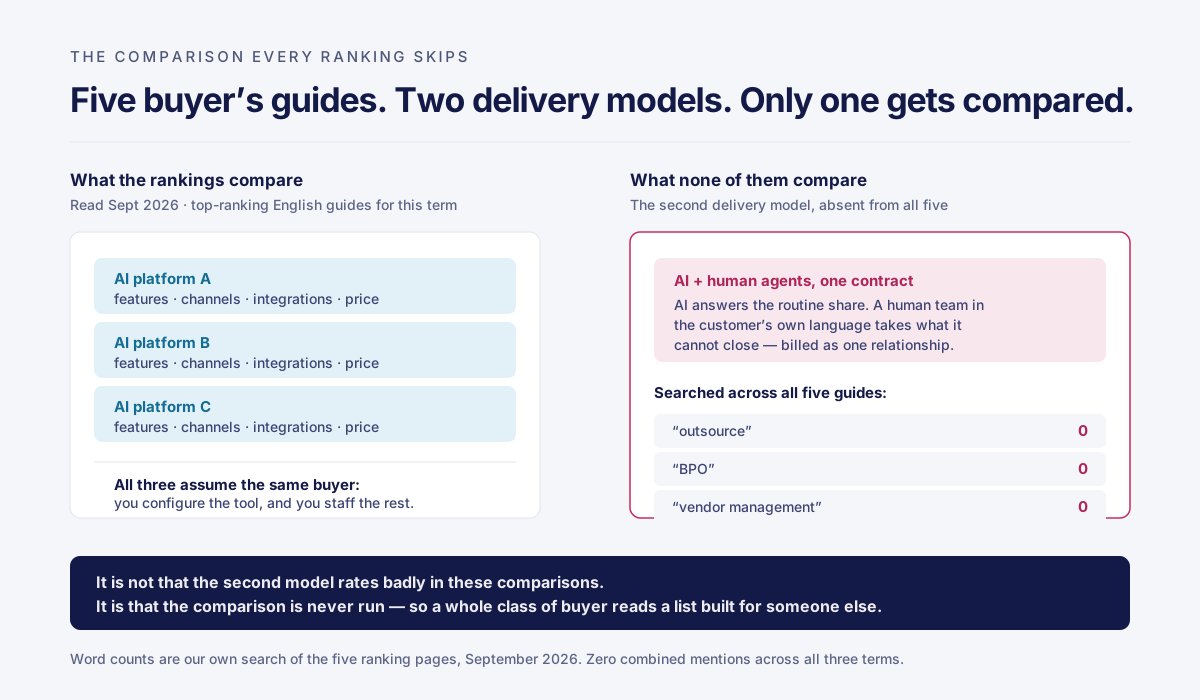
Five ranking pages read in September 2026. The three terms return zero combined mentions — the second delivery model isn’t rated poorly, it’s absent.
Most lists of ai customer service companies are really lists of software vendors, not delivery options. That framing leaves out a real buyer: a team that wants AI to answer the routine share of contacts and a multilingual human team to pick up the rest — billed as one relationship, not two separate vendor searches. If your evening or weekend queue is the actual problem, a pure-software comparison won’t help. None of the five vendors in it staff people.
This also changes what “language coverage” should mean. A survey of 2,501 people across eight markets found trust in AI support is task-dependent: 81% were comfortable with AI handling order tracking, but only 62% felt the same about billing or payment changes (Sinch, 2026, vendor-commissioned survey). Billing disputes are exactly where a native-speaking human beats a translated bot reply. “24 languages supported” on a pricing page doesn’t say which are native human agents and which are machine translation over an English script. Buyers evaluating ai customer service solutions for a multilingual ecommerce queue should ask that question before the demo, not after the contract.
Evaluation Framework: What to Verify Before You Trust a Vendor’s Numbers
“Resolution rate” is not a standardized metric. It’s whatever the vendor’s contract says it is. The definitions vary enough to change your bill.
Intercom’s Fin AI publishes its own benchmark: across 12,000+ customers and 110 million+ conversations, its top-decile performers average an 85% resolution rate (Fin AI, benchmark page refreshed May 2026). That’s a real number. It’s also the vendor’s own measurement of its own product. Before comparing it to anyone else’s, ask the same three questions of every platform on your shortlist:
| Platform | What counts as billable | Does AI time before handoff still bill | Who verifies the outcome |
|---|---|---|---|
| Zendesk AI agents | Automated resolution | No — escalation voids resolution status entirely | LLM re-checks the transcript; unverified attempts don’t count |
| Intercom Fin | Outcome, US$0.99 per resolution | Only for a configured Procedure Handoff; default escalations are free | ”Confirmed” (customer agrees) or “assumed” (customer goes quiet) |
| Salesforce Agentforce | Action (Flex Credits) | Yes — every action consumes credits regardless of outcome | No outcome verification |
| Callnovo.ai AI Chatbot / Voice | Usage: US$0.15/session, US$0.15/minute | Yes, by design — the public billing guide says substantive AI work bills even if the customer later escalates | Buyer can audit it against their own ticket log; the definition is published, not buried in an order form |
We’re one row in that table because it’s an honest comparison, not because we’re neutral. Our own usage-based pricing bills for AI work the same way Salesforce’s does, and we say so in the same public document a prospect reads before signing. The difference isn’t the billing mechanic. It’s that the definition is public before you ask.
If you’re comparing ai customer support software for saas pricing specifically, add one more line to that table: does the vendor price per seat, per resolution, or per action — and does a free trial user get billed the same way a paying one does? Most SaaS-focused pricing pages don’t say.
A check you can run in an afternoon, before any demo: pull 25 closed tickets from last month — real ones, including the messy ones. For each shortlisted vendor, read their published definition of “resolved” and mark each ticket against that definition, not against your own judgment of whether the customer went away happy. Then count the marks per vendor.
Two things usually fall out. The count differs between vendors on the same 25 tickets, sometimes by a third. And the tickets that flip — resolved under one definition, not under another — are almost always the same kind: billing disputes, anything with a human handoff mid-conversation, and customers who simply stopped replying. That count is your real comparison. The homepage percentage was measured on someone else’s tickets under someone else’s definition.
If you’re shortlisting the best ai tools for customer service 2026 or a single-purpose ai cx platform, run this before the demo, not after. Watch for one more pattern while reading comparison content: some of the highest name-counts for a platform come from that platform’s own blog. One 2026 buyer’s guide mentioned its own brand 15 times; competitors got a handful each. That’s a vendor’s listicle about itself, not evidence of category leadership.
How to Choose Without Getting Burned
Run this list before you sign anything, not after:
- Get the vendor’s written definition of a billable resolution, not the marketing-page summary
- Confirm in writing whether AI work that fails to resolve an issue, and later escalates, still bills
- Ask whether the resolution rate on their homepage is self-reported or independently audited
- Test the platform against 20–30 of your own real tickets before trusting a demo
- For any language beyond English, confirm native-speaking agents handle escalations, not machine translation
- If Black Friday or holiday-season volume outpaces what the AI can absorb, ask what bundled human coverage costs
When a pure AI platform is the right call
This comparison weighs AI-plus-human delivery against AI-only software. That’s not everyone’s situation.
If you already run an in-house support team and only need the software layer, the vendors compared above are the right list. We’re not a fit for that purchase — we don’t sell a tool you configure yourself. And if your volume is low enough that a billing-model difference is a few dollars a month, pick whatever your team can implement fastest. The questions above start to matter once a resolution-rate gap of a few points changes your bill by real money.
Final Thoughts
Three things to take from comparing the best ai customer service platforms 2026:
- “Resolution rate” is a vendor-defined metric, not an industry standard. Read the definition before trusting the percentage.
- The category assumes you’re buying software alone. Want AI and multilingual human coverage as one relationship? None of the standard rankings compare for that.
- Test the vendor’s definition against your own tickets before you sign. The gap between their number and yours is the real cost of the platform.
If your queue has hours or languages a pure AI platform can’t close, see published usage and resolution pricing, read how the model works, or check native-language human agent coverage for your markets.
References
- Fin AI, “Fin Resolution Rate Benchmarks,” refreshed May 2026 — Source
- Zendesk Help Center, “About automated resolutions for AI agents,” 2026 — Source
- Intercom Help Center, “Fin AI agent outcomes,” 2026 — Source
- Salesforce, Agentforce pricing documentation, 2026 — Source
- Gartner, 2026 customer service AI spending research (cited via internal research archive, “Gartner 2026 客服AI预算”)
- Sinch, 2026 eight-market consumer confidence survey, n=2,501, vendor-commissioned (“Sinch 2026 八市场消费者AI信心”)
- Twilio, Inside the Conversational AI Revolution, published November 13, 2025; global survey of 457 business leaders and 4,800 consumers across 15 countries; vendor-sponsored.
- Callnovo.ai, public pricing — https://callnovo.ai/pricing/
- Callnovo.ai, multilingual agent coverage — https://callnovo.ai/services/multilingual/
- Related: Best Platforms for AI-Led Escalation Handling, AI Quality Assurance Software