


Outsourcing back-office work is almost always sold the same way: these are the administrative, transactional processes that don’t generate revenue, so move them somewhere cheaper and let your team focus on what matters.
That framing is accurate and incomplete. It describes the work from the org chart’s point of view. From the customer’s point of view, the back office isn’t invisible at all — it’s the part they’re waiting on.
In September 2026 we read five of the top-ranking Google results (US, English) for this term. Across those five, “front office” appears 16 times, so the division of labor is well covered. “Queue” appears zero times. So does “wait”. Not one of them describes what the customer experiences while a back office task is in progress.
Back office outsourcing is the practice of contracting the processes that keep orders, billing, claims and records moving — the work a customer never sees but always waits on — to an outside provider that runs them under your rules.
On this page
- What back office support actually is
- The seam is where the ticket dies
- The multilingual gap nobody prices
- What it costs, and which unit to buy it in
- Three questions that reveal where the wait actually sits
- FAQ
What back office support actually is
The standard definition: processes that support daily operations without directly touching the customer. Data entry, document processing, payroll, accounting, order administration, catalog management, billing, compliance support.
The more useful definition, for anyone buying it: back office work is invisible to your org chart and extremely visible to your customer.
| Customer asks | Front office does | Back office does | What the customer sees |
|---|---|---|---|
| ”Where is my refund?” | Confirms the return was received, in two minutes | Processes the refund against the payment record | Nothing, for three days |
| ”My invoice is wrong” | Apologizes, logs a ticket | Reconciles the billing record, reissues | Silence, then a corrected invoice or a second wrong one |
| ”I sent the documents last week” | Checks the ticket | Locates and validates the documents | A repeat request for documents already sent |
| ”My order shipped to the old address” | Confirms the address change | Amends the order record before the carrier pickup | Either a fixed shipment or a support failure |
In every row, the front office response time is minutes and the customer experience is days. The response time isn’t the number that matters. The turnaround is.
The seam is where the ticket dies
If you outsource the back office and the front office to different providers — or outsource one and keep the other in-house — you’ve created a handoff. Handoffs are where work stops moving and nobody is accountable for the pause.
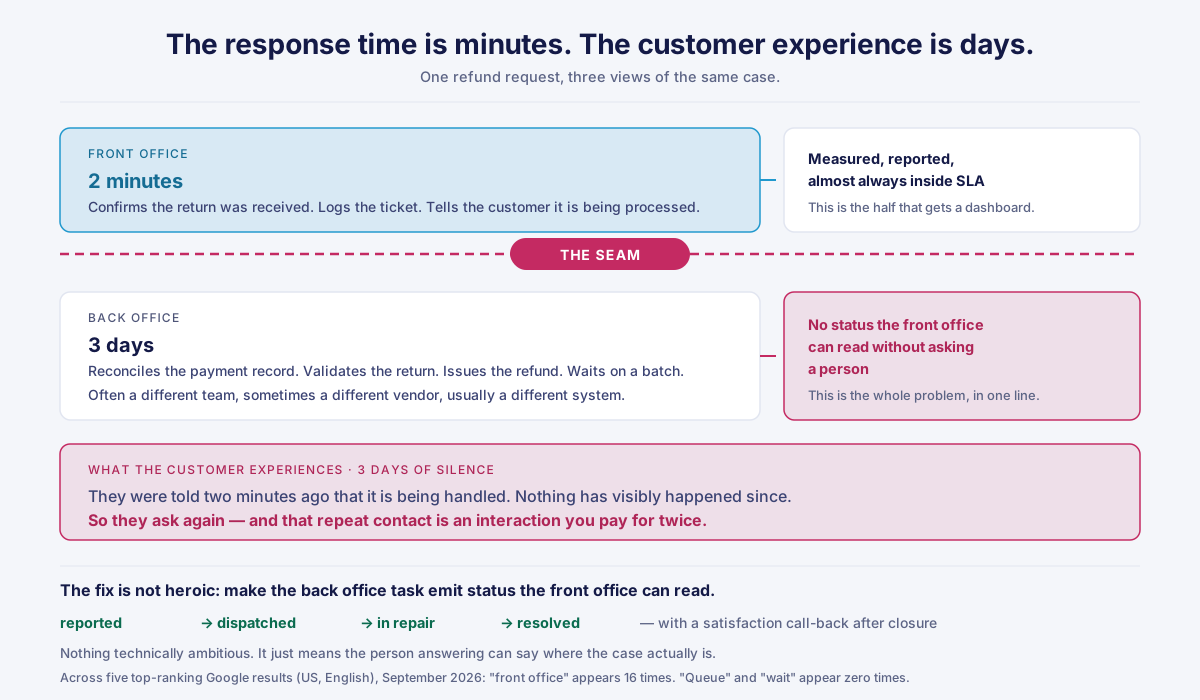
Three symptoms tell you the seam is leaking:
- Customers re-contact about tickets that are technically “open”. The front office closed its part; the customer has no way to see the rest, so they ask again. Every one of those repeat contacts costs you a second interaction you already paid for.
- Nobody can answer “where is it” without asking someone. If checking status requires a person to message another team, the status isn’t in a system, and it won’t scale past the volume you’ve today.
- Your SLA covers response, not resolution. A two-minute first response with an unbounded back office turnaround is a service commitment that measures the easy half.
The fix isn’t heroic. It’s making the back office task emit status the front office can read. One published example: for a heavy-machinery client, Callnovo tracks four named checkpoints on every fault case — reported, dispatched, in repair, resolved — with a satisfaction call-back after closure (Callnovo, 2026). Nothing about that’s technically ambitious. It simply means the person answering the phone can say where the case actually is.
That’s the whole argument for buying both halves from one operation rather than assembling them: not that it’s cheaper, but that there’s no seam to fall into. Where the front half is a live queue rather than a ticket, the same logic applies to staffing and concurrency, which we covered in outsource live chat support services.
The multilingual gap nobody prices
Here’s the second thing missing from those five pages. Between them they mention e-commerce 18 times. “Multilingual” appears zero times. So does “cross-border”.
They’re describing back office support for companies selling in one language. That’s a real market, and it’s not the one most sellers reading this are in.
A cross-border seller’s back office work is multilingual by construction:
- Marketplace appeals and policy disputes, written in the marketplace’s language
- Return and exchange paperwork that has to satisfy the destination country’s requirements
- Ticket archiving and categorization across queues in six or eight languages
- Compliance documentation that regulators read in the local language
You can’t route that to a data entry team that works in English and expect the categorization to survive. Callnovo.ai staffs these processes with native speakers across 65+ languages rather than translation software (Callnovo, 2026), which for back office work matters in an unobvious way: the cost of a mistranslated customer reply is an awkward message, but the cost of a mistranslated record is a decision made on bad data months later.
Automation belongs here too, and belongs first on the tasks where the rules are unambiguous — document classification, duplicate detection, format validation. Automate the deterministic layer, staff the judgment layer. The failure mode is doing it in the wrong order.
What it costs, and which unit to buy it in
Callnovo public pricing, so you can do the arithmetic before anyone calls you.
| Unit | Rate | Fits which back office work |
|---|---|---|
| Per interaction — ticket, email, chat, social | US$0.20 | High-volume, well-defined, repetitive: data entry, document processing, categorization |
| Hire a team, per productive hour | US$5–12 | Work requiring judgment or system access; engagements run half a seat to 200+, not a five-seat floor |
| Dedicated agent | from US$5.80 per hour | Processes needing continuity and account knowledge |
| Pay per resolution — simple | US$0.79–1.49 | Routine record updates, status lookups |
| Pay per resolution — standard | US$1.50–3.49 | Billing corrections, returns processing |
| Pay per resolution — complex | US$3.50–6.99 | Disputes, multi-step reconciliation |
Volume tiers apply to resolution pricing: standard rates up to 500 cases per month, 10% off from 500 to 2,000, 20% off above that (Callnovo, 2026).
The unit is the decision, not the rate. Per-interaction pricing is honest for a predictable, uniform queue. It’s misleading when a “ticket” can mean 30 seconds of data entry or 40 minutes of reconciliation — in that case you’re averaging two different jobs and the provider is incentivised to take the fast ones first. Outcome pricing removes that incentive, because an unresolved case is the provider’s cost.
Back office BPO and back office services are often used interchangeably, and should not be. Buying services means buying capacity you direct. Buying BPO means buying a process the provider owns end to end, including its design. Ask which one is on the table before comparing prices, because the two aren’t comparable.
For scale context: the same operation handles roughly 45,000 calls, 120,000 chats and 85,000 emails monthly (Callnovo, 2026), across 35+ operations centers. The relevant question for a back office buyer isn’t the volume but what it implies — that the front and back halves of a case sit inside one operating system rather than two.
When we’re not the right fit
- Your back office work runs inside proprietary internal systems that can’t be opened to an external team. No amount of process design solves an access problem.
- The volume is low and irregular — a few dozen cases a month with no pattern. Transition cost will exceed the saving, and you’ll spend more time briefing than the work takes.
- You need the provider to own regulated financial reporting or statutory filings. That is an accounting mandate, not a support mandate, and the right vendor is an accounting firm.
Three questions that reveal where the wait actually sits
Before signing anything, ask a prospective provider three things:
- What is the turnaround commitment, and is it measured from ticket creation or from when your team picks it up? The gap between those two definitions is where weeks disappear.
- Can the front office see the status of a back office task without messaging anyone? If not, every “where is it” becomes a second interaction.
- What share of your back office work is automated today, and which tasks did you decide not to automate? A provider who can’t name what they chose not to automate has not thought about it carefully.
None of this is difficult to build. It’s just specific, and the specificity is what most providers have not done — because they’re selling against a cost benchmark rather than against the customer’s wait. Where the work is technical support rather than administrative processing, the buyer and the cost model shift again; that split is covered in outsourced IT support services.
Customer satisfaction on the back half of a case isn’t measured by a survey. It’s measured by whether the customer had to ask twice.
References
- Callnovo public pricing — https://callnovo.ai/pricing/
- Axendi, back office services guide
- ARDEM, back office outsourcing services
- Solvo Global, back office outsourcing
- Liveops, back office support
- Hire Horatio, back office outsourcing guide
Related reading: Outsource live chat support services · Outsourced IT support services: two buyers, one search term