

Key Takeaways
- Australian Gen Z shoppers treat Instagram and Facebook like a search engine. 74% of young Australians start product research on social rather than a search engine — and for fashion, a real DM reply converts where an auto-reply converts no one.
- “Already Replied” is often a lie. An auto-response marks the conversation green on the dashboard while the customer is still waiting and no human has opened it.
- Three structural gaps lose the sale: a time-zone mismatch that turns Friday into Monday, no mechanism telling agents which message to handle first, and metrics that measure automation instead of service.
- The fix isn’t complicated — it’s specific. Coverage on Australian hours, SLA countdown ranking, and timers triggered only by human action.

Australian Gen Z shoppers treat Instagram and Facebook like a search engine — 74% start product research on social rather than on Google, and for fashion, many DM the brand to ask a real person before buying. Most of those messages get an automated “thanks for reaching out” — and then nothing. Here’s what a support operation built for this market actually looks like.
Why Australian fashion customers live in social media DMs
Australia has low population density, long distances between urban centres, and one of the highest ecommerce adoption rates in the world. Online shopping isn’t a convenience — for a significant share of the population, it’s the primary way they shop.
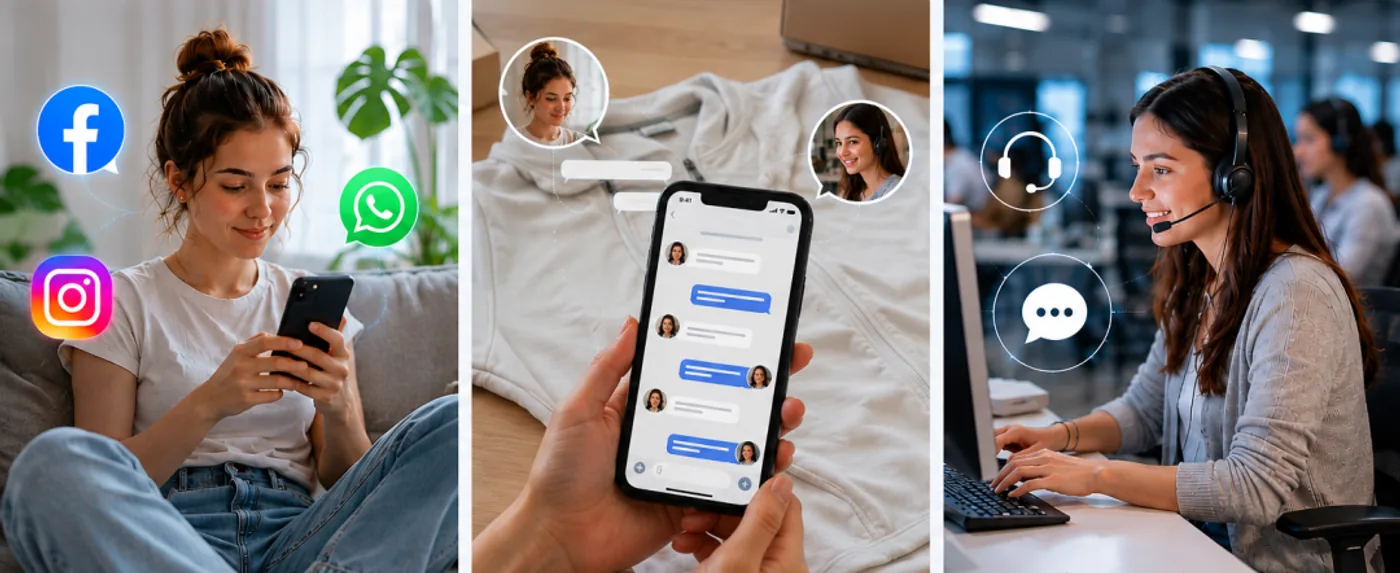
For fashion specifically, the younger demographic has developed a specific pre-purchase behaviour: they don’t go to the brand website to check specs. They DM the brand on Instagram or Facebook to ask a real person. Questions about fabric composition, size runs, shipping timelines, return policies, whether a particular item runs small — these get asked in private messages, not in the FAQ.
Recent Australian research found that 74% of young Australians begin product research on social media rather than a search engine, and 42% go to a brand’s social profile to make the final purchase decision — against just 11% who start on the brand’s website. In the fashion brands we work with, that increasingly means a direct message: shoppers DM to ask a real person about fit and fabric rather than trust the FAQ. A real response from a real person converts. A delayed auto-reply converts no one.
Fashion brands that have built meaningful market presence in Australia have usually figured this out. The ones struggling with conversion and repeat-purchase rates often haven’t — and the gap shows up most clearly in their social media response metrics.
Three problems that show up in every brand we talk to
Problem one: the time-zone gap that kills purchase decisions
Australia runs 2–3 hours ahead of many major markets, and on the opposite side of the clock from others. When Australian consumers are active — daytime, evenings, weekends — support teams operating on different time zones are either just starting their day or already finished.
A message sent on Friday afternoon in Sydney often doesn’t receive a human response until Monday. By Monday, the customer has either bought from a competitor, forgotten they were interested, or both. The purchase-decision window in fashion is short. A 72-hour response time isn’t slow customer service — it’s no customer service, because the decision has already been made without the brand’s input. This isn’t a soft preference: 73% of social users say that if a brand doesn’t respond on social, they’ll buy from a competitor, and most expect a reply within 24 hours.
Weekend and public-holiday coverage is where this problem is most acute. Australian retail culture has strong weekend shopping behaviour. The brands capturing those sales are the ones answering messages on Saturday morning Sydney time, not the ones whose support teams are offline until Monday.
Problem two: no mechanism telling agents which message to handle first
Social media inboxes don’t behave like email queues. New messages arrive continuously, older messages get buried, and without a structured prioritisation system, agents naturally gravitate to the easy ones — short questions, quick answers — while the complex queries involving stock checks, size availability, or policy clarification get set aside.
Without a countdown or SLA mechanism showing which conversation is closest to breaching its response target, “I’ll get to that one next” becomes “that one timed out.” At high volume during peak periods — new collection launches, sale events, seasonal promotions — this problem compounds fast. Agents work hard and still miss messages, because the system isn’t showing them where the urgency actually is.
Problem three: “Already Replied” hiding the fact that no human ever responded
Most social media platforms let brands set up automatic responses — “Thanks for reaching out, we’ll get back to you soon!” These auto-replies are useful for setting expectations. They’re actively harmful when they’re used as a substitute for human follow-up rather than a bridge to it.
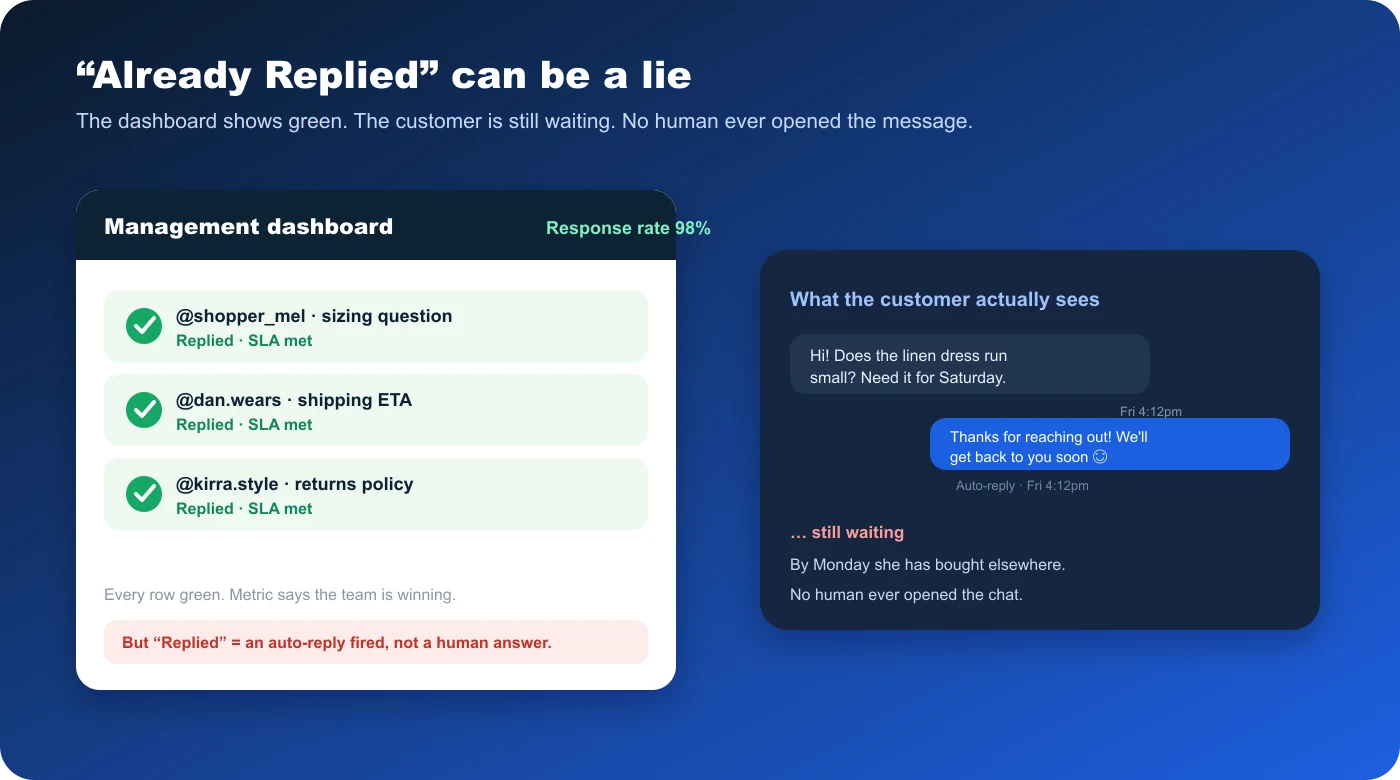
When a platform marks a conversation as “replied” after an auto-response triggers, the management dashboard shows green. Response rate looks good. The SLA looks met. But the customer is still waiting for an actual answer, the agent hasn’t opened the conversation, and the metric that’s supposed to be measuring service quality is measuring automation output instead.
This is the “Already Replied” problem — and it’s the reason brands can have strong-looking social media response metrics and still lose the customers those metrics are supposed to reflect.
What a support operation built for the Australian market actually looks like
Fix one: coverage that matches Australian active hours, including weekends
Callnovo operates across multiple global centres, which means staffing for Australian time zones isn’t a scheduling workaround — it’s a standard deployment. English-speaking agents are scheduled for Australian daytime and evening hours. Weekend and public-holiday coverage is included as standard, not as a premium add-on.
The practical effect for a fashion brand: a consumer in Melbourne who messages at 7pm Saturday asking whether a jacket runs true to size receives a genuine human response within the response window — not an auto-reply, not a Monday-morning catch-up, but an answer while they’re still thinking about the purchase.
This is what “time-zone coverage” actually means in operational terms. Not that someone is technically reachable, but that a real person is answering during the hours when Australian customers are actually messaging.
Fix two: countdown timers and SLA ranking that tell agents exactly what to handle first
In HeroDash, when a ticket is assigned to an agent, a countdown timer starts — configurable from 1 to 72 hours depending on the channel and priority tier. The agent workspace automatically sorts conversations by time remaining, with the conversations closest to their SLA breach shown at the top.
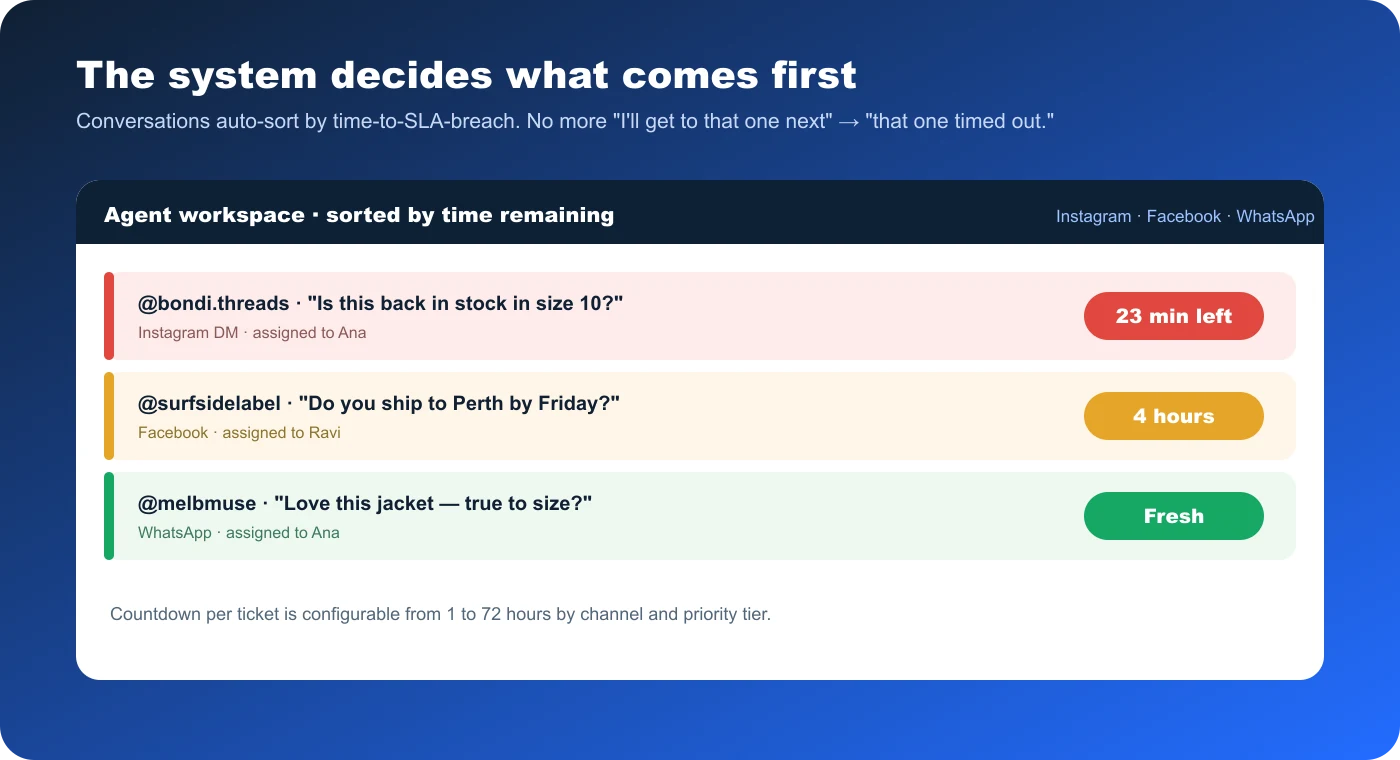
An agent logging in at the start of their shift doesn’t need to make judgment calls about what to handle first. The system surfaces the answer: this conversation has 23 minutes left, this one has 4 hours, this one is fresh. The straightforward queries that agents would naturally gravitate toward don’t disappear — they’re just shown in the right position relative to what actually needs attention first.
This mechanism makes SLA compliance achievable at high volume rather than dependent on agents accurately self-managing their own urgency judgments under pressure. During a sale event or new collection launch when message volume spikes, the countdown system is what keeps the queue from becoming a backlog.
Fix three: SLA timers triggered only by human action, not by automation
This is the fix that addresses the “Already Replied” problem directly.
In HeroDash, the countdown clock starts when a human agent is assigned to a ticket — not when an auto-reply fires. An automated response can still acknowledge the customer immediately. But it doesn’t count toward the human-response SLA. The timer measures what it’s supposed to measure: how long it actually takes a real person to engage with the customer’s question.
The management dashboard reflects this distinction. When a supervisor looks at response-time metrics, they’re seeing genuine agent performance — not automation throughput dressed up as human service. Individual agent response time, volume handled, and satisfaction scores are visible per agent, updated in real time, accessible from the management console without manual data export.
Facebook, WhatsApp, and Instagram conversations are unified in the same dashboard. A brand managing all three channels doesn’t need three separate backends — everything flows into one workspace, with the same SLA management and the same reporting structure across all channels.
What changes when the system works correctly
Australian Gen Z fashion consumers don’t have high demands. They want a reasonably fast reply, an accurate answer, and a tone that feels like a real person rather than a policy document. None of those requirements are difficult to meet — but they can’t be met by a support operation that’s structurally misaligned with when and how this customer base communicates.
The time-zone misalignment means the fastest possible response is still too slow for the purchase-decision window. The absence of SLA structure means agents work hard without the system helping them direct that effort correctly. The auto-reply problem means management can’t see where the real gaps are, so they can’t fix them.
Fix the structure, and the outcomes follow. Faster genuine response times during Australian active hours. No more Friday-to-Monday gaps. Agents who know which conversation needs attention right now rather than making that judgment under pressure. Management dashboards that show real service quality rather than automation metrics.
Cover Australian hours
English-speaking agents scheduled for Australian daytime, evenings, weekends, and public holidays as standard — not a premium add-on.
Rank by time-to-breach
HeroDash countdown timers auto-sort the queue so the most urgent conversation is always first, even when volume spikes.
Measure human response only
The SLA clock starts on human assignment, not on the auto-reply — so metrics reflect real service, and gaps become visible.
The bar for winning social media customer service in the Australian fashion market isn’t high. It’s just specific — and most brands haven’t built the operational infrastructure that meets it.
Three questions worth asking about your current setup
- What is your genuine human response time for Instagram and Facebook DMs sent on Saturday evening in Sydney? If you don’t know, or if the answer is “Monday morning,” that’s where the purchase decisions are being lost.
- Does your current system distinguish between auto-reply response time and human response time in its reporting? If not, your metrics are measuring automation, not service quality — and the gap between those two numbers is invisible to management.
- When message volume spikes during a promotion or launch, what mechanism tells your agents which conversation to handle first? If the answer is agent judgment, some conversations are being missed in a predictable and preventable way.
Australian fashion ecommerce will keep growing. The social media DM channel will keep growing with it. The brands that capture that growth are the ones answering on Saturday evening, prioritising by urgency rather than by what’s easiest, and measuring service quality with numbers that reflect what their agents are actually doing.
The system that makes all of that possible isn’t complicated. It just has to be built for the market it’s serving.
FAQ
Why do Australian fashion shoppers message brands on social media before buying?
Australia has very high ecommerce adoption, and younger fashion shoppers treat Instagram and Facebook like a search engine. 74% of young Australians begin product research on social rather than a search engine, and 42% make the final purchase decision from a brand’s social profile — so for fashion they DM to ask about fit, fabric, shipping, and returns, finding a real human reply more trustworthy than the website.
What is the “Already Replied” problem in social media customer service?
It’s when an automated “thanks for reaching out” reply marks a conversation as replied, so the dashboard shows the SLA met and response rate high — while the customer is still waiting for a real answer and no human has opened the message. The metric measures automation output, not service quality.
How should social media DMs be prioritised during peak volume?
By time-to-SLA-breach, not by what’s easiest. In HeroDash a countdown timer (configurable 1–72 hours) starts when a human agent is assigned, and the workspace auto-sorts conversations so the one closest to breaching appears first — instead of leaving prioritisation to agent judgment under pressure.
Why does time-zone coverage matter for Australian ecommerce support?
Australia’s active hours — daytime, evenings, and weekends — often fall outside offshore teams’ shifts, so a Friday-afternoon message may not get a human reply until Monday. Fashion purchase windows are short, so a 72-hour gap means the decision is made without the brand. Weekend and public-holiday coverage is essential.
Selling fashion or lifestyle products in Australia and managing social media customer service across Instagram, Facebook, and WhatsApp? Explore HeroDash — Callnovo’s social media management platform — or talk to our team about what the right setup looks like for your brand and markets.