

Key Takeaways
- In Turkey, VIP retention is a customer service problem. One VIP’s one-star review dropped a game’s rating from 4.3 to 3.8, took six guild members with it, and zeroed out ₺8,000 in monthly spend.
- The complaint wasn’t about the game. It was a support reply in machine-translated English that ignored a VIP’s actual issue — an uncredited purchase.
- Turkish gaming is intensely community-oriented, so churn travels in clusters and negative reviews raise the cost of the next acquisition cycle.
- The rebuild lifted the rating 3.8 → 4.4 in 30 days — with native game-trained agents, UTC+3 coverage, automatic VIP routing, and AI quality monitoring on every interaction.
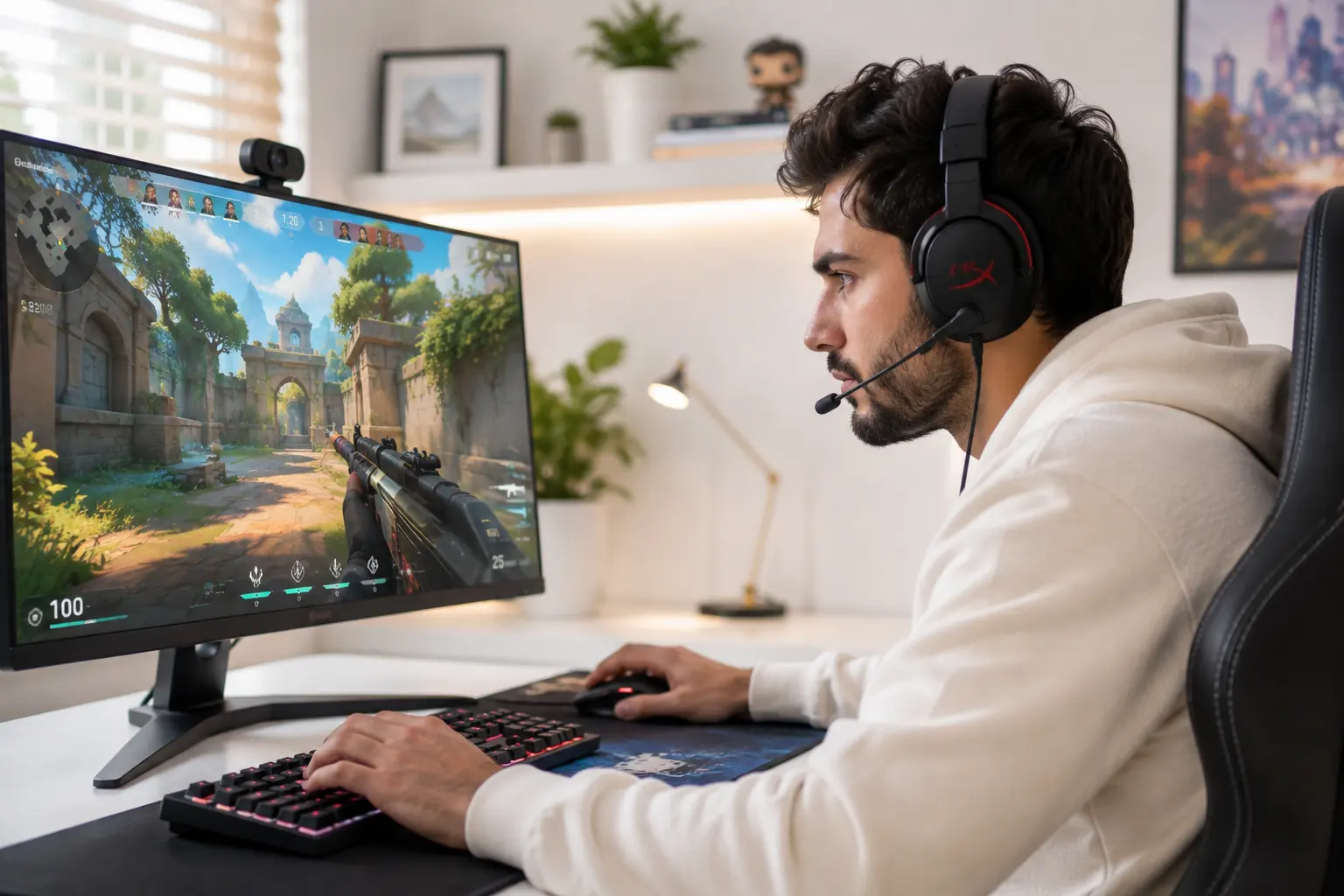
Turkey’s gaming market crossed US$1 billion in 2025 with 50 million active players. The publishers winning long-term aren’t the ones with the biggest acquisition budgets. They’re the ones who figured out that VIP retention is a customer service problem — and built support infrastructure that matches what Turkish players actually expect.
The guild that went silent
An FPS mobile game launched in Turkey. Downloads were growing. Revenue was climbing. Three months in, a high-spending VIP player left a one-star review.
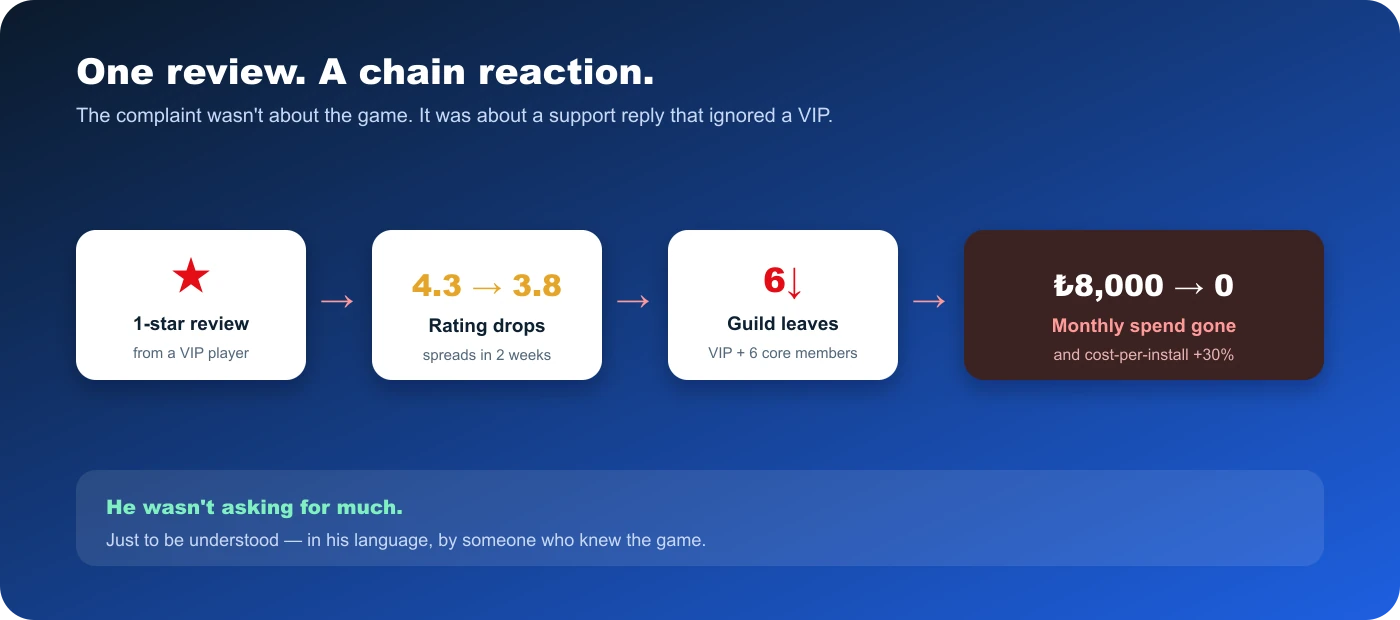
The review spread through the game’s Turkish community over two weeks. The App Store rating dropped from 4.3 to 3.8. The VIP player stopped spending. Six core guild members — all high-paying — left the game together. The guild’s monthly spend of ₺8,000 went to zero.
The platform algorithm registered the rating drop. Cost-per-install rose 30%. The publisher was now paying significantly more to acquire new players to replace the ones who had left — players who had originally cost nothing beyond the product to retain.
The original complaint that started this chain wasn’t about the game. It was about a support interaction that made the VIP player feel ignored. The response had been in English. Machine translated. Generic. The player’s specific issue — an in-game purchase that hadn’t credited correctly — was met with a template response that didn’t address his actual situation.
He wasn’t asking for much. He was asking to be understood, in his language, by someone who knew the game.
Why Turkey punishes bad customer service more than most
Turkey’s gaming market in 2025 reached US$1.01 billion in revenue, growing 24.69% year over year. Mobile contributed US$649 million of that. There are more than 50 million active players — roughly 60% of the national population — with an average annual spend of US$145.30 per player. The 30-49 bracket, the segment with the most disposable income and the most guild-leadership roles, accounts for 44% of spending.
These numbers explain why publishers invest heavily in Turkey. What they don’t show is the social structure that makes VIP churn so damaging here specifically.
Turkish gaming culture is intensely community-oriented. Guilds, alliances, and player communities are highly cohesive social groups. When a high-status VIP player leaves — particularly if they leave publicly, with a negative review that explains why — their departure carries social weight. Guild members follow. The churn isn’t one player. It’s a cluster, with a revenue impact that multiplies the value of the original player by the size of their social network within the game.
Turkish players also have cultural expectations that generic support misses. English proficiency in Turkey is below 35%. A machine-translated English response isn’t just inconvenient — in a culture where respect in communication is a meaningful social signal, it reads as dismissive. During Ramadan and other significant local events, player behavior and service expectations shift in ways a team without local cultural knowledge won’t recognize. A standard template response sent during a religious holiday is not a neutral act in this context.
Four structural problems that accelerate VIP loss
Problem one: a language and culture gap machine translation cannot close. Machine translation handles grammar. It doesn’t handle gaming terminology, cultural register, or the specific vocabulary Turkish SLG and FPS players use to describe a mechanic problem. An agent working from a translated template who answers a question about card-draw probability or alliance rules with phrasing that sounds unnatural in Turkish isn’t just unhelpful — they’re signaling to an experienced player that the person on the other end doesn’t understand the game. And during Ramadan, when activity patterns shift and the threshold for frustration is lower, a team that doesn’t know this is blind in one of the highest-engagement periods of the year.
Problem two: a time-zone mismatch that leaves urgent tickets unaddressed for hours. Turkey operates at UTC+3, with peak activity from 16:00 to midnight local. For teams based in Asia, that’s late evening to early morning — when night-shift coverage is thinnest. An uncredited purchase, a wrongful suspension, or a guild conflict needing moderation is exactly when a VIP contacts support. If the response exceeds two hours, the player’s next move is usually to post about it publicly — and by the time a morning team picks up the ticket, the review is already live.
Problem three: agents who know Turkish but don’t know the game. A Turkish speaker recruited for language ability but never trained on the game’s mechanics cannot handle what high-spending players bring: card-draw odds, equipment-enhancement probability, alliance territory rules, ranking mechanics. “We’ll pass this to technical support” is not an acceptable answer to a player who spent thousands of lira on the mechanic they’re questioning. It confirms the team can’t help them.
Problem four: no VIP priority — everyone in the same queue. A player who spent ₺20,000 and a player who registered yesterday are handled in the same order. The high spender waits, repeats their account information on transfer, and gets a response that doesn’t reflect their history. Their spending produced no differentiation when something went wrong — and the players whose departure hurts most are the ones who feel least valued when they need support.
What the purpose-built Turkish support system looks like
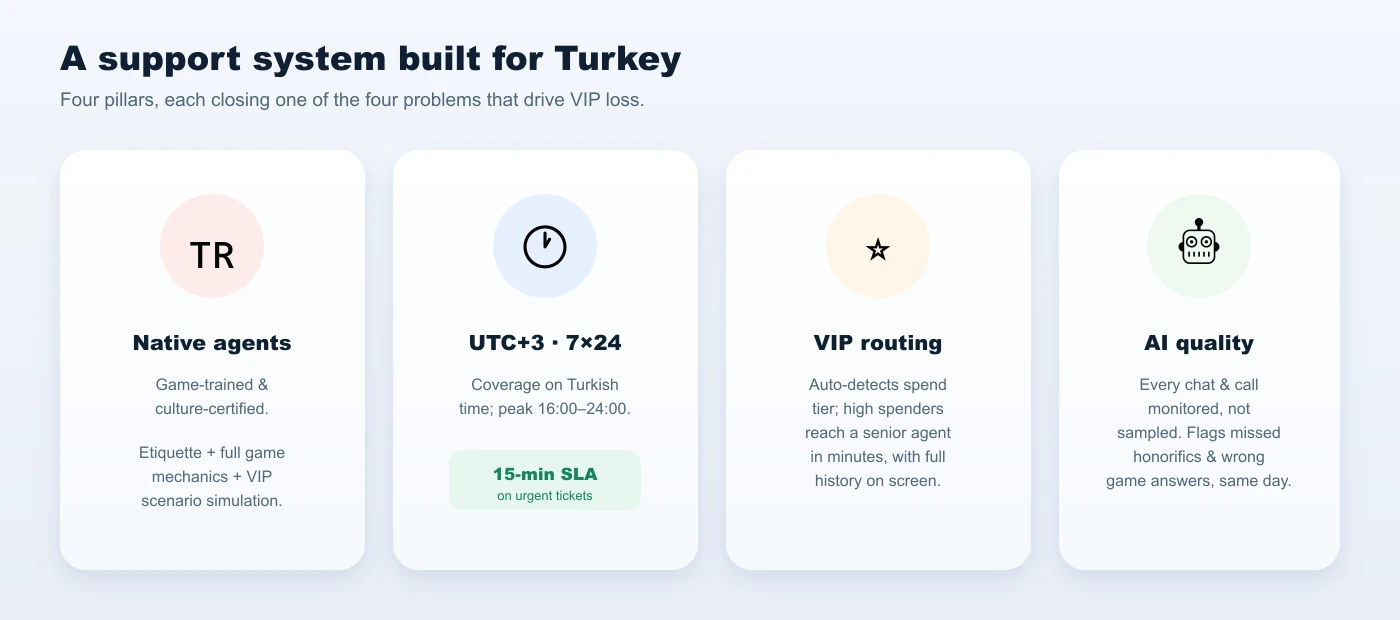
Native Turkish agents, game-trained and culture-certified
Callnovo sources full-time native Turkish-speaking agents for gaming accounts, prioritizing candidates with gaming backgrounds and genuine interest in the categories they’ll support. Before going live, every agent passes three assessment layers.
Local etiquette
Turkish communication norms and honorifics — the register that reads as respectful rather than dismissive.
Full game mechanics
An operational assessment on the specific systems players ask about: card-draw odds, enhancement probability, alliance rules, ranking.
VIP scenario simulation
High-stakes situations — disputed purchases, account actions, competitive disputes — where the quality of the response matters most.
The knowledge base for each account includes local high-frequency question patterns, response templates calibrated for Ramadan and other significant periods, and game-specific terminology that reflects how Turkish players actually talk about the mechanics — not how they’re described in English documentation.
UTC+3 scheduling — 7×24 coverage from a local operation
The team operates on Turkish time. Peak coverage aligns with 16:00–midnight local, the hours when players are active and issues arise. Major events, version launches, and server openings trigger dynamic staffing expansion to absorb the extra volume.
Urgent ticket categories — uncredited purchases, account suspensions, payment failures — carry a 15-minute response SLA. No more two-hour gaps during peak hours; no more morning backlog reviews for tickets that should have been resolved the night before.
Automatic VIP routing — high spenders reach a senior agent immediately
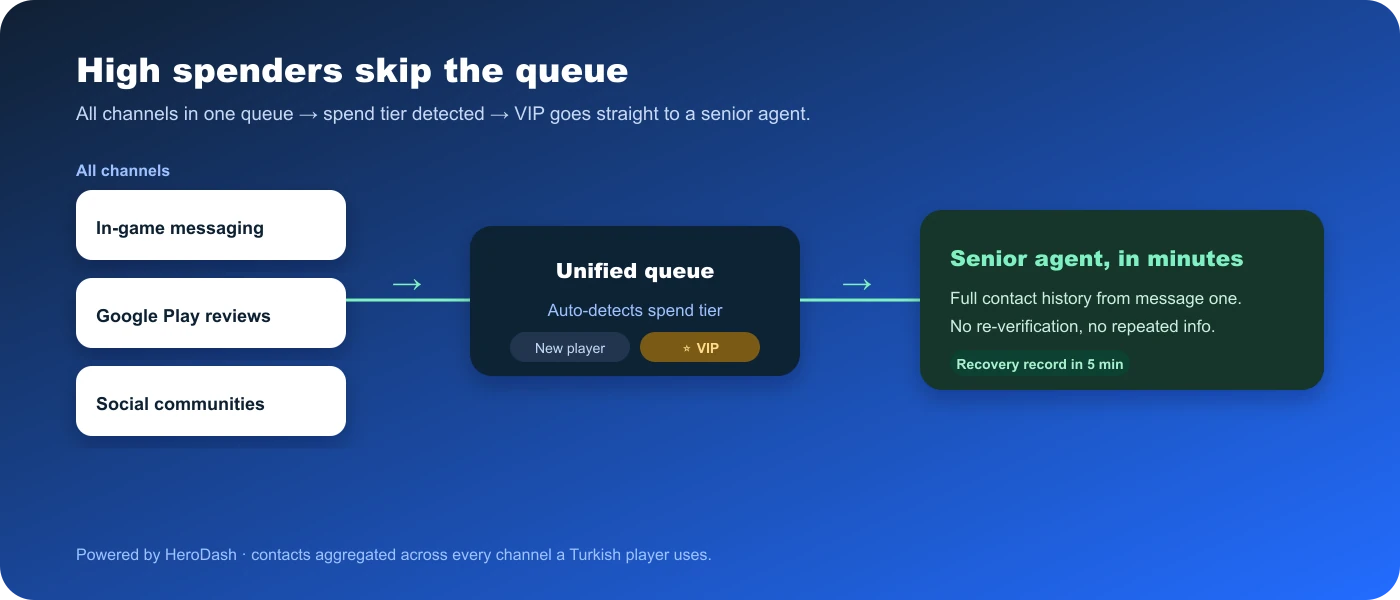
HeroDash’s ticket system connects to in-game messaging, Google Play review channels, and social community platforms, aggregating all player contacts into a unified queue. When a contact arrives, the system automatically identifies the player’s spending tier. VIP tickets are surfaced immediately and assigned to senior agents with the product knowledge and authority to handle complex disputes.
The complete contact history is available from the first message — no re-explanation, no repeated identity verification. A VIP who reaches a senior agent within minutes, one who already knows their game history and can address their specific situation, has a fundamentally different experience than the same player in a standard queue. When a negative review or community complaint is filed, the full interaction record is retrievable within five minutes — the context for recovery is immediately available.
AI quality monitoring across all interactions — not sampling
Every conversation, text and voice, is automatically archived. AI monitoring runs in real time, flagging missed honorifics, factually incorrect game-mechanic answers, and deflective language that signals an agent is avoiding a question they can’t answer. Flagged cases generate same-day alerts to the quality supervisor rather than surfacing in a weekly review after the damage is done. A dedicated customer success manager reviews VIP complaint data weekly, updates the knowledge base with terminology from new versions, and briefs the whole team before major updates for zero-gap coverage on new content.
What 30 days of the rebuilt system produced
For an SLG title that deployed the full Turkish customer service system, the results after one month were specific and measurable: App Store rating up from 3.8 to 4.4, VIP monthly churn down 62%, guild collective complaint volume at zero, average handling time for urgent purchase and account issues compressed to 12 minutes, and a player satisfaction score of 93%. Organic traffic and paid conversion both improved as the rating recovered.
The rating improvement wasn’t produced by asking players for better reviews. It came from resolving the issues that had been generating bad ones — urgent tickets answered in minutes rather than hours, VIP players reaching agents who understood their game and their language, and the social contagion of negative reviews stopping because the underlying complaints were fixed before they reached the App Store.
What game publishers entering Turkey should take from this
User acquisition can produce short-term growth in any market. In Turkey — where the gaming community is cohesive, vocal, and highly networked within guilds and alliances — acquisition without retention is expensive: every lost VIP takes their social network with them, and every public negative review raises the cost of the next acquisition cycle.
The publishers building durable positions in Turkey understood early that the App Store rating is a customer service metric as much as a product metric.
Three questions worth asking about your current Turkey support setup:
- When a VIP contacts support at 10pm Istanbul time about an uncredited purchase, how long before a native Turkish speaker who knows the game mechanics responds? If the answer is measured in hours, the guild is at risk.
- Does your support system distinguish between VIP players and new players in how it routes contacts? If not, your highest-value customers wait in the same queue as your lowest-value ones — and they know it.
- During Ramadan and major Turkish holidays, does your team adjust its approach? If not, your service experience during the highest-engagement periods of the Turkish gaming year has a significant blind spot.
The guild that went silent didn’t leave because the game was bad. They left because a VIP felt dismissed by a support interaction that could have been resolved in five minutes by someone who spoke Turkish and understood the game. The ₺8,000 in monthly revenue didn’t have to go to zero. The rating didn’t have to drop. Both were preventable — with the right support infrastructure in place before the review was posted.
FAQ
Why does VIP player churn hurt more in Turkey than in other gaming markets?
Turkish gaming culture is intensely community-oriented — guilds and alliances are cohesive social groups. When a high-status VIP player leaves publicly with a negative review, guild members follow. The churn isn’t one player; it’s a cluster, with revenue impact that multiplies the player’s value by the size of their in-game social network.
Why isn’t machine-translated support good enough for Turkish players?
English proficiency in Turkey is below 35%, and machine translation handles grammar but not gaming terminology or cultural register. In a culture where respectful communication is a meaningful social signal, a generic translated reply reads as dismissive — and an experienced player can tell immediately that the agent doesn’t understand the game.
How does VIP ticket routing work in HeroDash?
HeroDash aggregates contacts from in-game messaging, Google Play reviews, and social communities into one queue, then automatically identifies each player’s spending tier. VIP tickets are surfaced immediately and assigned to senior agents with full contact history on screen, under a 15-minute SLA for urgent issues like uncredited purchases or account suspensions.
Can better customer service really raise an App Store rating?
Yes. In this case the rating rose from 3.8 to 4.4 in 30 days — not by asking players for better reviews, but by resolving the issues that generated bad ones: urgent tickets answered in minutes, VIP players reaching agents who knew their game and language, and negative-review contagion stopping because the underlying complaints were fixed first.
Publishing mobile games in Turkey and dealing with VIP churn, App Store rating pressure, or coverage gaps during peak hours? Explore Callnovo’s Turkish-language gaming support teams, the HeroDash VIP routing and quality platform, or talk to our team about what purpose-built Turkish player support looks like for your title.
Game title and publisher identity withheld. Market data sourced from 2025 Turkish gaming market reports. Operational metrics reflect results from an active Callnovo partnership.