

本文目前仅提供英文版本。查看英文版 →
If you’re researching “customer service outsourcing Philippines,” you probably already know why the country appeals to buyers. Before you sign, your risk or procurement team needs more specific answers: who takes the calls during a typhoon, which country’s privacy law covers the customer records, and which city your team will work in.
This guide answers those questions, covers languages and price, and says when the Philippines is the wrong answer. We run a site there, in Cabanatuan City, so some of the examples are ours.
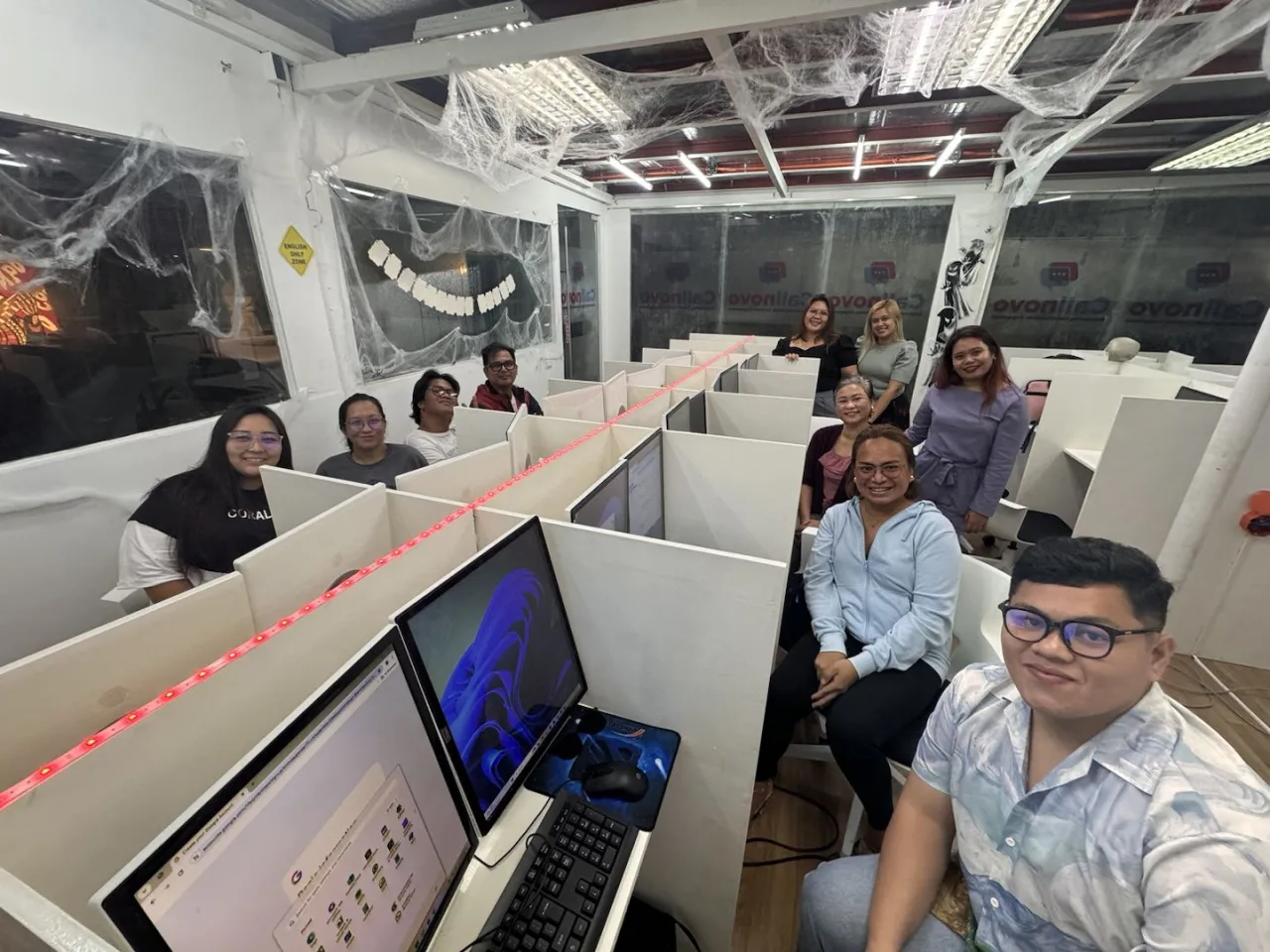
Looking for a job and not a vendor? Callnovo.ai lists its open positions on a separate site.
TL;DR: when the Philippines fits, and when it doesn’t
The Philippines fits English-language support that needs overnight and weekend coverage for North American customers. Any contract there should name a backup site in another country, because an average of 20 tropical cyclones enter the Philippine area each year (PAGASA, 2026).
| Type of work | Fit | The one thing to confirm before you sign |
|---|---|---|
| English phone support for US and Canadian customers | Strong | Which site answers, and which site takes over if it closes |
| Live chat and email | Strong | Whether your team is dedicated to you or shared with other clients |
| SaaS tier-1 technical support | Good when the fix can be written as steps | Who takes escalations, and in which time zone |
| Spanish, German or French queues | Confirm with the vendor | Which site staffs each one, and with how many people |
| Japanese or Korean queues | Confirm with the vendor | The same, plus whether the staff are native speakers |
| Work that touches regulated data | Depends on the contract | Which clauses your home law calls for, written into the agreement |
What customer service outsourcing in the Philippines buys you
For a North American buyer, the Philippines is an offshore location. Agents covering your daytime work a local night shift; a different shift can provide overnight coverage for your customers. You’re paying for English fluency and an established industry with standard ways to hire, train and score quality.
English and cultural fit. English proficiency and cultural familiarity with US consumers are the pitch on every vendor’s page. Don’t take either on trust. Ask for five recorded calls from an account like yours and listen to them.
The clock. Manila is 12 hours ahead of New York in summer and 13 in winter. A 9 a.m. call from Boston lands at 9 or 10 p.m. in Manila, so your business day is their night, and the weekend shift you can’t fill at home is a normal roster there.
Scale. IBPAP, the industry association, lists a “1.9 Million Talent Workforce” for the country’s IT and business process sector, which includes contact centers along with other back-office work (IBPAP, 2026). At that size the jobs around the agent are careers too: trainer, team leader, quality reviewer, workforce planner.
Judge the results through customer satisfaction (CSAT) and first-contact resolution, which tracks whether the customer’s issue was resolved on the first contact. A large headcount alone won’t tell you either. Put the two targets in the contract and state how each will be measured.
Use the next four checks to ask how the vendor will run your account, beyond its general description of the country.
Four things the “why the Philippines” pages leave out
Weather: what happens to your queue when a typhoon hits
PAGASA, the Philippine weather agency, counts an average of 20 tropical cyclones in the Philippine Area of Responsibility each year, with “about 8 or 9 of them crossing the Philippines.” The peak runs “July through October, when nearly 70%” of typhoons develop (PAGASA, 2026). A support contract there should name the backup site, who triggers the reroute, and when it was last used.
If a vendor says, “We have a business continuity plan,” ask how that plan keeps your calls covered when a site closes. Check these three details:
- Where the backup site is. A second building in the same city sits under the same storm. Ask for the country.
- Who triggers the reroute, and on what signal. A named role acting on a weather alert is an answer. “Management will assess” is not.
- When it was last used for real. A date and a call count, not a drill.
Callnovo.ai (human agents working in 65+ languages across 26 delivery countries) has one such date on record, and the direction matters. In September 2025, Super Typhoon Ragasa hit Guangzhou hard enough that the city issued a full suspension order. Our Guangzhou site had 2,000 calls expected that day, and its 60 agents couldn’t come in. Incoming call routing was redirected to our Philippines call center before the morning shift began.
| When | What happened |
|---|---|
| The night before | The project manager received the weather alert and started the plan already written for that account |
| Before the morning shift | Call routing moved from Guangzhou to the Philippine site; HeroDash, our platform, pushed call assignments and agent presence there automatically |
| Before the first call of the day | The client was told |
| Morning peak | Callers waited slightly longer |
| The rest of the day | All SLA targets held |
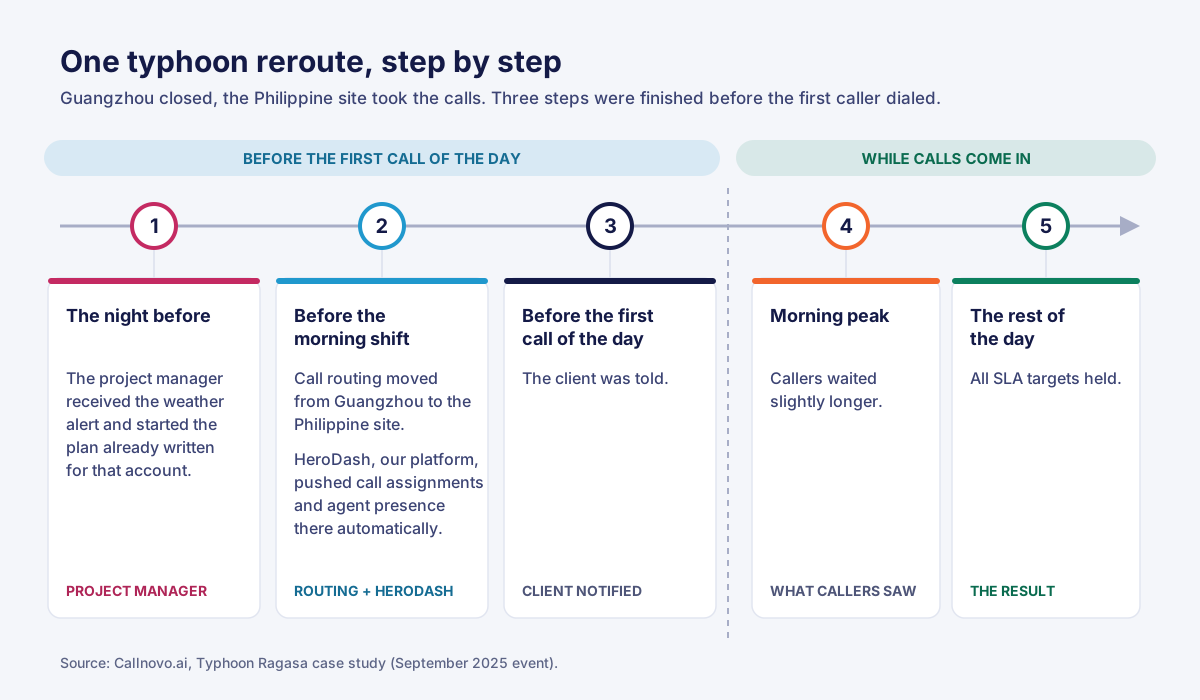
The switch itself took minutes. The full account is in the Typhoon Ragasa reroute.
In that case, Guangzhou moved its calls to the Philippines. If a storm closes the Philippine site, the plan sends calls to our China operations or our Canada call center instead. Each site’s infrastructure includes two internet providers with automatic failover, so the connection can switch if one provider goes down.
Compliance: which country’s privacy law covers your customers’ data
The Philippines has its own privacy statute, Republic Act No. 10173, the Data Privacy Act of 2012. Outsourced customer service in the Philippines means your customers’ records are read and updated there, so start with what the statute says about its own scope.
Section 4 says the Act “applies to the processing of all types of personal information” and to anyone involved in it, including controllers and processors who, “although not found or established in the Philippines, use equipment that are located in the Philippines.” That’s the wide end.
The same section then lists what falls outside the Act. Item (g) reads: “Personal information originally collected from residents of foreign jurisdictions in accordance with the laws of those foreign jurisdictions, including any applicable data privacy laws, which is being processed in the Philippines.”
Whether your records fall under (g) is a question for your counsel. Give them both passages, since (g) points back at your home law with the words “in accordance with the laws of those foreign jurisdictions.” Ask them, too, what your home law requires you to write into the vendor contract.
| Where the customers are | Question for your counsel | What to ask the vendor for |
|---|---|---|
| US patients or health plan members | Does HIPAA treat this vendor as a business associate? | Whether they sign a business associate agreement (BAA) before any record is shared |
| EU residents | Which GDPR transfer mechanism covers processing in the Philippines? | The data-processing agreement and transfer terms your counsel names |
| US retail shoppers | Do state privacy laws such as CCPA reach this work? | Data security terms: who can see what, how long it’s kept, how a breach is reported |
For our part, Callnovo.ai builds its systems to HIPAA requirements and signs BAAs, and our controls are aligned with ISO 27001 and SOC 2 framework practices. The detail is on the page about how we handle compliance.
Location: Metro Manila, Cebu, or a provincial city
“The Philippines” isn’t one location. Teams in Metro Manila, in Cebu, and in a provincial city such as Cabanatuan face different hiring competition, different power and network conditions, and different typhoon exposure. Ask a vendor for the street address of the site that will answer your customers.
| Site type | Hiring | Power and network | Storms |
|---|---|---|---|
| Metro Manila | How many other employers recruit from this building’s commuting radius, and what is attrition on accounts like mine? | Which two carriers serve the floor? | How do staff get in when roads flood? |
| Cebu | How deep is the local talent pool for my schedule and volume? | Do the links leave the island by separate routes? | Is the backup site on a different island, or in a different country? |
| A provincial city | How many Filipino agents with my skill profile can you hire here in 30 days? | What happened the last time the grid or a carrier went down? | When did a storm last close this site, and where did the calls go? |
We don’t rank the three, because the right answer depends on your volume, your hours and where the vendor’s backup sits.
Callnovo.ai’s site is on Maharlika Highway, Cabanatuan City, Nueva Ecija 3100, a provincial city on Luzon. We expanded to the Philippines in 2012, and a hardware-tool brand is among the accounts staffed from that call center. Our other sites are listed on the about page.
Agents stay with Callnovo.ai for 4.2 years on average; the industry figure we benchmark against is 1.1. That’s a company-wide number, not a number for one site. Ask every vendor, us included, for tenure at the site that will serve you.
Languages: what a Philippine team covers and what it doesn’t
English is the main reason buyers hire a Philippine team. If you need other languages, ask the vendor who will cover each queue rather than assuming the same team handles them all.
Say you also need Spanish and French. Ask where the people handling those queues will work. A vendor with sites in several countries can staff each queue where its speakers live and still give you one contract and one report. A vendor with one site either hires those speakers locally or uses translation software. Confirm which setup you’re being quoted.
| Ask this for each queue | Why it matters |
|---|---|
| Which site staffs it? | It tells you the time zone, the backup plan and the law that applies to that queue |
| How many people, today? | One bilingual person is a single point of failure on sick days |
| Are they native speakers? | Decide which contact types need one before you ask, so the answer can be checked against your queue |
We cover the staffing math in multilingual call center services, and Callnovo.ai’s own multilingual support page shows how we set it up.
Match the shift to the hours your customers need
Choose the coverage window before comparing locations. A team in the Philippines can work a daytime or an overnight shift; the location alone does not tell you when agents are available.
For example, when New York is on daylight saving time, 9 a.m.–6 p.m. in Manila corresponds to 9 p.m.–6 a.m. in New York, starting on the previous calendar day. Covering 9 a.m.–5 p.m. in New York instead requires 9 p.m.–5 a.m. in Manila. During New York standard time, those windows shift by one hour.
Write the customer’s time zone, the agents’ shift, weekend coverage and supervisor availability into the proposal. If your internal team must approve refunds or handle escalations during the same hours, include that overlap in the schedule.
Call center outsourcing in the Philippines: what the hourly rate includes
An outsourcing quote from the Philippines covers more than the agent’s wage. It includes the agent, a team leader and quality reviewer, the site and equipment, and the statutory night-shift premium. Ask whether you’re paying for a dedicated or shared agent and what the minimum commitment is, then check the items below.
| Item | Ask the vendor |
|---|---|
| Agent pay and benefits | Is the rate per paid hour or per productive hour? |
| Team leader and QA reviewer | How many agents per team leader, and how many contacts are reviewed? |
| Site, workstation, network | Is this the site at the address you gave me? |
| Night-shift premium | Is it inside the rate for my hours, or a line of its own? |
| Channels and software | Is the quote omnichannel (phone, chat, email), and whose helpdesk license is it? |
| Onboarding | Who pays for training hours before the first live contact? |
| Public holidays | Philippine holidays, mine, or both, and at what rate? |
| Dedicated or shared | Do these people work only my account? |
| Minimum commitment | How many seats, for how many months? |
The night-shift line has a statutory floor. Article 86 of the Labor Code of the Philippines entitles every employee to a night shift differential of “not less than” 10% “of his regular wage for each hour of work performed between ten o’clock in the evening and six o’clock in the morning.”
Do the time-zone math. In summer, 10 p.m. to 6 a.m. in Manila is 10 a.m. to 6 p.m. in New York. Most of a US East Coast business day falls inside the premium window, so a quote “for US hours” should already carry it.
Pay particular attention to the last two rows: how many seats you must buy, for how long, and whether the agents work only for you. Those terms can change the bill more than the hourly rate. We compare vendors by minimum commitment in one guide and explain shared and dedicated agents in another.
Before you count seats, take away the contacts that automation can close, such as order-status lookups and address changes. What’s left is the volume a human team has to carry.
Compare proposals using the same workload
Ask each shortlisted provider to price the same channels, service hours and contact volume. Include onboarding, supervision, quality reviews, software, overtime and holiday coverage. A lower hourly rate is not a lower total cost if those items sit outside the quote.
Separate company-wide resources from the team assigned to your account. Ask which site will handle the work, who manages the shift, how absences are covered and which team handles escalations. For voice support, use an approved sample conversation or a role-play based on your product to assess communication and judgment.
Keep the answers together with the quote. This makes providers comparable without relying on a ranked list or a global headcount that says little about your own team.
Callnovo.ai puts its prices on a public page. Our published pricing lists a dedicated English agent with an hourly rate from US$5.80. Engagements start at half a seat and go to 200+ agents under the Hire Your Team model. That’s a company-wide list price. Ask us which site a quote assumes, the same way you’d ask any outsourcing partner.
When not to outsource to the Philippines
The Philippines is the wrong answer for three kinds of support: queues in a language the vendor can’t show you staff for, programs where sharing a time zone with Latin American customers matters more than cost, and operations that can’t pause for a day when the vendor has only one site.
| Situation | Why it’s a poor fit | What to do instead |
|---|---|---|
| A queue needs native speakers the vendor can’t show you at that site | Outsourced customer service only works when someone can actually take the contact; a promise to hire later leaves you covering the gap | Put that queue with a site where those speakers live, under the same vendor or another |
| Your customers are in Latin America, or same-day callbacks in their hours matter most | An offshore team 12 or more hours away works their day as a night shift, every day | A nearshore site in the Americas |
| You can’t lose a day, and the vendor has one site | A storm that closes the building closes your support | A vendor with a second site in another country, or keep an in-house fallback |
When Callnovo.ai isn’t the right vendor for this
Two cases. If you need the team in Metro Manila or Cebu, for client visits or because your own office is there, our Cabanatuan site is the wrong address. And if your procurement policy requires onshore agents only, no Philippine site fits, ours included.
Start a small team with a defined queue
For a small business, begin with a queue you can describe clearly: the customer questions, the channels, the hours and the actions agents can take. Give the team your approved answers, account-access rules and escalation contacts before live work begins.
Agree on how the first operating period will be reviewed. Track response time, unresolved cases, repeat contacts and quality findings alongside the bill. Review where agents needed help and whether your internal team was available to provide it. Use those results to decide whether to extend hours, add channels or increase staffing.
Compare shared and dedicated agents when choosing the staffing model, and use Hire Your Team to discuss a managed team for your scope.
Checklist: eight questions to settle before you sign
Before you sign a Philippines call center outsourcing contract, get eight answers in writing. Each one maps to a section above.
- Get the street address of the site that will answer your customers. (Location)
- Name the backup site and its country. (Weather)
- Name who triggers a reroute, on what signal, and the date it last happened. (Weather)
- Attach the data-processing terms your counsel asked for, including data security and compliance clauses. (Compliance)
- State dedicated or shared for every seat. (Hourly rate)
- Write down the minimum commitment in seats and months. (Hourly rate)
- Price night and holiday hours as their own lines. (Hourly rate)
- List each language queue with its site, headcount and whether staff are native speakers. (Languages)
Then three questions for yourself:
- If the site closed tomorrow morning, who at the vendor would move your calls, and do you have that person’s name? If you don’t, you have a plan on paper and nobody assigned to run it.
- Can your counsel point to the clause that covers your customers’ records while they’re processed abroad? If not, the contract is relying on the vendor’s good habits.
- Could you find the building on a map today? If the vendor won’t give an address before signing, expect the same answer after.
If you came here searching “customer service outsourcing Philippines,” the short version is this: it suits English support that runs through the North American night and weekend. Check four things before you commit: the backup site, the law that applies to your records, the city, and where each language is staffed. If you’d like those answers from us in writing, request a quote.
References
- PAGASA, Tropical Cyclone Information, first paragraph (retrieved October 13, 2026). https://www.pagasa.dost.gov.ph/climate/tropical-cyclone-information
- Republic Act No. 10173, Data Privacy Act of 2012, Sections 4 and 7. https://lawphil.net/statutes/repacts/ra2012/ra_10173_2012.html
- Presidential Decree No. 442, Labor Code of the Philippines, Article 86, Night shift differential. https://lawphil.net/statutes/presdecs/pd1974/pd_442_1974.html
- IBPAP (IT and Business Process Association of the Philippines), homepage figures (retrieved October 13, 2026). https://www.ibpap.org/
- Callnovo.ai, Typhoon Ragasa Shut Down Our Call Center. Clients Never Noticed., April 20, 2026. https://callnovo.ai/blog/case-study-typhoon-call-center-resilience/
- Callnovo.ai, pricing page (retrieved October 13, 2026). https://callnovo.ai/pricing/