


本文目前仅提供英文版本。查看英文版 →
A phone call about an online order rarely stays a phone call. The customer may need an order-status check, a carrier update, an address correction, a return label, a refund explanation, or a human decision about an exception. If the agent can only take a message, the call has been transferred rather than solved.
Ecommerce call center outsourcing gives an online brand an external team to handle those conversations under its policies, systems, service levels, and brand voice. The useful version is more than an answering service: agents can work through the customer journey from pre-sales questions to post-purchase problems, while automation handles routine lookups and people take over when the cost of getting the answer wrong is high.
This guide explains what an outsourced ecommerce call center should handle, how it should connect to your store and support stack, how to plan for peak season, and which numbers to require before signing a provider.
On this page
- What outsourced ecommerce phone support covers
- What the call center should handle
- How the operation connects to your store
- How to scale for Black Friday and peak season
- How to evaluate an ecommerce phone support provider
- Where Callnovo.ai fits
- FAQ
What Outsourced Ecommerce Phone Support Covers
Ecommerce call center outsourcing is the managed handling of customer calls for an online store, marketplace seller, or direct-to-consumer brand. The outsourced team may handle product questions before checkout, order and delivery questions after checkout, returns and refunds, complaints, and escalations.
The important distinction is between answering and operating.
An answering service records a name, number, and message. A customer service operation can look up an order, confirm an approved policy, update a case, explain the next step, and escalate an exception with the right context attached. The second model is what an ecommerce brand usually needs when phone volume is affecting conversion, repeat purchase, or the workload of an internal team.
| Customer journey stage | Typical call | Useful agent action |
|---|---|---|
| Pre-sales | “Will this product work for me?” | Explain approved product and policy information |
| Checkout | “Can I change the address or payment method?” | Follow the approved change and verification process |
| Order in progress | “Where is my order?” | Check order and delivery status, then explain the next action |
| Delivery exception | “The package is late, damaged, or missing.” | Capture the exception, follow the carrier workflow, and escalate when required |
| Returns | “How do I exchange this item?” | Confirm eligibility, explain the process, and initiate the approved workflow |
| Complaint or VIP issue | “Nobody has fixed this.” | Review the history, own the next step, and route the case by risk |
This is why the dedicated ecommerce customer service outsourcing page and an ecommerce phone support page serve different purposes. The broader page covers the whole customer service model. This page focuses on the voice queue: what callers need, what agents must access, and how quickly the operation can absorb demand.
What the Call Center Should Handle
A good ecommerce call center is organized around the customer’s problem, not the channel. The same order may generate a call, a chat, and an email. The operation should preserve the context instead of asking the customer to start again each time.
Chat is bought differently from voice; the numbers to ask for are in live chat outsourcing.
Pre-sales and product questions
Pre-sales calls are often treated as a cost center, but they happen while purchase intent is active. Agents may need to answer questions about product fit, sizing, availability, delivery cutoffs, promotions, subscriptions, compatibility, or warranty terms.
The rule is simple: agents should use an approved knowledge base and product information, not improvise. If the answer is uncertain, the correct action is to verify or escalate rather than create a future return.
Order changes and order status
Order calls commonly include address changes, item changes, cancellation requests, split shipments, backorders, and “where is my order?” questions. These require more than a script. The agent needs the correct customer record, order status, payment state, and policy boundary.
The provider should define which actions agents can complete and which actions require approval. For example:
- a tracking link may be provided automatically;
- an address change may be permitted only before fulfillment;
- a cancellation may require a payment-state check;
- a replacement may require a damaged-item workflow;
- a refund may need a separate authorization or quality review.
The difference between “we can see the order” and “we can resolve the order problem” should be part of the service definition.
Delivery and WISMO calls
WISMO — “where is my order?” — is one of the most repetitive ecommerce call types. It is also one of the easiest to make worse. A vague answer such as “please wait a few more days” creates another contact when the delivery date passes.
A useful workflow gives the agent:
- the latest order and carrier status;
- the promised delivery window;
- the carrier-exception rule;
- the approved compensation or replacement path;
- the escalation trigger for lost, damaged, or high-value shipments.
A Callnovo logistics client handled around 4,500 customer contacts per day (Callnovo case library, 2026). The figure is recorded as total customer contact volume, not as phone calls alone, so it should not be presented as a pure call-center benchmark. It does show why delivery operations need routing, status visibility, and escalation rules before volume becomes unmanageable.
Returns, refunds, and exchanges
Returns calls are not only administrative. They reveal why customers are dissatisfied and where product, policy, fulfillment, or expectation-setting is failing.
The agent should be able to distinguish between:
- a return that is eligible under policy;
- an exchange that can prevent a lost customer;
- a delivery or fulfillment error;
- a product-quality complaint;
- a refund that is approved but still processing;
- a case that needs a specialist or fraud review.
The Callnovo case library includes an anonymous Japanese bedding brand where the return rate went from 37% to zero after the underlying cause was identified as something other than a product defect. The record does not provide a full process narrative, so it should be used as evidence that return reasons can expose an operational problem — not as a claim that outsourced phone support alone produced the entire result.
Complaints and escalations
A complaint is often a history problem. The customer has already contacted the brand, repeated the story, or received conflicting answers. The agent needs the previous case context and a clear authority boundary.
Route complaints by the cost of getting them wrong:
| Situation | First-line action | Escalate when |
|---|---|---|
| Routine delivery delay | Check status and explain next step | Carrier exception or promise breach |
| Damaged package | Capture evidence and start approved replacement path | High-value item or repeated damage |
| Refund overdue | Verify refund status and expected timing | Payment mismatch or deadline breach |
| Repeat contact | Review prior interactions and take ownership | More than one failed resolution |
| Public complaint or VIP issue | Follow priority workflow | Reputation, legal, safety, or executive risk |
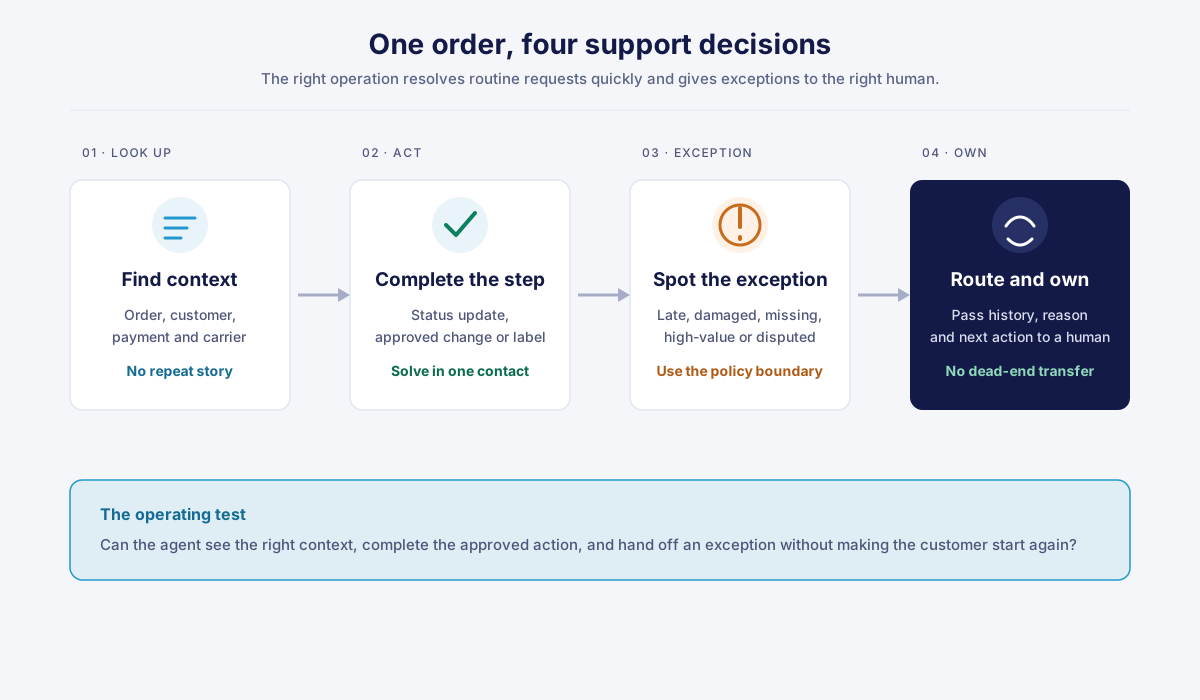
The goal is not to make every call sound identical. It is to make the next action reliable.
How the Operation Connects to Your Store and Support Stack
An outsourced call center cannot deliver useful ecommerce phone support without the right context. At minimum, the operation needs an agreed way to access customer identity, order status, product and policy information, delivery updates, and case history.
The exact integration list must be confirmed during discovery. Do not assume that a provider supports every Shopify, Amazon, CRM, help desk, payment, or carrier workflow simply because it mentions ecommerce on its website.
A practical access map looks like this:
| System or data | What the agent needs | Control to define |
|---|---|---|
| Store or marketplace | Customer, order, item, and fulfillment status | Read/write permission by role |
| CRM or help desk | Contact history, case notes, and escalation status | Required fields and ownership |
| Order management | Cancellation, address, replacement, and refund state | Approval limits |
| Carrier data | Tracking, exceptions, and delivery estimate | Source of truth and refresh time |
| Knowledge base | Product, policy, warranty, and return rules | Version owner and update process |
| Telephony | Local number, IVR, recording, and routing | Consent, retention, and escalation |
| Reporting | Calls, wait time, resolution, repeat contact, and CSAT | Definitions and reporting cadence |
A local number may help customers in a target market reach the team, but number provisioning is only one part of the experience. The caller still needs a clear IVR path, an agent who can see the order, and a handoff that does not erase the conversation history.
The same principle applies to AI. Automation can handle a routine order-status lookup or policy question when the data is reliable. A human agent should take over when the customer is repeating the contact, asking for an exception, disputing a payment, reporting damage, or showing signs that the standard workflow has failed.
That is why an AI-led escalation workflow should be judged by its routing and handoff rules, not only by its automation percentage.
How to Scale for Black Friday and Peak Season
Peak season support is not just a hiring problem. It is a coordination problem across forecasts, training, schedules, knowledge, telephony, order systems, quality assurance, and returns.
A brand that adds agents without preparing those pieces may answer more calls while producing more inconsistent answers.
A practical peak-season timeline
T-30 days: forecast the queue. Estimate contacts by campaign, product, market, language, channel, and reason. Separate order and delivery questions from returns, which may peak after the sales event.
T-14 days: train against the real policies. Freeze the version of the returns, exchange, shipping, and promotion rules that agents will use. Build examples for the products and exceptions most likely to generate calls.
T-7 days: test the systems and routes. Confirm logins, permissions, IVR options, escalation contacts, carrier status, recordings, dashboards, and business-continuity procedures.
T-3 days: run a live rehearsal. Test a normal order, a late delivery, a cancellation, a damaged package, a refund-status question, and a complaint. Record where the agent gets stuck.
During the peak: monitor the queue, not only the average. Watch wait time, abandonment, repeat contacts, transfer rate, first-call resolution, CSAT, and the reasons that are growing fastest.
After the event: plan for the returns wave. The support curve does not end when the promotion ends. Returns, exchanges, refund questions, and delivery complaints may arrive later and require a different skill mix.
Callnovo’s Black Friday 2024 case recorded a 340% increase in contact volume, wait times below two minutes, CSAT of 4.7/5, and a 45-person seasonal team expanded in three days (Callnovo case library, 2024). Those figures describe that case; they are not a blanket guarantee for every ecommerce program. They are useful because they show the dimensions a buyer should ask about: volume increase, customer wait, satisfaction, team size, and ramp time.
How to Evaluate an Ecommerce Phone Support Provider
Ask the provider to put the operating model in writing before comparing hourly rates.
1. What can the agent actually do?
Ask for a workflow table, not a list of channels. For each common contact reason, identify:
- what the agent can see;
- what the agent can change;
- what requires approval;
- what triggers escalation;
- what the customer is told if the issue cannot be completed during the call.
2. Which service levels are measured?
At minimum, define:
- answer rate;
- average and percentile wait time;
- abandonment rate;
- first-call resolution;
- repeat contact rate;
- transfer and escalation rate;
- refund and return accuracy;
- CSAT;
- quality-assurance coverage.
A single average can hide a bad queue. Ask for the distribution and for separate reporting during peak periods.
Callnovo’s published operating commitments include FCR of at least 90%, CSAT of at least 85%, an average resolution time below two hours, and 100% QA coverage within the HeroDash platform scope. Confirm which metric definition applies to your program, which channels are included, and whether a QA add-on is required.
3. How does the pricing unit match the work?
Ecommerce programs may be priced by productive hour, dedicated seat, shared team, minute, interaction, or resolved case. Each unit changes the incentive.
Callnovo’s public pricing page lists phone support at US$1 per minute, Email/Chat/Social/Ticket at US$0.20 per interaction, dedicated agents from US$5.80 per hour, and Pay-Per-Resolution tiers from US$0.79 to US$6.99 depending on case complexity (Callnovo public pricing, 2026). Treat these as public reference points, not a final quote. Ask what counts as a resolution, what happens to unresolved contacts, how transfers are billed, and how volume discounts apply. For a broader managed-team route, compare the hire-a-team service and the BPO outsourcing model before selecting a price unit.
4. What happens when the operation is not a fit?
Outsourcing is not automatically the right answer. Keep a small internal team or choose another provider if you need complete control over every customer conversation, cannot expose the required order data, have highly technical products without stable documentation, or require a service geography the provider cannot support.
A trustworthy partner should be able to say what it will not handle, what needs a specialist, and what must be solved before launch.
Where Callnovo.ai Fits
Callnovo.ai combines AI-assisted workflows with human agents across 65+ languages for customer support operations. For an ecommerce brand, that can mean routing routine order and policy questions through approved automation while human agents handle exceptions, complaints, refunds, and cases where context matters.
The relevant question is not whether the team claims to automate everything. It is whether the operating model makes the handoff visible:
- which contacts are handled automatically;
- which are assigned to human agents;
- which metrics are reported separately;
- which cases count as resolved;
- how repeat contacts and escalations are tracked.
The broader model, supported channels, and customer-service outsourcing options are explained on the ecommerce customer service outsourcing page. For pricing assumptions, use the published pricing page and validate the current unit, minimum, and scope before building a business case.
Final Thoughts
This model works when the phone queue is connected to the rest of the customer journey.
Before you sign, verify three things:
- Agents can complete the actions your customers call about, not only take messages.
- The provider can show how orders, delivery, returns, and escalations connect to its systems.
- Peak-season capacity is backed by training, routing, quality controls, and measurable service levels.
If those three pieces are clear, the conversation can move from “How many agents do we need?” to the more useful question: “Which customer problems should this operation resolve, and how will we prove that it did?”
References
- Callnovo public pricing — https://callnovo.ai/pricing/
- Callnovo case library — Black Friday 2024, logistics client, US fashion startup, European fan brand, Japanese bedding brand
- SkyCom, Peak Season Customer Support Outsourcing
- Upstream BPO, E-Commerce Customer Service Outsourcing
- Customer Direct, E-Commerce Customer Service Outsourcing
- Nexa, E-Commerce Answering Service
- Ringly, The 8 Best Call Center Outsourcing Companies for eCommerce
- Sponsored directory listing: DesignRush verified call center directory
Related reading: Ecommerce customer service outsourcing · Best platforms for AI-led escalation handling · Multilingual call center services