


本文目前仅提供英文版本。查看英文版 →
For twenty years the constraint on quality assurance in a contact center was arithmetic: one analyst could listen to a handful of conversations a day, and everything else went unheard.
That constraint is gone. Call center quality assurance software is tooling that transcribes and scores every conversation against a rubric, and the vendors selling it compete on features, dashboards and integrations. Read six of their pages and you’ll find the same list in a different order.
What you won’t find on any of them is the question that actually decides whether the program works: does the person being scored know what is being scored, and on what basis?
Here’s what changed, what didn’t, and what to ask before you sign.
| If this is your situation | The number that matters | Who owns it |
|---|---|---|
| You have your own agents | Scored conversations per agent per month | Your QA lead |
| Your agents sit at an outsourcer | Whether you can see the scoring rubric, not just the score | Your vendor manager |
| Your conversations are not all in English | Who reviews the non-English ones, and in what language | Your delivery lead |
| You have agents in the EU | What the system infers, not what it is called | Your DPO |
On this page
- What sampling was actually costing you
- What “AI scores every conversation” actually means
- The question none of those six pages answers
- Two buyers this category forgets
- Three questions before you sign
- FAQ
What sampling was actually costing you
The industry standard for manual review is four scored calls per agent per month, and 41% of contact centers do not reach even that, according to reader research published by Call Centre Helper. Against an agent handling several hundred conversations a month, that is a rounding error. Run the number on your own floor before reading further: divide four by your monthly conversations per agent. That fraction is your current coverage.
The problem with a sample that small isn’t that it’s small. It’s that it fails in two directions at once: an agent gets coached on one unrepresentative conversation, while a missed verification step repeated across dozens of conversations is never seen at all. A random draw of four won’t reliably catch a behavior that shows up in one call in twenty.
A contact center manager posting to r/CustomerService in September 2026 called it coaching that runs “on luck.” The post named the second failure precisely: a skipped verification step or wrong information “could span dozens of calls with no one noticing.”
This is why the best tools for identifying support quality gaps are the ones that change what you can see, not the ones that speed up what you already do. Faster scoring of a 4-call sample produces the same blind spot, sooner — prettier dashboards, the same missing insights.
There’s a standards answer here too, older than the current wave of automation: COPC’s CX Standard for Contact Centers 7.0 requires the selection methodology to be unbiased. In a survey of more than 900 executives (COPC, 2022), 63% said they select transactions randomly. That satisfies the standard and still leaves you looking at four conversations.
What “AI scores every conversation” actually means
Full coverage is now ordinary: 79% of executives said their organizations already use speech analytics for quality assurance, while 20% still run the program on spreadsheets (COPC, 2022). The technology question is settled. The procurement question isn’t.
Three things separate an automated QA score that survives an appeal from one that doesn’t.
The scoring input has to be nameable
A score is only defensible if you can say what produced it. Callnovo’s omnichannel QA runs against four declared inputs — a knowledge base, business rules, prompts, and a deduction rubric — applied across calls, messages and tickets. The price is published: US$30 per agent per month. Whether or not that is the right tool for you, the useful part is that the inputs are named: an agent who disputes a score can be shown the rule that produced it.
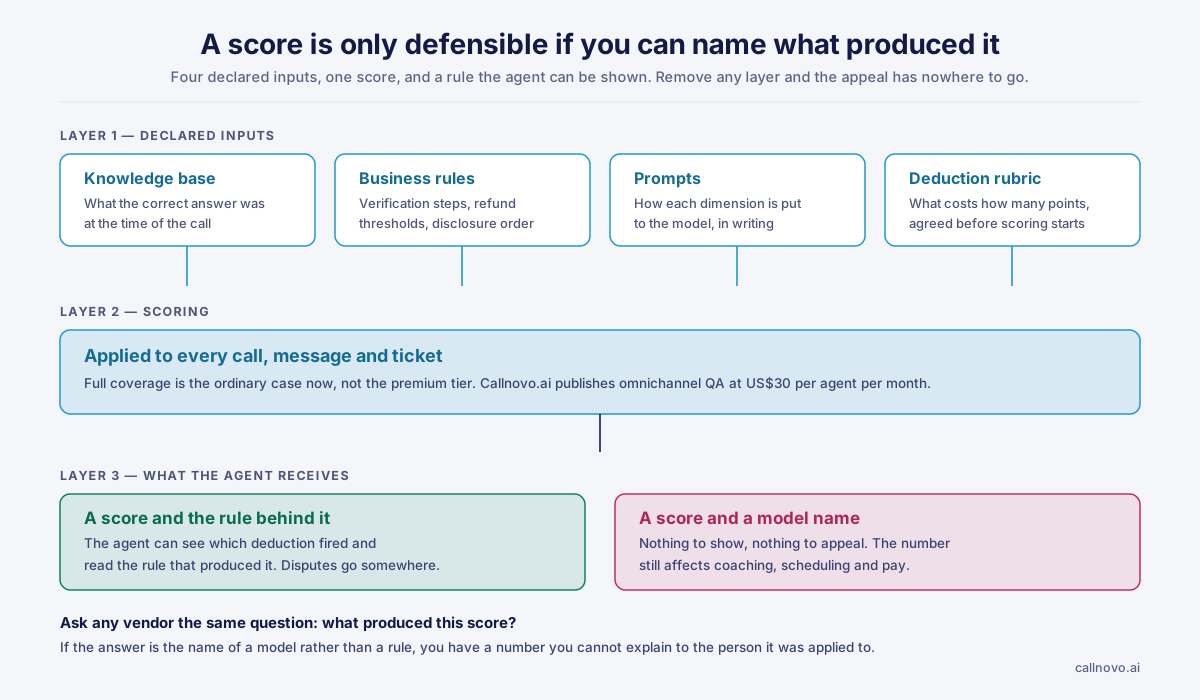
Ask any vendor the same question. If the answer is a model name, you have a number you cannot explain to the person it was applied to.
The scorecard has to be yours
Teams shopping for top-rated QA tools with customizable scorecards are usually not asking for cosmetic flexibility. They’re asking whether the rubric can encode the two or three things their business actually fails at — a compliance disclosure, a refund threshold, a handoff that has to happen before a certain point in the conversation.
Real-time flagging is worth paying for only once that rubric exists; before then it surfaces the wrong moments faster. A generic scorecard scores generic behavior. It’ll tell you that agents are polite. Our guide to customer service quality assurance covers how to write that scorecard and how to check the scores it produces.
The migration off spreadsheets is a data problem, not a software problem
For teams looking for the best software to replace manual QA scorecards in contact centers, the hard part is rarely the new platform. It’s that the old scores live in a spreadsheet with categories nobody can define any more.
Decide before you migrate which categories map forward and which are being retired. Automation applied to an undefined rubric produces a faster undefined rubric.
The question none of those six pages answers
Every vendor here sells the same capability: listen to everything, flag what matters. Search the leading pages for the word consent and you won’t find it. Not in one of them.
That absence is worth sitting with, because the people being recorded have noticed. The same practitioner thread ended on a different question: does scoring everything improve coaching, “or does it just make agents feel watched all day?”
There is also law, and it’s more specific than most buyers realize. Under the EU AI Act, the line is not what the feature is called — it is what the system infers.
- Article 5(1)(f) prohibits the use of AI systems “to infer emotions of a natural person in the areas of workplace and education institutions,” with exceptions only for medical or safety reasons. This has applied since 2 February 2025.
- Article 50(3) requires deployers of an emotion recognition system to inform the people exposed to it that the system is operating, and to process personal data in accordance with GDPR (Regulation (EU) 2016/679). This applies from 2 August 2026.
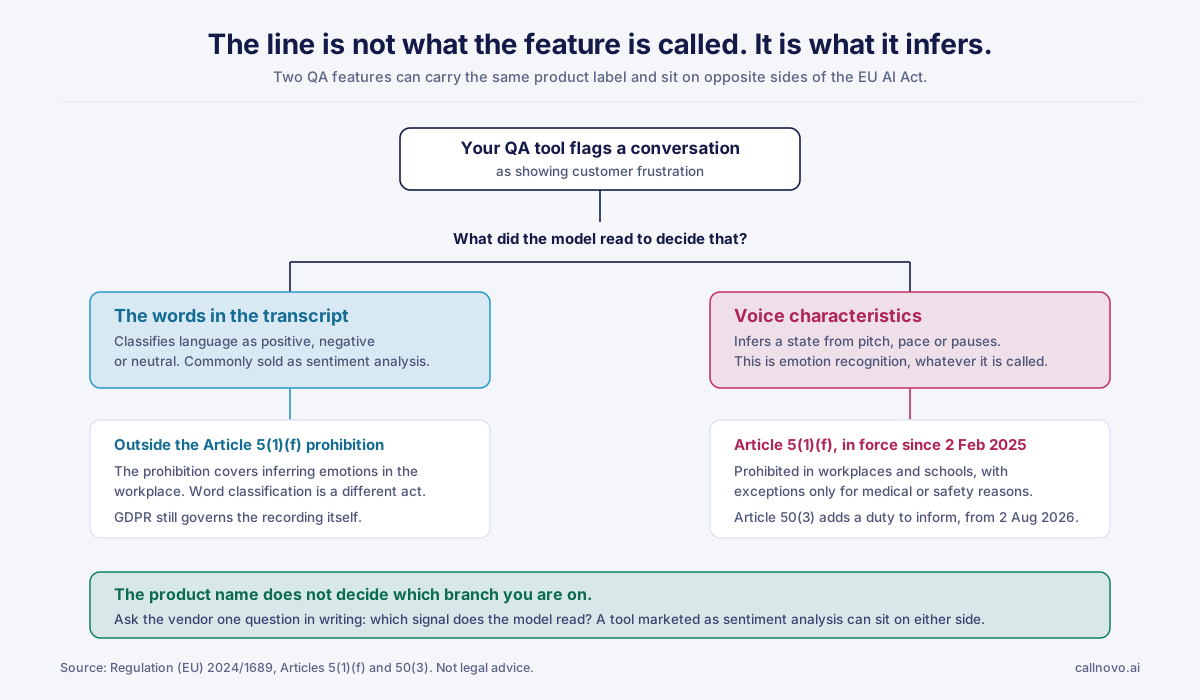
The practical consequence for anyone evaluating quality monitoring software for call centers with EU agents: a feature marketed as “sentiment analysis” that classifies the words in a transcript is treated differently from one that infers a state from voice characteristics such as pitch, pace or pauses. The vendor’s product name doesn’t settle which one you’re buying. Five questions do:
- What does the system actually infer?
- Is the inference drawn from language, or from physiological signals?
- Which decisions does the output affect — coaching, pay, scheduling, termination?
- Is there notice to the person, and human review of the outcome?
- Can you show the program improved the customer experience, rather than only the cost of measuring it?
These are compliance questions and trust questions at once. A program that can’t answer them is exposed on both sides.
Two buyers this category forgets
The category’s marketing reconstructs its intended buyer: a contact center leader with in-house agents, a CRM, and a supervisor team that needs better scorecards. Two other buyers show up in the search data and almost nowhere in the copy.
The one whose conversations are not in English. Six leading pages in this category mention Spanish zero times. A platform can transcribe a Spanish conversation and return a score. What it can’t tell you is whether the agent’s Spanish was any good — whether the register was right for a complaint, whether the idiom landed, whether the customer was left more confident or less. That judgment requires a reviewer who works in the language. Callnovo.ai runs quality assurance across 65+ languages with human agents, against a workforce of 2,500+ agents whose average tenure is 4.2 years — the review sits with people who have been doing the work in that language long enough to hear the difference.
The one whose agents work for somebody else. If your support is outsourced, you’re not scoring employees. You’re verifying a supplier. The evaluation shifts: what you need from customer support quality assurance tools is not a better coaching workflow but an auditable rubric you can hold a contract against.
This is also where being honest about fit matters. A dedicated QA platform will beat us on integration breadth and reporting depth — that’s what those companies build. If you have your own agents, your own CRM, and a supervisor team already running the program, buy the platform. The comparison tips the other way only when the reviewing itself is the hard part: multiple languages, or agents you don’t employ.
So when you compare the best tools for QA scoring in customer support, sort the shortlist by which problem is actually yours. Tooling and reviewing are different purchases, and this category sells them as one.
Building the shortlist without a research budget
Buyers ask where to find QA platforms for support teams. The honest answer is that review sites hand you the same twelve names in a different order, ranked by market share and review volume. That tells you who sells well, not who fits.
A shorter route: write down the three failures your rubric must catch, then ask each vendor to score two real conversations against them during the demo. Most decline — which is itself information.
Teams searching for affordable QA software for call centers usually run a small floor where a per-seat license plus an analyst’s salary is the whole quality budget. At that size the arithmetic often points toward buying the review as part of delivery rather than as a separate tool. Our published pricing carries no separate analyst headcount. Where conversations span languages, multilingual customer service and the review sit on one team. For tooling without delivery, HeroDash is where the scorecards live.
Three questions before you sign
The habit worth building is the one this category makes easy to skip: treat a vendor’s improvement claim the way you’d treat an agent’s self-assessment. This applies as much to written channels as to voice. The best tools for auditing support ticket quality are held to exactly the same standard as the call-scoring ones. A ticket is easier to audit than a call: the text is already there, and nobody has to be recorded to review it.
In September 2026, CX Today declined to accept a vendor’s published claim that its testing cycles ran 60% faster, on the grounds that no baseline, sample or calculation method was disclosed. That’s the right standard, and it applies to every number in this category — including the ones here. The coverage arithmetic above is a formula you run on your own volume, not an industry average.
Before you sign, get three things in writing:
- The baseline. Improvement relative to what, measured when, on whose floor?
- The sample. How many conversations, selected how, over what period?
- The calculation. What counts as a defect, who adjudicates a disputed score, and what happens to the disputed one?
And two more that belong to your own program rather than the vendor’s:
- The rubric is written down and an agent can be shown the rule behind any score.
- The notice exists — the people being scored know the system is running and what it looks at, and they get the feedback, not just their supervisor.
Coverage no longer separates a good quality management program from a bad one. Every serious product here can score everything. What separates them now is whether the scoring can be explained to the person it lands on — and that’s never been a feature you can buy.
References
- COPC Inc., Global Benchmarking Series 2022 — Contact Center Quality Assurance, published May 2022. Survey fielded 1 September to 18 December 2021 with more than 900 executives in customer experience roles across geographies. https://cx.copc.com/hubfs/Global%20Benchmarking%20Series%202022_Contact%20Center%20Quality%20Assurance.pdf
- Call Centre Helper, What Are the Industry Standards for Call Centre Metrics? — reader research on quality monitoring volumes (year not disclosed). https://www.callcentrehelper.com/industry-standards-metrics-125584.htm
- Regulation (EU) 2024/1689 (EU AI Act), Article 5(1)(f), applicable from 2 February 2025. https://artificialintelligenceact.eu/article/5/
- Regulation (EU) 2024/1689 (EU AI Act), Article 50(3), applicable from 2 August 2026. https://artificialintelligenceact.eu/article/50/
- Regulation (EU) 2016/679 (GDPR). https://eur-lex.europa.eu/eli/reg/2016/679/oj
- CX Today, coverage of LivePerson Conversational Cloud, 10 September 2026.
- Callnovo public pricing and operating metrics, 2026. https://callnovo.ai/pricing/