


本文目前仅提供英文版本。查看英文版 →
Customer support becomes difficult to outsource when the work has never been defined. A provider may answer every channel and still leave your team with the hard part: unclear permissions, repeated contacts, unresolved exceptions, and customers who have to explain the same problem twice.
Customer service outsourcing is the assignment of defined customer-facing workflows to an external provider while the brand retains control of its policies, customer data, and escalation decisions. The right model can add multilingual coverage, extend service hours, and absorb demand without forcing every issue into a permanent internal headcount plan.
This guide explains what to outsource, how to combine AI with human agents, how outsourcing cost is usually calculated, and which questions to ask before selecting a provider. It is written for operations leaders who need a working model, not just a list of providers.
What Does Outsourced Customer Support Mean?
This model means assigning selected support activities—such as voice, email, chat, social messaging, ticket triage, or basic technical support—to an external team that works under the brand’s processes and service levels. The brand still owns the customer promise, policy decisions, data governance, and escalation rules.
The scope can be narrow or broad. A company might outsource an after-hours queue, one language, Tier 1 support, returns processing, or its entire customer service operation. That makes this model different from simply hiring a call center: the purchased unit is a managed workflow, not only access to agents.
| Model | What the external team owns | What the brand keeps |
|---|---|---|
| In-house | All customer-facing work | Policy, people, tools, and quality |
| Outsourced | Defined channels, tasks, hours, or languages | Brand decisions, access rules, and escalation authority |
| Co-sourced | A shared queue or selected customer segment | Internal specialists and high-risk cases |
| AI-assisted | Routine answers, classification, summaries, and routing | Exceptions, policy changes, and complex decisions |
The model should be written down before onboarding begins. If “handle customer service” is the only scope statement, disagreements will appear later as missed SLAs, unapproved refunds, or calls that were answered but not resolved.
When Should a Business Outsource Customer Service?
A business should consider outsourcing customer service when its support demand, coverage needs, or operational complexity have outgrown the internal team’s current model. Volume alone is not the deciding factor. The more useful question is whether an external team can perform a defined set of tasks with better coverage and equal or better control.
Common triggers include:
- support volume rising faster than the company can recruit and train;
- a need for night, weekend, holiday, or multi-time-zone coverage;
- expansion into markets that require additional languages;
- a product launch, seasonal campaign, or funding event that changes demand quickly;
- internal specialists spending too much time on repetitive Tier 1 work;
- a need to separate frontline support from product, engineering, or account teams;
- an existing vendor or internal queue failing its response-time or quality targets.
Before choosing a provider, confirm that five internal conditions exist:
- The company has an owner for the customer service program.
- Policies for refunds, replacements, access, and escalation are documented.
- The data and tools agents need have been identified.
- The company can define what “resolved” means for each major workflow.
- Someone inside the business can review quality and update the knowledge base.
If these conditions do not exist, outsourcing may move the confusion to another team without solving it. In that case, the first project should be service design: document the top contact reasons, decision rules, permissions, and escalation paths before adding coverage.
Outsourcing Services: What Can Be Included?
Customer support outsourcing services work best when the scope is organized around work types and customer outcomes, rather than a vague promise to “cover all channels.” Customer care outsourcing can include frontline questions, transactions, technical triage, and back-office follow-up. The provider should state which actions agents can complete and which ones require approval.
| Work type | Possible outsourced work | Internal control to retain |
|---|---|---|
| Tier 1 support | FAQs, account questions, order status, appointment changes, ticket classification | Knowledge-base ownership and policy version |
| Transaction support | Order changes, returns, refunds, account updates, replacement requests | Approval limits, fraud checks, and exceptions |
| Technical support | Basic troubleshooting, information gathering, known-issue guidance | Product roadmap, security, and major incident decisions |
| Voice and digital support | Phone, email, chat, social messaging, and ticket queues | Brand voice, privacy, and escalation rules |
| Back-office support | Case updates, data validation, follow-up, and reporting | Data retention, auditability, and role access |
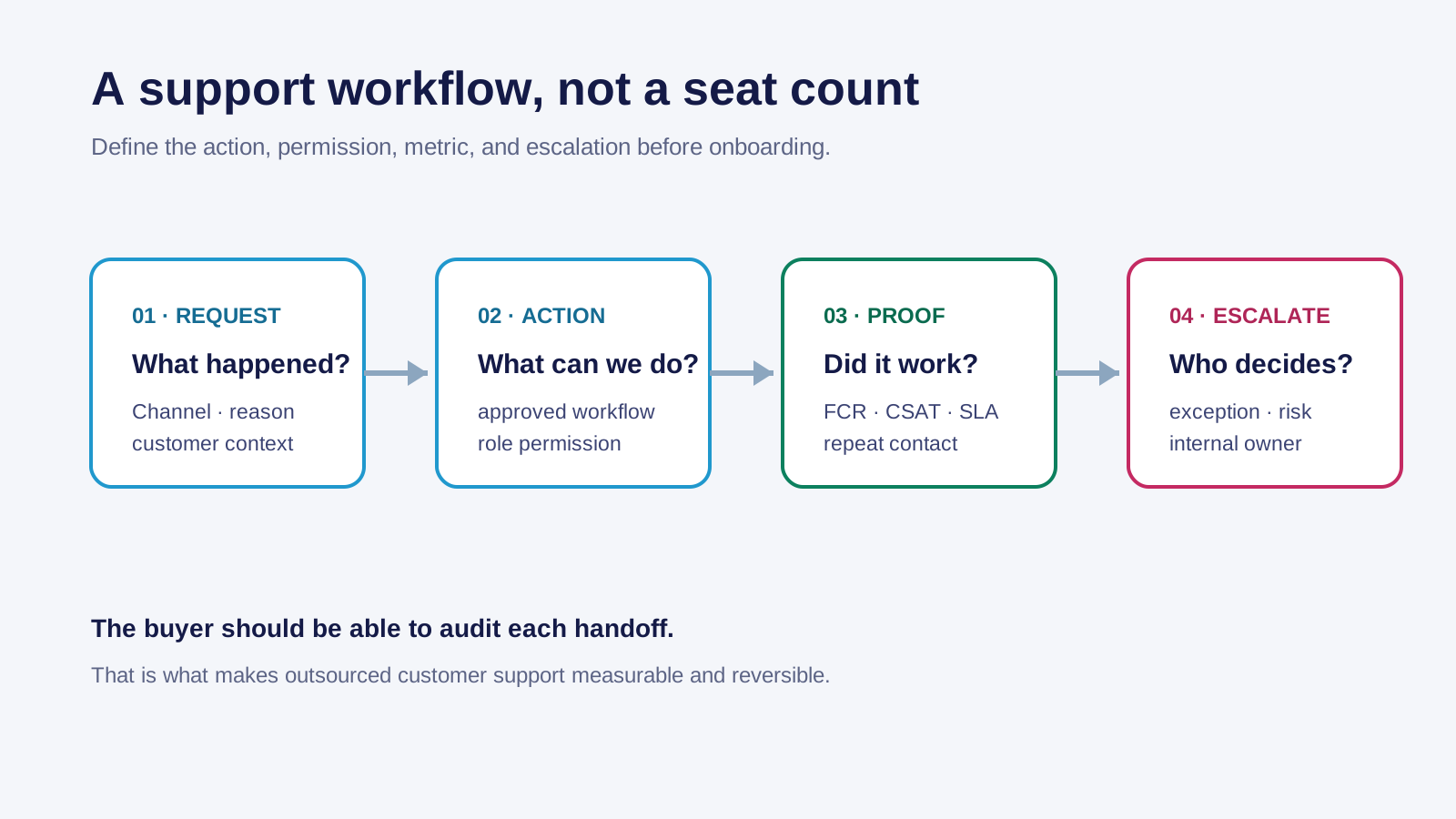
The key distinction is message taking versus action completion. A team that records a request and forwards it may reduce the visible queue, but it has not necessarily reduced the customer’s effort. A useful statement of work should identify the approved action, the information required, the permission level, and the trigger for escalation.
For example, “handle refund requests” is incomplete. The operating definition should say whether an agent can verify eligibility, approve a refund, submit it, explain the processing time, and close the case—or whether the agent can only collect the request for an internal specialist.
How Outsourced Agents Should Work With Your Systems
An outsourced customer service team needs enough context to make a correct decision without receiving unlimited access to every system. The access design should map each workflow to the data, action, permission, and escalation rule it requires.
| System or data | Agent needs | Control to define |
|---|---|---|
| CRM or help desk | Customer history, case notes, ownership, and status | Required fields and case ownership |
| Store or account system | Customer, account, order, and entitlement details | Read/write access by role |
| Knowledge base | Current product, policy, and troubleshooting guidance | Version owner and update process |
| Order or billing system | Status, payment state, refund, and replacement information | Approval limits and audit log |
| Identity data | Enough information to verify the customer | Authentication steps and masking |
| Quality system | Interactions, evaluations, coaching notes, and trends | Retention period and reviewer access |
| Reporting layer | Volume, response, resolution, escalation, and CSAT data | Metric definitions and cadence |
The provider should not claim support for a specific Shopify, Amazon, Zendesk, CRM, or payment workflow without confirming the exact implementation. “We work with ecommerce tools” is not the same as “agents can complete an address change in your store.” The discovery process should test the highest-risk actions before launch. For a staffed model, compare the hire-a-team service with a resolution-based model before choosing the implementation path.
Data protection must be part of the operating design, not a late-stage contract paragraph. The UK Information Commissioner’s Office describes access control as a way to ensure that people can access only the information they need for their role (ICO, 2026). In practice, that means using role-based access, limiting sensitive fields, recording material actions, and removing access when a role changes.
How to Combine AI, Outsourced Agents, and In-House Teams
AI and outsourced human support solve different parts of the service operation. AI is useful when the request is repetitive, the approved answer is stable, and the risk of an incorrect action is low. Human agents are needed when the customer’s context is complex, the workflow crosses systems, or the decision requires judgment.
| Layer | Good fit | Escalate when |
|---|---|---|
| AI | Classification, routing, summaries, approved FAQs, simple status checks | The answer is uncertain, the policy is exceptional, or the customer requests a person |
| Outsourced human team | Multi-step support, multilingual service, troubleshooting, complaints, and routine transactions | The case requires policy ownership, product expertise, legal review, or executive judgment |
| Internal specialists | Policy exceptions, product safety, major incidents, VIP decisions, and systemic fixes | Return the documented learning to the frontline workflow |
A clean handoff should carry the customer identity, conversation history, data already checked, actions already attempted, and reason for escalation. Without that context, automation has only moved the repetition from one queue to another.
The same boundary matters for pricing. A usage-based AI model may charge when the AI performs substantive work before a handoff, while an outcome-based model may require a verified result before charging for that result. The contract should state which model applies and how reopened or failed outcomes are handled. See the pay-per-resolution model for the distinction between usage and verified outcomes.
What Does Outsourcing Cost?
The cost of outsourced customer service depends on the unit being purchased. Comparing a per-minute phone rate with a staffed-hour rate or a verified-resolution rate without normalizing the work will produce a misleading answer.
| Pricing model | Usually fits | Question to ask |
|---|---|---|
| Per minute | Voice support and phone queues | Does the rate include waiting, transfer, recording, and carrier costs? |
| Per interaction | Email, chat, social, and ticket support | What counts as one interaction, and are follow-ups included? |
| Productive hour | Dedicated or shared human teams | What productive time, supervision, and coverage are included? |
| Monthly team | Stable capacity and managed operations | What happens when demand is below or above the planned capacity? |
| Verified resolution | Large programs with measurable outcomes | What is the verification rule, and how are reopenings handled? |
Callnovo’s public pricing page lists Phone Support at US$1 per minute, Email/Chat/Social/Ticket support at US$0.20 per interaction, Hire a Team at US$5–US$12 per productive hour, dedicated support from US$5.80 per hour, and Full CX from US$990 per month (Callnovo public pricing page, 2026). Pay-per-resolution packages list US$0.79–US$6.99 by complexity, with the final definition of a resolution tied to the workflow and verification rule. Pricing should be confirmed against the current pricing page when requesting a quote.
The cheapest unit is not automatically the lowest-cost model. A low hourly rate can become expensive if agents lack context and generate repeat contacts. A low per-resolution rate can be difficult to forecast if “resolved” is not defined. Ask for a sample calculation using your actual monthly volume, channel mix, language requirements, coverage window, escalation rate, and expected quality level.
How to Measure an Outsourced Customer Service Program
An outsourced support program needs a balanced scorecard. No single metric can show whether the operation is working.
| Measurement group | Useful metrics | What it reveals |
|---|---|---|
| Customer experience | CSAT, first-contact resolution, repeat contact rate | Whether the customer had to work twice |
| Operational performance | First response time, wait time, abandonment, average resolution time | Whether demand and capacity are aligned |
| Business outcome | Retention signals, refund accuracy, escalation reason, conversion assistance | Whether support is protecting the wider operation |
| Governance | QA score, SLA attainment, knowledge-base freshness, access violations | Whether the program is controlled and repeatable |
First-contact resolution (FCR) should have a defined observation window. A ticket closed quickly is not necessarily resolved if the customer reopens it the next day. Average handling time also needs context: reducing it by ending conversations early may increase repeat contacts and complaints.
Set a review rhythm before launch. Daily monitoring can catch queue or outage problems. Weekly reviews can identify coaching and knowledge gaps. Monthly reviews should examine contact reasons, policy friction, repeat contacts, and whether the outsourced team is exposing a product or process problem that the internal team needs to fix.
How to Choose a Provider
When comparing providers, score the operating model rather than the sales presentation. A useful provider should be able to explain the workflow in enough detail for your operations team to test it. Review multilingual support coverage separately from language count: the buyer needs to know how customers reach the team and how quality is reviewed.
Ask these questions before signing:
- Which languages, channels, hours, and customer segments can the team cover?
- Which actions can agents complete, and which actions require approval?
- Who owns the knowledge base and policy updates?
- How are customer identity, sensitive fields, and role access handled?
- How does an AI or frontline agent transfer context to a specialist?
- How are voice, chat, email, and ticket interactions quality-checked?
- What happens when demand rises suddenly or a major incident occurs?
- How are FCR, CSAT, SLA, QA, and repeat contact defined?
- What is included in the price, and what creates an additional charge?
- How are data, knowledge, reports, and open cases returned when the relationship ends?
The last question is often skipped. A good outsourced support program should be useful without making the brand permanently dependent on one provider’s undocumented processes.
When Is Outsourcing Not a Fit?
Outsourcing is not the right first move when the company has no stable policy, no internal owner, no usable knowledge base, or no agreement about what agents are allowed to do. It is also a poor fit when the business needs every customer interaction to be handled by a product specialist whose knowledge changes daily and cannot yet be documented.
In those cases, start with a limited pilot. Choose one queue, one language, one customer segment, or one after-hours window. Define the actions and escalation rules, measure repeat contacts and quality, then expand only when the model is working. This creates a reversible decision instead of a large commitment based on a forecast.
Where Callnovo.ai Fits
Callnovo.ai combines AI assistance with human customer support across phone, chat, email, social, and ticket workflows. Callnovo.ai provides human support in 65+ languages and reaches customers across 150+ countries; the country figure describes business coverage, not the number of operating centers. HeroDash provides a shared workbench and AI assistance layer for routing, context, and agent support (Callnovo company facts, 2026).
The relevant question is not whether a provider can list many channels. It is whether the proposed workflow defines the agent’s actions, permissions, escalation conditions, quality measures, and pricing unit. Use the published Callnovo pricing to establish a starting model, then confirm the current scope, languages, coverage, and implementation requirements during discovery.
Final Thoughts
Customer service outsourcing works when the scope is specific enough to manage and broad enough to improve coverage. Before selecting a provider, verify five things:
- the external team’s approved actions;
- the data and system permissions behind those actions;
- the AI, human, and internal escalation boundaries;
- the scorecard that defines quality and resolution;
- the pricing unit and exit plan.
If those five items are clear, outsourcing becomes an operating model that can be tested and improved—not a permanent transfer of responsibility. If they are unclear, document the workflow first.
For a program that needs multilingual human support, AI-assisted operations, or a mixed coverage model, review Callnovo’s published pricing and use the discovery process to validate the exact workflow before launch.
References
- Shopify. “6 Outsourcing Companies.” 2026.
- Zendesk. “Outsourcing: Pros and Cons.” 2026.
- ShyftOff. “What Is This Support Model?” 2026.
- Information Commissioner’s Office. “Access control.” 2026. https://ico.org.uk/
Author note: Neil Fernandez is an Operations Manager writing about multilingual customer support, outsourced service delivery, and the controls that make human and AI support workable at scale.