Key Takeaways
- The problem was never LINE. It was what happened after the message arrived — the copy, tab-switch, download, re-upload, and log that every LINE contact required.
- In Japan, Thailand, and Taiwan, LINE is the default channel — up to 94.5% population reach. Missing LINE there isn’t missing a channel; it’s missing the channel.
- HeroDash now integrates LINE directly into the support workspace — real-time sync of every message type, automatic ticket creation, and speech-to-text on voice messages.
- Setup takes minutes, not sprints — Channel ID and Secret, no developer, no IT project.
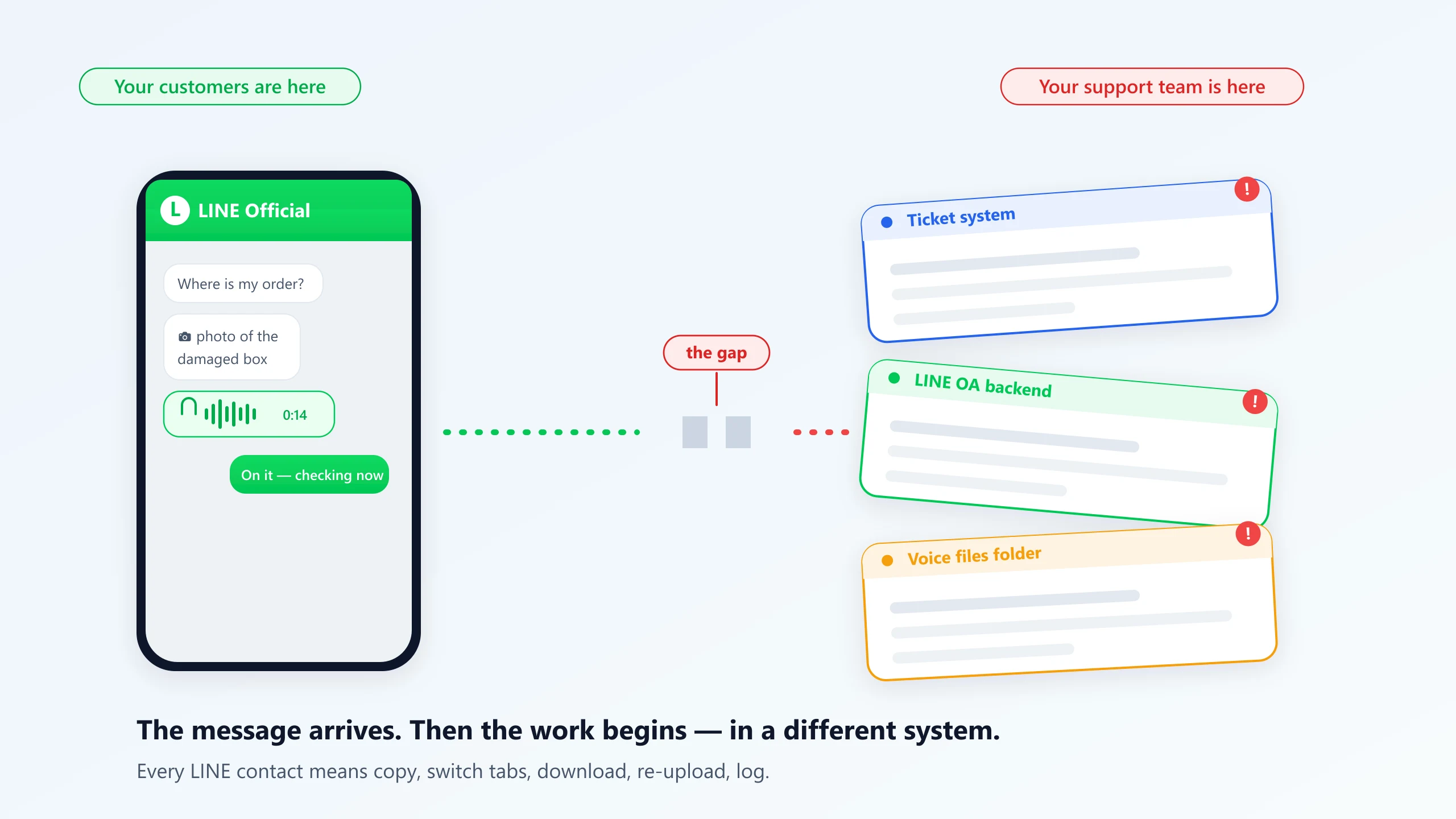
A consumer electronics brand expanding in Japan already had a LINE Official Account. Their customers were using it. The team wasn’t arguing about whether to be on LINE — that question was settled.
The problem was operational. When a LINE message came in, the agent opened the LINE Official Account backend, read the message, responded there, then switched back to the ticket system to log what happened. If the customer sent a photo or a voice message, it had to be downloaded, stored somewhere, then re-uploaded. During peak periods, there was no reliable way to know whether a message had been seen, who had responded to it, or whether any follow-up was needed.
The team’s description of the situation was precise:
It's not that we don't have LINE. It's that we can't handle the volume LINE generates.
Support lead, Consumer electronics brand, Japan
This is the gap that HeroDash’s LINE integration closes. The problem wasn’t LINE. It was what happened after the message arrived.
Why LINE isn’t optional for these markets
LINE’s user numbers in Asia are large enough that they change the calculus for any brand operating in the region. LY Corporation’s published data (as of March 31, 2026) shows how dominant it is across three key markets:
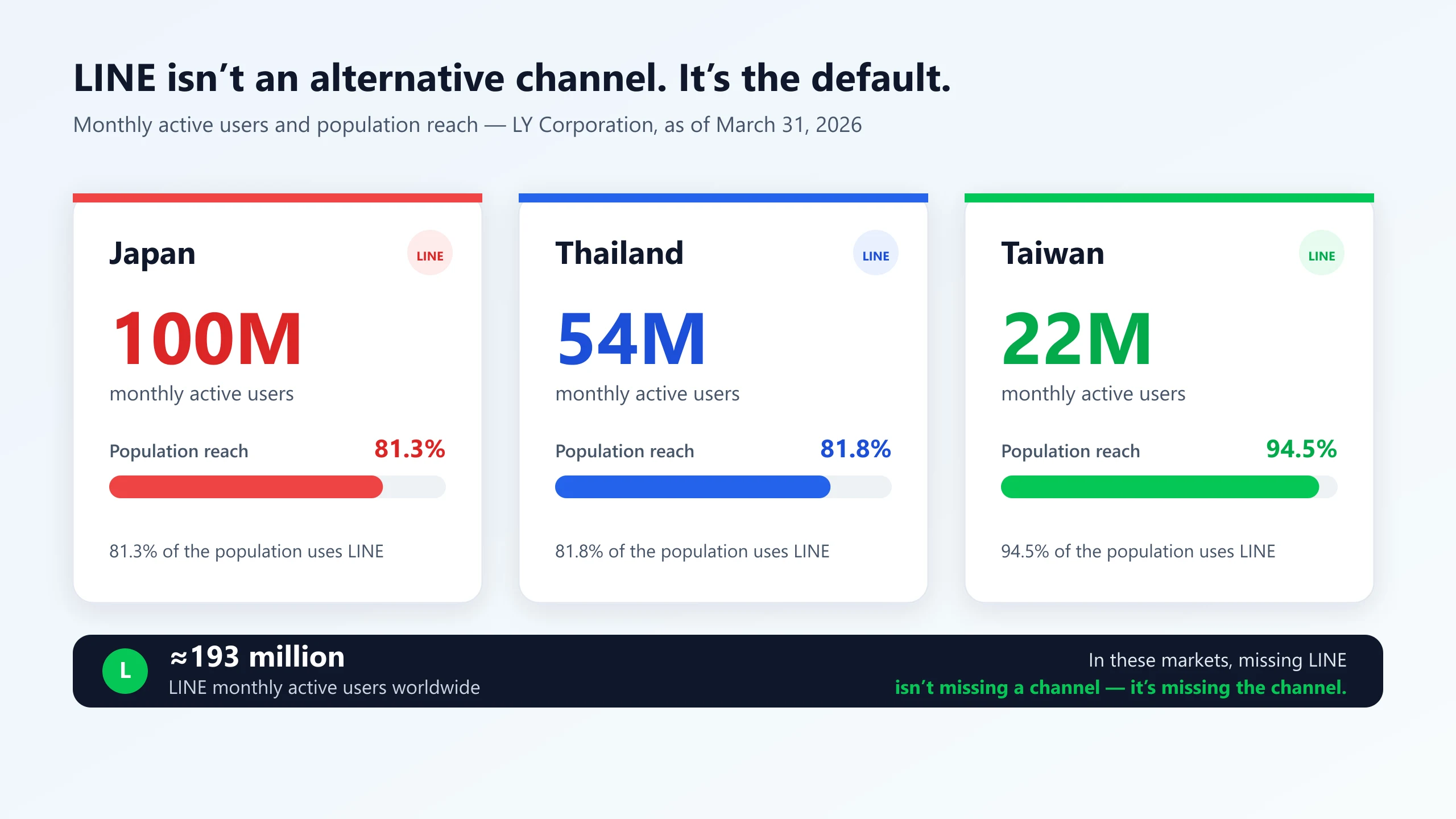
These numbers describe something specific: in Japan, Thailand, and Taiwan, LINE isn’t an alternative communication channel — it’s the default. When consumers in these markets want to contact a brand, reaching out on LINE is as natural as sending an email is in other markets. A support structure that doesn’t include LINE in these regions isn’t missing a channel — it’s missing the channel.
Brands that have opened LINE Official Accounts have taken the right first step. The issue, for most of them, is the gap between having the account and being able to actually service the contacts that come through it at scale.
Four things that break when LINE sits outside your main support system
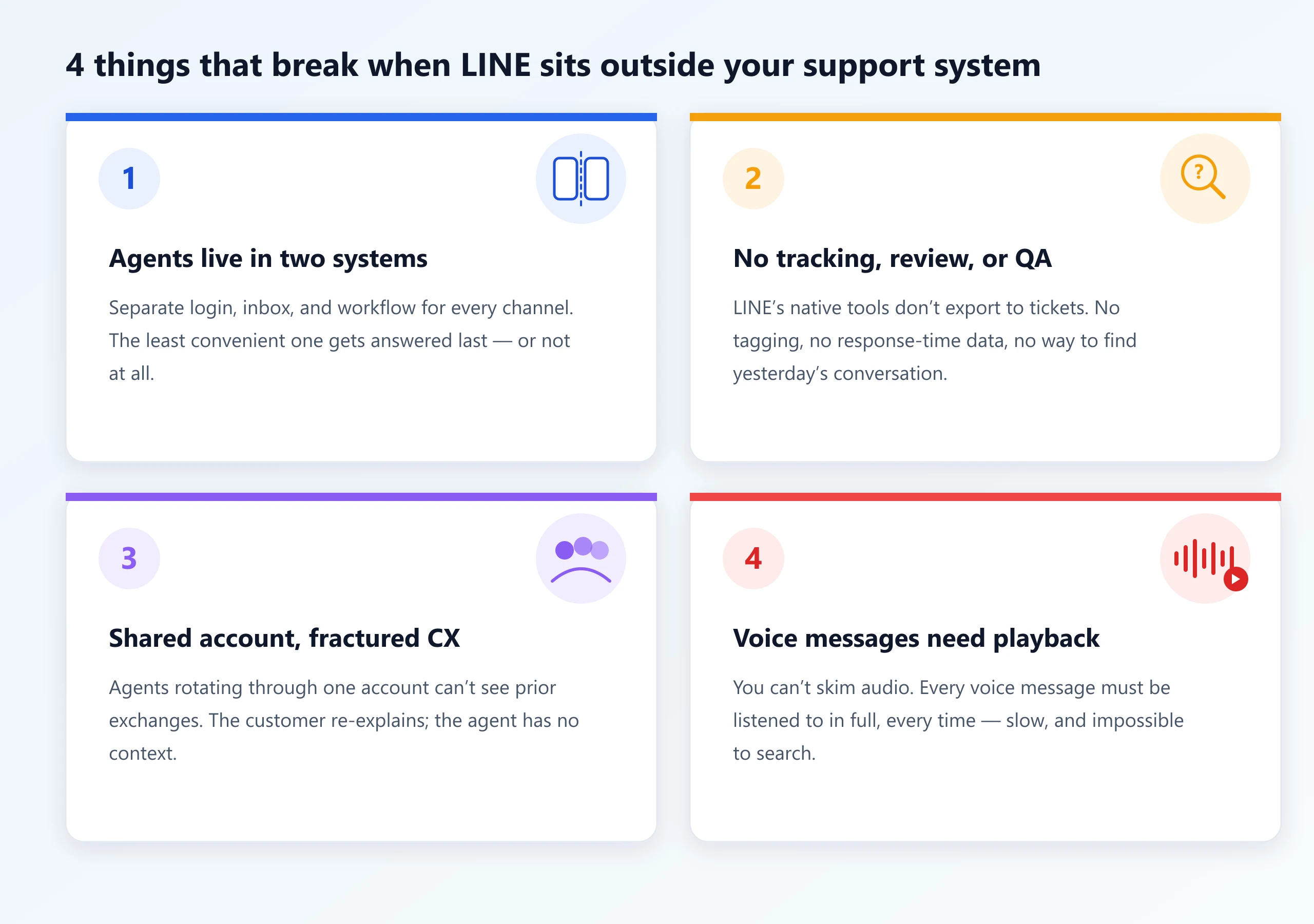
1. Agents live in two systems simultaneously. Phone has its own system. Email has its own system. Live chat has its own system. And now LINE has its own system. Each channel requires separate login, separate inbox management, separate response workflow. At high volume, the cognitive overhead of monitoring all of these at once is significant — and the practical result is that messages on whichever channel is least convenient get answered last, or not at all.
2. Conversations can’t be tracked, reviewed, or quality-checked. LINE’s native conversation management doesn’t export cleanly into ticket systems. There’s no built-in way to tag conversations, escalate them to colleagues, measure response time, or pull records for a quality review. A manager trying to understand how the LINE channel is performing relative to SLA targets is working from anecdote rather than data. An agent who handled a conversation yesterday has no easy way to find it again if the customer follows up today.
3. Multiple agents sharing one account produces a fractured customer experience. When several agents share access to a single LINE Official Account and rotate through it, customers interacting across different time periods encounter different people with no visibility into previous exchanges. The customer has to re-explain their situation. The agent has no context for what’s already been tried. The brand’s service experience becomes inconsistent in exactly the market where consistency matters most for building trust.
4. Voice messages — which LINE users send constantly — require audio playback to understand. LINE users in Japan and Thailand frequently communicate via voice message rather than text. In the native LINE backend, this means the agent has to play the audio to understand what the customer said. In an open-plan office, that’s disruptive. In any environment where the agent is handling multiple contacts simultaneously, it’s slow. There’s no way to skim a voice message, and no searchable record of what was said. Every audio file has to be listened to in full, every time.
What HeroDash’s LINE integration actually does
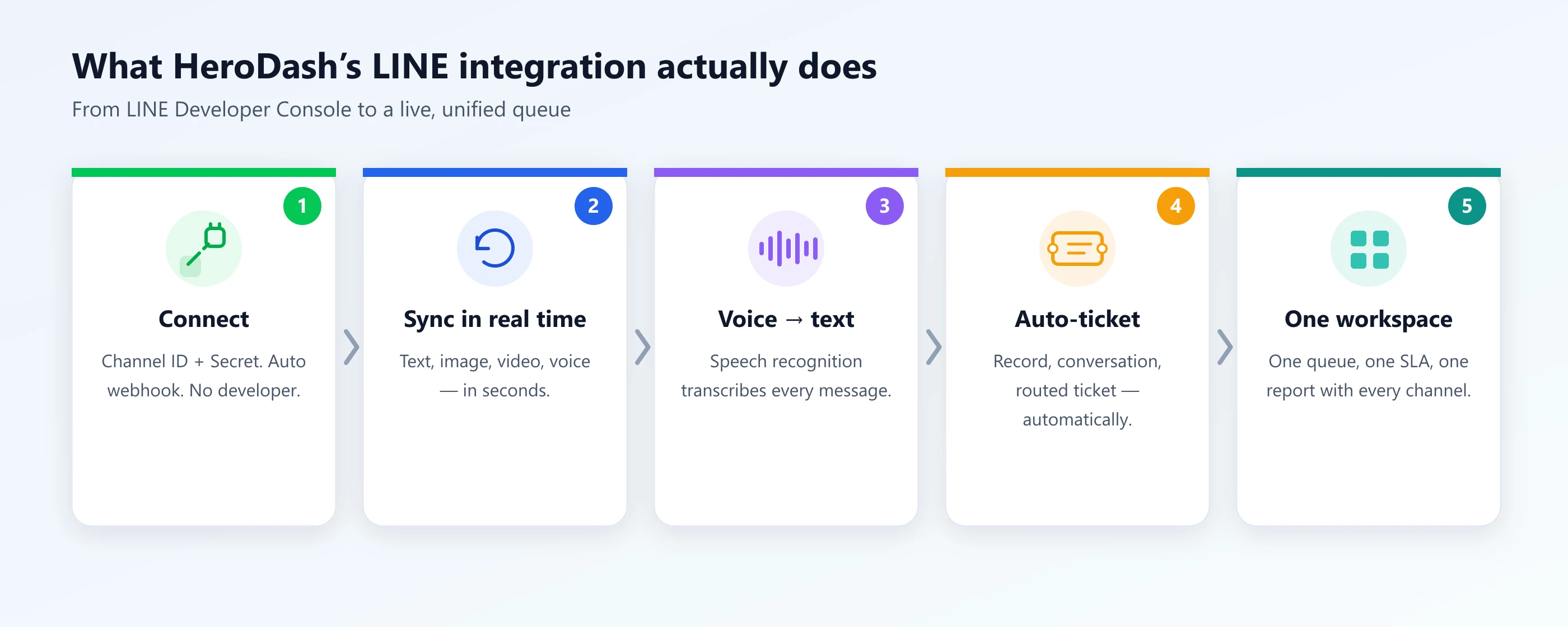
Setup takes minutes, not sprints. Connecting a LINE Official Account to HeroDash requires the Channel ID and Channel Secret from the LINE Developer Console. Enter those in the HeroDash backend and the system handles the Messaging API authentication and webhook configuration automatically. No developer involvement required. No IT project to scope and schedule.
Every message type syncs in real time. Text, images, video, voice — whatever the customer sends on LINE appears in the HeroDash workspace within seconds. Agents respond from HeroDash, and the reply reaches the customer through the LINE Messaging API. The entire conversation lives in one place, with the same ticket structure, tagging capability, and escalation options as every other channel. The LINE backend becomes optional rather than mandatory.
Voice messages become text. HeroDash’s built-in speech recognition converts LINE voice messages to text automatically. The agent reads the transcript instead of playing the audio.
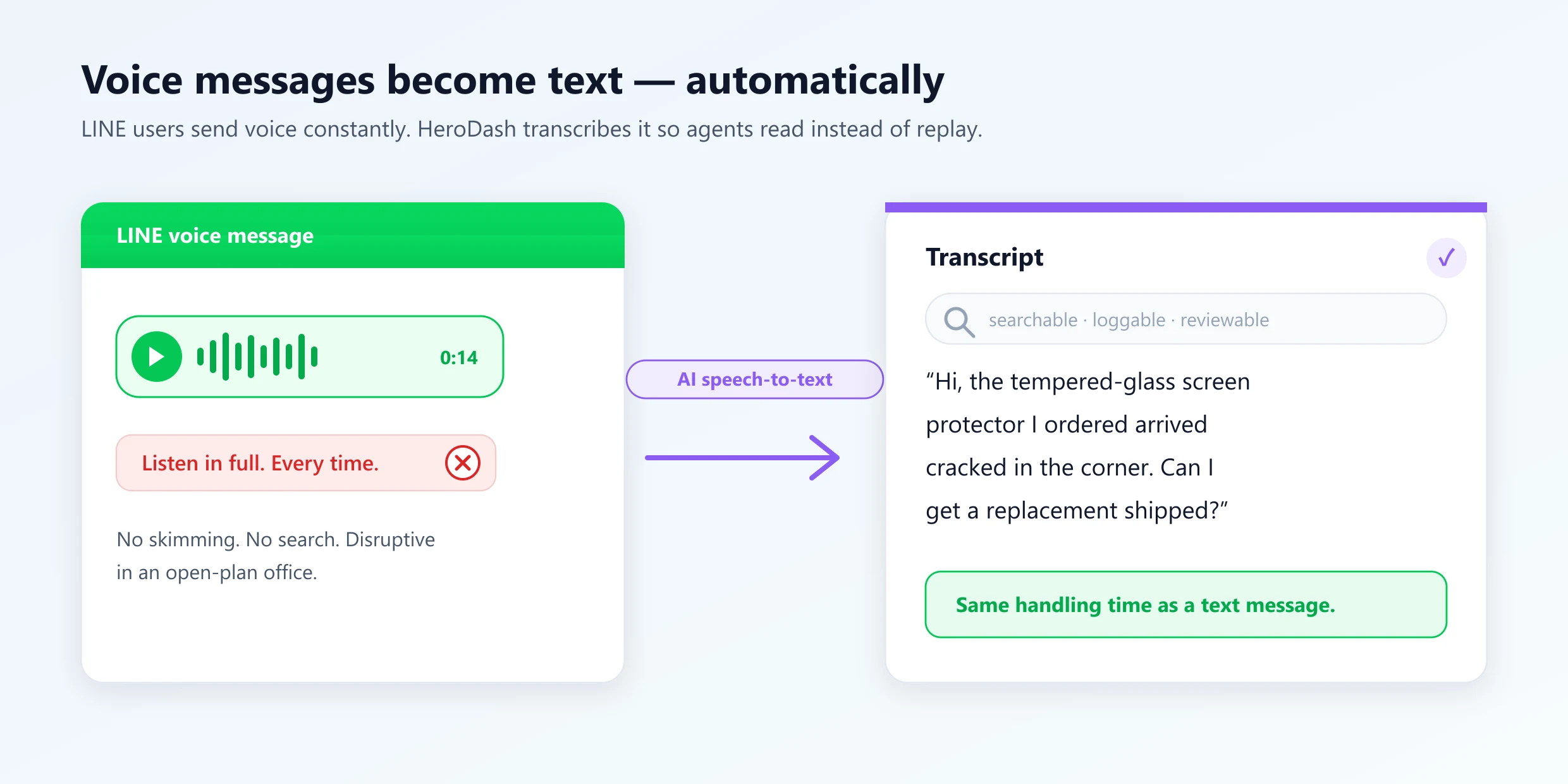
In a busy workspace, the operational difference is immediate — voice messages take the same time to process as text messages, and the content is searchable, loggable, and reviewable like any other written record.
Speech-to-text isn’t flawless: heavy accents, dialect, or a noisy recording can still need an agent to check the original audio. But the default shifts from “listen to every message in full” to “read most, verify the exceptions” — and that’s the difference that makes voice volume manageable.
Each LINE message creates a ticket automatically. When a LINE contact arrives, HeroDash creates a contact record, opens a conversation, and generates a ticket — routed to the appropriate agent or skill group based on pre-configured rules. Nothing has to be manually transferred between LINE and the ticket system. The data is in the right place from the moment the message arrives.
LINE sits inside the same unified workspace as everything else. HeroDash already handles phone, email, live chat, WhatsApp, Facebook, Instagram, Amazon, eBay, and Shopify in a unified agent workspace. LINE is now part of that same interface.
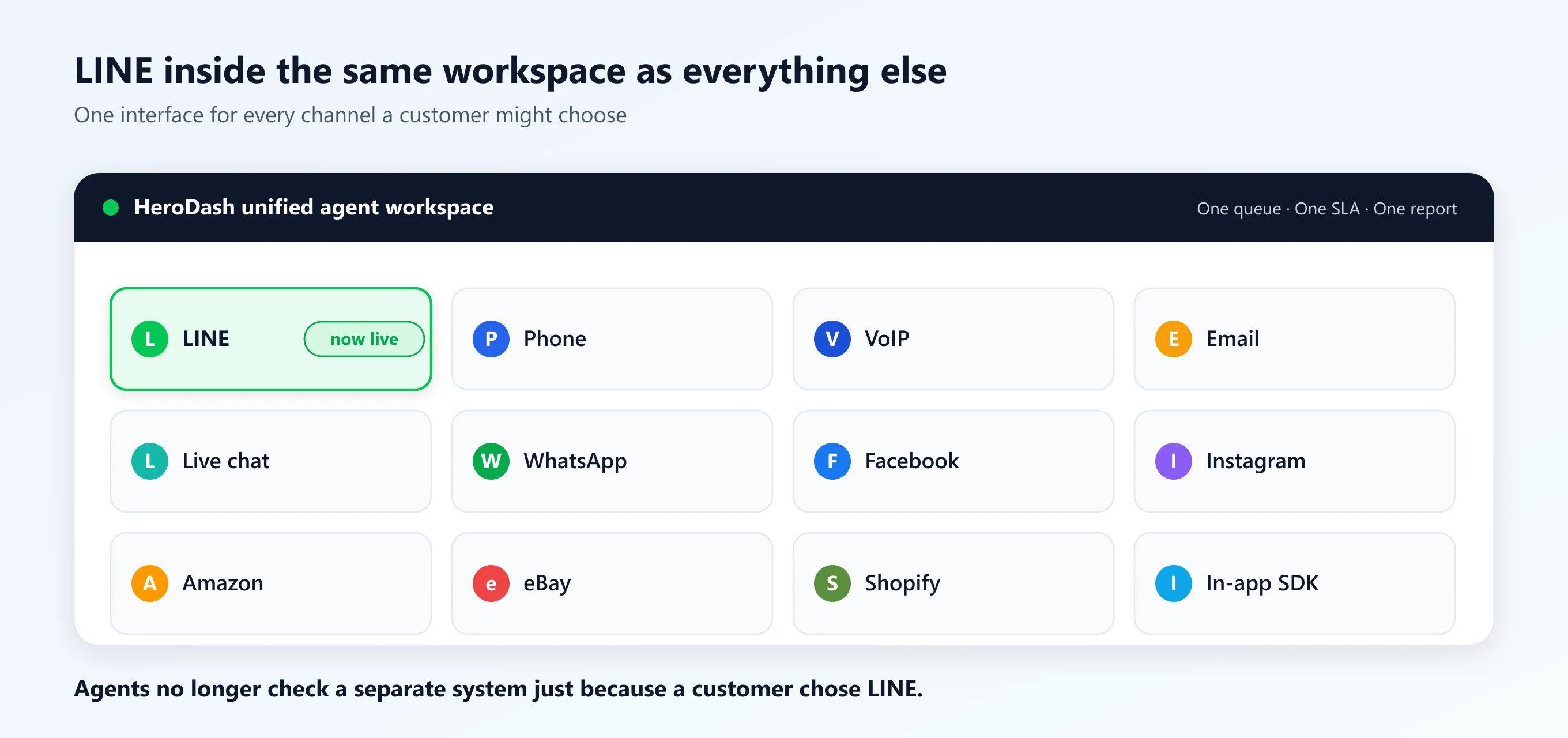
One queue, one SLA framework, one reporting structure. Agents managing all of a brand’s channels no longer need to check a separate system specifically because a customer chose LINE. This is the same channel-unification work behind HeroDash’s H1 2026 platform upgrades — LINE is one of the channels that expansion brought in.
What this changes for brands in Japan, Thailand, and Taiwan
The consumer electronics team that described their LINE problem as a volume problem wasn’t wrong — but the volume wasn’t the actual issue. The issue was that handling LINE contacts required more steps per interaction than handling contacts from any other channel. More steps means more time per contact, more chances for something to fall through, and a practical limit on how many contacts the team could process before quality degraded.
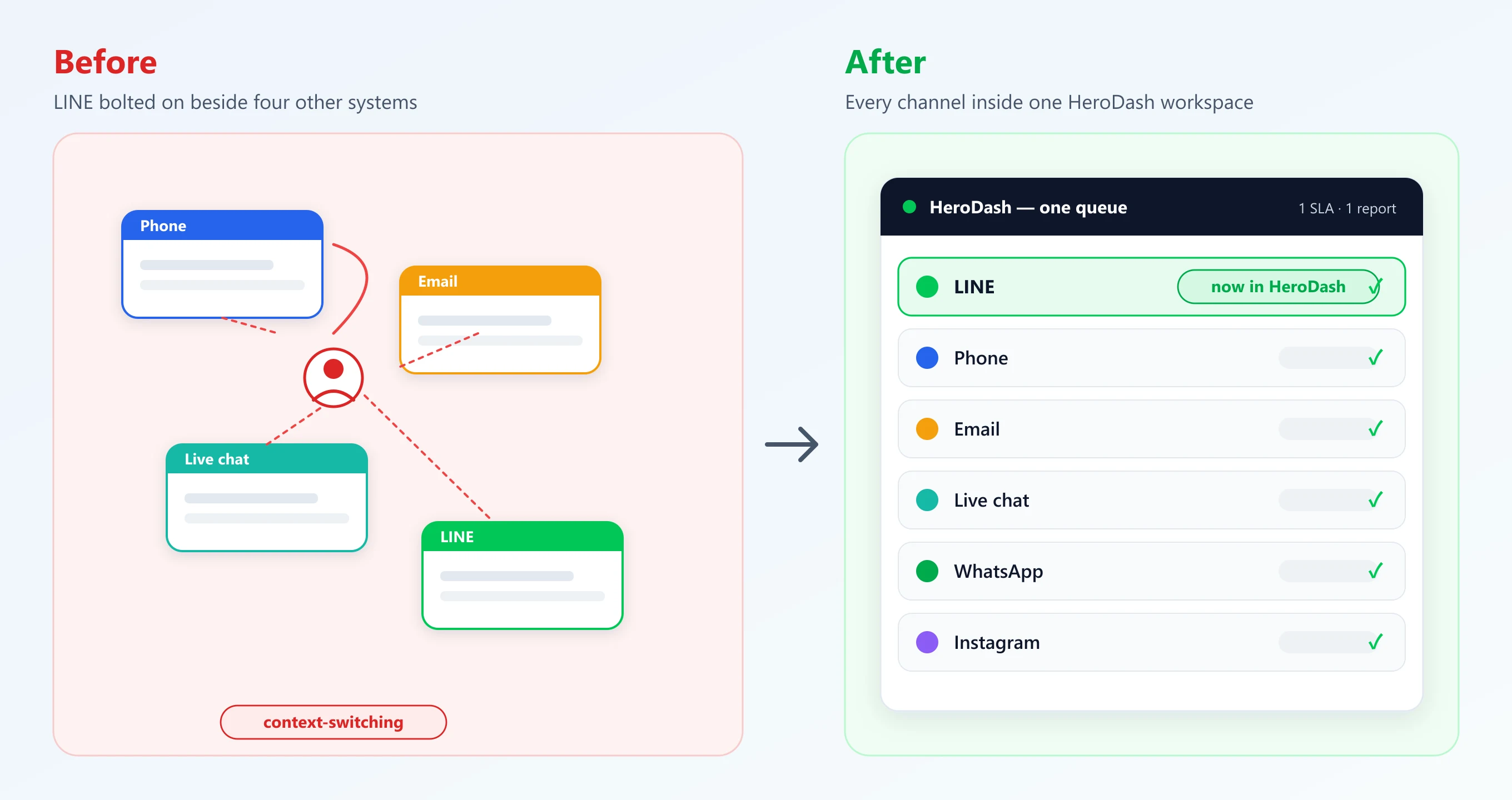
When LINE sits inside the same workspace as every other channel, those extra steps disappear. The agent isn’t context-switching between systems. The voice message isn’t requiring audio playback. The ticket is already created. The conversation history is already there if the customer contacts again tomorrow.
For markets where LINE is the primary consumer communication channel, this isn’t a feature upgrade. It’s the structural fix that makes the channel actually manageable at scale — and it pairs naturally with multilingual support, since the same team handling LINE for Japan is often covering Thai and Traditional Chinese for Taiwan too.
FAQ
What is a LINE Official Account and why does it matter for customer support?
A LINE Official Account is a business profile on LINE that lets brands message customers through the app the way a consumer messages a friend. It matters because in Japan, Thailand, and Taiwan LINE is the default consumer messaging app — roughly 100 million monthly active users in Japan alone. In those markets, reaching a brand on LINE is as natural as email is elsewhere, so a support operation without LINE isn’t missing an option, it’s missing the channel customers actually use.
Can you integrate a LINE Official Account with a customer support ticketing system?
Yes. HeroDash connects a LINE Official Account through the LINE Messaging API using the Channel ID and Channel Secret from the LINE Developer Console. Every LINE message — text, image, video, or voice — then syncs into the HeroDash workspace in real time and automatically creates a routed ticket, so agents no longer work out of LINE’s separate backend.
How does HeroDash handle LINE voice messages?
HeroDash’s built-in speech recognition transcribes LINE voice messages to text automatically. Agents read the transcript instead of playing the audio, so a voice message takes the same time to handle as a text message and the content becomes searchable, loggable, and reviewable like any other written record.
Which countries use LINE as their main messaging app?
LINE is the dominant messaging app in Japan (about 100 million monthly active users, 81.3% of the population), Thailand (about 54 million, 81.8%), and Taiwan (about 22 million, 94.5%), per LY Corporation data as of March 31, 2026. Globally LINE has roughly 193 million monthly active users.
Does connecting LINE to HeroDash require developers or an IT project?
No. Setup takes minutes. You enter the Channel ID and Channel Secret in the HeroDash backend, and the system handles Messaging API authentication and webhook configuration automatically — no developer involvement and no IT project to scope and schedule.
About Callnovo & HeroDash
HeroDash is Callnovo’s unified customer-service platform, pairing AI automation with human agents across chat, email, voice, social, and marketplace channels in 65+ languages. Callnovo builds and staffs the cross-border support operations that run on it — so the platform’s channel integrations, like LINE, are shaped by what real teams servicing Japan, Thailand, and Taiwan run into every day.
Managing LINE support outside your main ticketing system? Explore the HeroDash platform, see how multilingual teams and per-resolution support fit together, or talk to our team about what connecting your channels looks like for your operation.
Sources
- LY Corporation — company data (LINE monthly active users, as of March 31, 2026)
- LINE Developers — Messaging API documentation
LINE monthly active user data sourced from LY Corporation public disclosure, March 31, 2026.