Key Takeaways
- Six H1 2026 upgrades, each built around a specific daily frustration — not features for a spec sheet, but fixes for the mechanical friction agents deal with every day.
- The headline change: order numbers read themselves. SmartExtract pulls order and tracking numbers out of any message and auto-fills the ticket — no copy-paste, no tab-switching.
- One team can now cover every language, with real-time two-way translation and a custom terminology dictionary for cross-border terms.
- Every interaction is quality-checked — not a 10% sample — and phone support now runs on the same AI as text. The 80/20 split (AI handles routine, humans handle judgment) gets closer to reality.

A few things make customer service work feel unnecessarily hard — not the difficult conversations or the genuinely complex problems, but the mechanical friction that exists because systems weren’t built to work together.
A customer sends a message with their order number in the body. The agent copies it, switches tabs, pastes it into another system, waits, switches back. Thirty seconds gone — times two hundred contacts a day. A Japanese customer asks a question; the English-speaking agent has to translate it, verify the meaning, draft a reply, and translate it back — ten minutes for something that should take two. A chatbot gets a question phrased in a way it hasn’t seen, fails, and the customer re-explains everything to a human who has no context.
These aren’t edge cases. They’re daily reality for cross-border customer service. HeroDash’s H1 2026 updates were built to fix them — specifically, and in ways that change what agents actually do with their time.
01 — ChatBot: from keyword matching to actual understanding
The previous generation of chatbots ran on a simple premise: if the customer says “return,” show the returns process. It worked — until the customer said “I don’t want this anymore” and the bot had no idea what to do.
HeroDash’s chatbot now runs on intent recognition rather than keyword matching. The bot understands what the customer is trying to accomplish, not just which words they used. “Where’s my stuff,” “has my package left yet,” and “my order hasn’t arrived” are the same question — and the bot answers all three by pulling the actual shipping data, rather than pointing the customer at a tracking page. Ask to change a delivery address, and it checks whether the order status still allows it. Ask about a product spec, and it queries the knowledge base instead of returning a generic “please contact support.”
Escalation is smarter too. The bot recognizes when a customer’s language signals they want a person — or when the situation is beyond what automation should attempt — and transfers with the full conversation context intact. The agent sees everything that happened; the customer doesn’t repeat themselves. Language is automatic: write in Spanish, get Spanish back — Japanese, French, German too, with no configuration.
02 — SmartExtract: the order number reads itself
This is the one that saves the most time per day for high-volume agents — and those savings compound, because constant task-switching carries a real cognitive tax. The American Psychological Association notes that switching between tasks can cost as much as 40% of someone’s productive time.
SmartExtract is an intelligent field-recognition engine that identifies order numbers, tracking numbers, customer identifiers, and other structured data inside incoming messages — across any channel — and automatically fills the matching ticket fields. The agent doesn’t copy anything. The agent doesn’t switch tabs. The information is already in the right place when the ticket opens.
A paired upgrade — the shared intent platform — means intent rules are configured once and apply across every bot at the same time. Teams running multiple bots (pre-sale, post-sale, VIP) used to update each separately, and the drift between them created unpredictable experiences. Now: configure centrally, apply everywhere, toggle specific intents on or off per bot as needed.
03 — Multi-engine translation: one team, every language
The economics of multilingual support have always been unfortunate: one language group per team. English agents handle English; Japanese agents handle Japanese. Staffing scales with the number of languages your customers speak — which, for cross-border, is usually more than you can comfortably staff.
Multi-engine translation breaks that model. Agents work in their own language, customers in theirs, and the system translates both directions in real time — the agent never has to initiate anything. This matters because most consumers strongly prefer support in their own language, and staffing a native speaker for every market rarely pencils out.
The custom terminology dictionary is what makes it usable in practice. Generic machine translation handles conversation well enough, but cross-border ecommerce runs on terminology — SKU, FBA, listing hijacking, A-to-Z claim, chargeback — that untrained engines translate inconsistently. The dictionary lets teams define how each term is translated and apply it across every conversation. The same term means the same thing every time.
04 — Full channel integration: one workspace, every channel
The H1 2026 channel expansion adds Shopify, eBay, Lingxing ERP, HubSpot, and LINE. Agents in a single workspace can now handle contacts from a much larger share of where cross-border customers actually reach out — without switching systems to look up an order or respond.
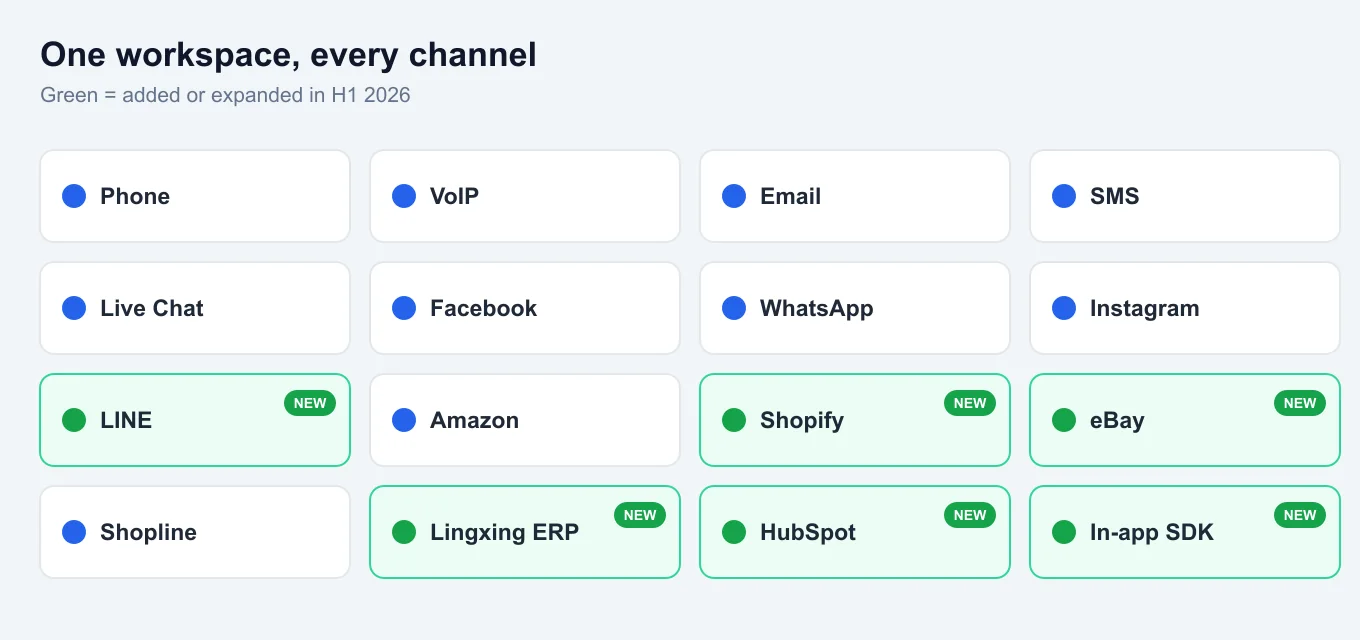
AI-first handling now extends beyond web chat to email, Facebook, WhatsApp, Instagram, and eBay. Each WhatsApp number and Facebook page can carry its own welcome message, so brands with distinct segments keep tone differentiation without separate workflows. In-app integration is new: brands can embed the HeroDash chat window directly in their mobile app, and in-app conversations sync to the workspace in real time — the customer never leaves the app, and the agent handles it alongside every other channel. Channel- and account-level SLA management rounds it out: response-time targets and agent-load limits can be set per channel and per account, instead of one blanket SLA across very different volumes.
05 — AI quality inspection: from sampling to full coverage
Traditional quality monitoring works on sampling — an inspector reviews 10–20% of interactions and extrapolates. The problems are obvious: most interactions never get reviewed, the sample is rarely random in practice, and feedback lands weeks after the fact.
HeroDash’s AI quality inspection covers every interaction. Not a sample. Every one.
It runs on a dual-track architecture: ticket-level inspection evaluates the complete service lifecycle across all channels for a given issue, while channel-level inspection analyzes each channel’s behavior independently. Want overall service quality? Look at ticket inspection. Want to know specifically how email is performing? Look at channel inspection. The two data sets don’t interfere.
Three scoring dimensions
Resolution — was the customer’s problem actually solved, not just responded to? Compliance — flags interactions that approach risk thresholds (regulatory language, commitment language, privacy-adjacent requests). Knowledge accuracy — compares agent responses against the knowledge base and scores the alignment.Four reporting views — overview, agent-level, trend, and dimension — update on an event-driven basis with daily automated summaries. A manager opening the dashboard any morning has a complete picture of yesterday’s quality, without waiting for a human to compile a report.
06 — Voice AI: phone calls finally catch up
Phone has been the last channel to get real AI automation — real-time speech recognition across languages, plus actually doing something useful with what’s heard, kept it in a separate category from text. HeroDash’s Voice AI closes that gap, in three layers.
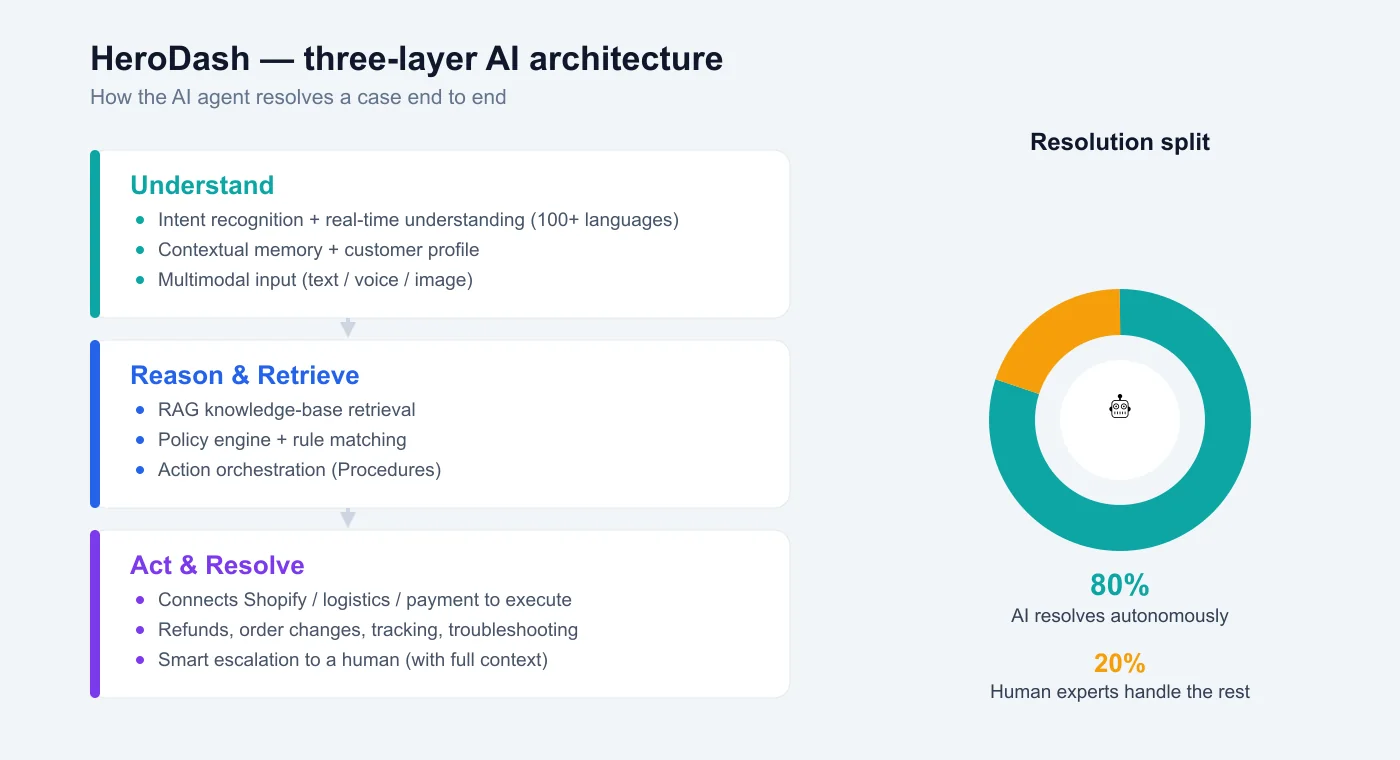
The perception layer handles real-time speech recognition across 65+ languages, with contextual memory and customer-profile integration from the first moment. The decision layer uses RAG-based knowledge retrieval to identify the resolution path — the same logic as text-based AI, applied to speech. The execution layer connects directly to Shopify, logistics, and payment systems to perform real operations: refunds, order modification, shipment lookup, troubleshooting.
It isn’t magic. Heavy accents, cross-talk, and noisy lines still reduce recognition accuracy — which is exactly why the escalation path matters as much as the automation does.
A customer calling about a delayed order isn’t transferred and put on hold — Voice AI pulls the tracking in real time and answers in the same call. Someone who wants to modify an order gets a live check on whether the status permits it, and if so, it’s done. Calls are transcribed in real time for immediate quality review (activation is switchable per agent and per project). And the ~20% of calls where human judgment adds real value escalate with complete context — the AI’s summary, the stated issue, what it already tried, and what’s still unresolved. The human continues the conversation instead of restarting it.
What these six changes add up to
Individually, each upgrade addresses a specific frustration. Together, they shift what the platform is capable of — and what agents spend their time on.
The tab-switching is gone. The copy-pasting is gone. Bot failures that forced agents to start from scratch are sharply reduced. The language barrier that required separate staffing per language is manageable with one team. Quality monitoring that used to catch problems weeks late now catches them daily. And phone support — the manual channel in most operations — runs on the same AI infrastructure as everything else.
The 80/20 dynamic HeroDash is designed around — AI handling 80% of routine contacts so humans can focus on the 20% that actually benefits from judgment — gets closer to reality with each upgrade. The contacts that reach a human are more complex, more valuable to resolve well, and more worth the investment of human attention.
The upgrades that matter aren't the ones that demo well — they're the ones that delete a step an agent repeats two hundred times a day.
Manny Xu, CTO, Callnovo
The platform is still being built. These six changes are what the first half of 2026 produced; the second half will be shaped by what the teams using the platform run into in practice — which is where the most useful feedback always comes from.
FAQ
What’s the difference between intent recognition and keyword matching in a chatbot?
Keyword matching triggers a canned response when a specific word appears — say “return,” show the returns process. Intent recognition understands what the customer is trying to accomplish regardless of the words they use, so “where’s my stuff,” “has my package left yet,” and “my order hasn’t arrived” all resolve to the same intent. HeroDash’s chatbot now runs on intent recognition and pulls live shipping data to answer, instead of pointing the customer at a tracking page.
How does HeroDash SmartExtract save agents time?
SmartExtract is a field-recognition engine that reads order numbers, tracking numbers, and customer identifiers directly out of incoming messages across any channel and auto-fills the ticket fields. The agent doesn’t copy, paste, or switch tabs — the data is already in place when the ticket opens. It handles Amazon, eBay, Shopify, and ERP formats like Lingxing without per-platform configuration.
Can one team support customers in multiple languages?
Yes. HeroDash’s multi-engine translation lets agents work in their own language while customers communicate in theirs, translating both directions in real time. A custom terminology dictionary keeps cross-border terms — SKU, FBA, A-to-Z claim, chargeback — consistent across every conversation, so staffing no longer has to scale one team per language.
Which channels does HeroDash integrate?
Phone, VoIP, email, SMS, live chat, Facebook, WhatsApp, Instagram, LINE, Amazon, Shopify, eBay, Shopline, Lingxing ERP, and HubSpot — plus an in-app SDK to embed the chat window directly in a brand’s mobile app. H1 2026 added Shopify, eBay, Lingxing ERP, HubSpot, and LINE, and extended AI-first handling to email, Facebook, WhatsApp, Instagram, and eBay.
How does HeroDash Voice AI handle phone calls?
Voice AI works in three layers: perception (real-time speech recognition in 65+ languages with contextual memory and customer profile), decision (RAG-based knowledge retrieval to find the resolution path), and execution (direct connections to Shopify, logistics, and payment systems to actually process refunds, modify orders, or look up shipments). Calls are transcribed in real time, and complex situations escalate to a human with the full AI summary and context.
About Callnovo & HeroDash
HeroDash is Callnovo’s unified customer-service platform, pairing AI automation with human agents across chat, email, voice, social, and marketplace channels in 65+ languages. Callnovo builds and staffs the operations that run on it — so the platform’s upgrades are shaped by what real cross-border support teams encounter every day.
Want to see any of these features in your own operation? Explore the HeroDash platform, see how per-resolution support and multilingual teams fit together, or talk to our team about what deployment looks like for your channels and markets.
Sources
- CSA Research — consumer language preference
- American Psychological Association — multitasking & task-switching costs
Product details reflect HeroDash platform updates from the first half of 2026.