Privacy note: To protect customer confidentiality, identifying details have been removed.
Key Takeaways
- The team did not grow. The operating system got smarter. The same 40 agents moved from queue pressure to 4,500+ daily contacts after HeroDash improved routing, data visibility, and self-service deflection.
- Language routing was the hidden bottleneck. Spanish and Portuguese contacts were landing in the same pool, creating unnecessary transfers and avoidable frustration.
- Live order data changed the first minute of every call. Agents no longer started by collecting tracking details the customer had already entered.
- Analytics turned staffing from floor-walking into management. Supervisors could see pressure by hour, language, inquiry type, and agent group instead of relying on answer rate alone.

A Monday Morning, One Month Apart
At 9 a.m. in Sao Paulo, Mariana, the operations supervisor, walks into the call center floor and checks HeroDash.
The numbers are moving steadily: Spanish queue, Portuguese queue, 38 agents online, inbound handled, outbound completed. The floor is focused. Nobody is counting busy lights by eye. Nobody is guessing which language queue is about to break.
One month earlier, the same Monday morning looked very different.
The team had the same 40 agents. The call volume was not dramatically different. But the system could not reliably separate a Spanish-speaking caller from a Portuguese-speaking caller. Spanish agents picked up Brazilian customers they could not help. Transfers happened constantly, and each transfer reset the customer’s patience.
The old dashboard showed answer rate, average wait time, and call count. It did not show why the queue was failing.
Why the Old System Broke Under Normal Growth
This last-mile logistics company supports Spanish-speaking markets and Brazil. That means two primary support languages: Spanish and Portuguese.
The queue covers the everyday reality of delivery operations: package tracking, address corrections, delivery complaints, redelivery scheduling, failed delivery disputes, and escalations when a package has already created real customer anxiety.
Three structural problems had been building for months.
1. High Volume With No Intelligent Routing
Logistics volume is volatile. Promotions, holidays, weather, and carrier exceptions can double inbound demand within hours. The old system processed contacts as a general queue. It did not route by language, intent, or escalation risk.
When volume spiked, the queue grew in the simplest possible way: linearly. Customers waited, hung up, called back, and increased the pressure. The system was amplifying the problem it was supposed to absorb.
2. Reporting That Could Not Answer Operational Questions
The available reporting described activity, not performance.
Mariana could see answer rate and average wait time. She could not quickly see which hours generated the most complex escalations, whether Spanish or Portuguese was under more pressure, which inquiry type consumed the most handle time, or whether Thursday afternoons consistently required more coverage than Tuesday mornings.
Scheduling was still experience-based. Experience matters, but it is not enough when a two-language operation is moving thousands of contacts every day.
3. Language Routing That Did Not Work
As Brazil grew, Portuguese inbound volume grew with it. The old system distributed calls based on agent availability. Whoever picked up next got the call, whether they spoke the caller’s language or not.
A Spanish agent receiving a Portuguese-speaking Brazilian customer could not resolve the issue. The agent transferred the call manually. The customer repeated the tracking problem. The queue lost time. The agent lost time. The customer lost confidence.
What HeroDash Changed
The fix was not hiring another large team. The fix was changing what reached the team.
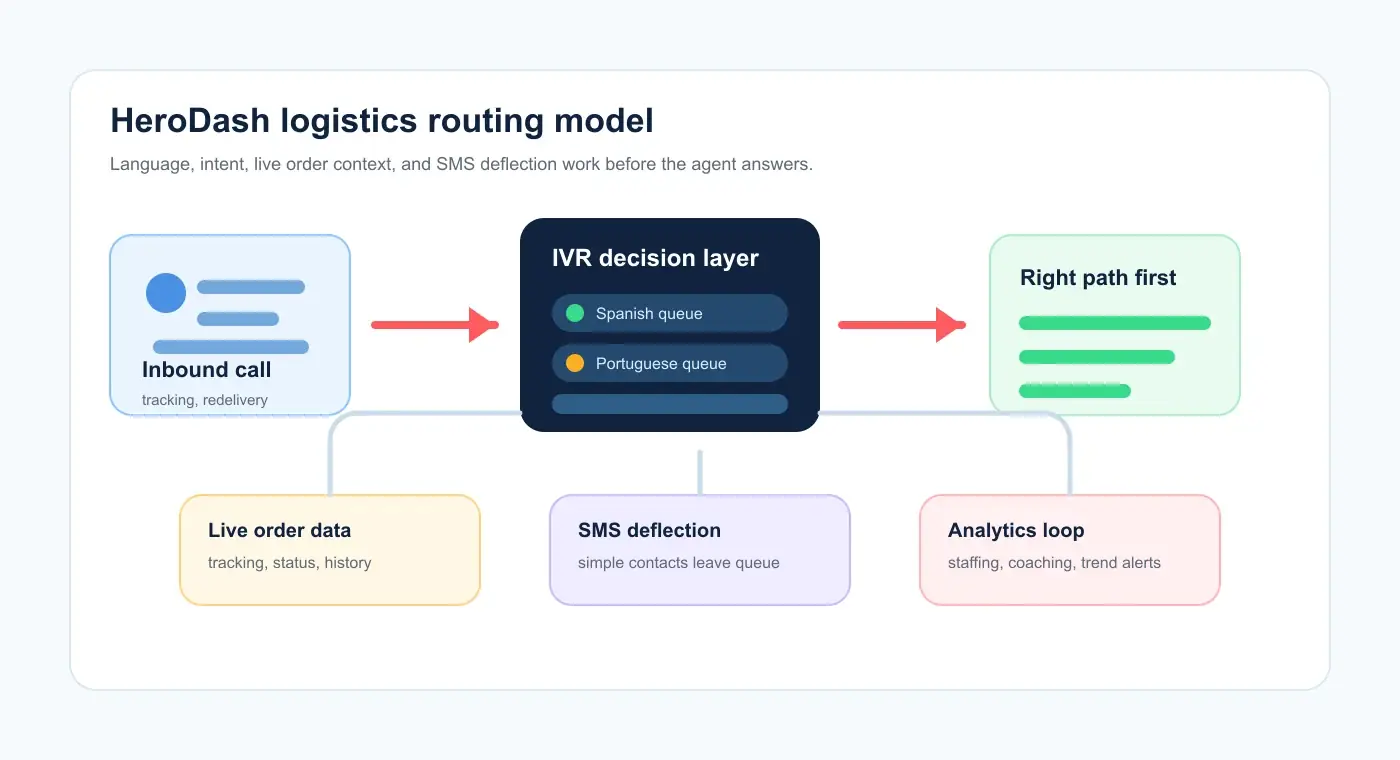
Intelligent IVR Routing by Intent and Language
When a customer calls, the IVR now routes on two signals at the same time: what the customer needs and which language they are using.
A Brazilian customer calling about a delayed package goes to the Portuguese tracking queue. A Spanish-speaking customer with an address correction goes to the Spanish address management path. An escalated delivery complaint follows a different rule from a simple tracking inquiry.
Agents receive contacts they are equipped to handle. Customers reach the right person on the first attempt. The language-related transfer rate that had consumed agent time and created frustration fell to near zero.
The 40-person team’s theoretical headcount did not change. Its usable capacity changed.
Live Order Data at the Point of Contact
HeroDash connects to the company’s logistics systems: shipment tracking, delivery status, address records, and customer history.
When a customer enters a tracking number in the IVR, the system pulls the package context before the agent answers. The agent sees current location, delivery history, estimated delivery window, and exception flags.
That changes the opening of the call. The agent does not begin with “Can I have your tracking number?” or “Let me look that up.” The conversation starts at the actual issue.
For logistics support, that first minute matters. It sets the emotional tone and reduces handle time without making the agent rush.
IVR-to-SMS Deflection for Self-Service Contacts
Not every logistics contact needs a live agent.
Some customers need a tracking link, a delivery-window confirmation, or a redelivery scheduling path. Those contacts previously entered the same queue as complaints and disputes.
HeroDash routes eligible contacts from IVR into SMS. The customer receives a link, confirmation, or next step and completes the interaction without waiting for an agent.
The important point is not “automation replaces agents.” The important point is that automation protects agents for the contacts where human judgment matters: escalated complaints, failed delivery disputes, complicated address changes, and frustrated customers who need a real conversation.
Analytics That Replaced Guesswork
The reporting gap was the quietest problem and probably the most expensive one.
HeroDash tracks the dimensions a supervisor actually needs: call volume by hour and day, queue length by skill group, handle time by inquiry type, language-group performance, agent-level efficiency, and trend signals before the queue becomes visibly chaotic.
Mariana can now see that Wednesday afternoons consistently generate higher Portuguese volume. She can see which inquiry type takes longest. She can identify which agents are strong on complex escalations and structure coaching around evidence instead of impressions.
Before and After Support Workflow
| Operating area | Before HeroDash | After HeroDash |
|---|---|---|
| Language routing | Calls assigned by availability | Spanish and Portuguese routed separately |
| First minute of call | Agent collected tracking details again | Order context appeared before answer |
| Simple tracking contacts | Entered live queue | Deflected to SMS when eligible |
| Staffing decisions | Floor observation and broad totals | Scheduling based on hour, language, and inquiry data |
| Escalations | Mixed with ordinary contacts | Tagged and routed with clearer priority |
What the Numbers Look Like Now
Latin America logistics support with HeroDash
The same 40-person team now handles more than 4,500 contacts a day: roughly 2,500 inbound and 2,000 outbound across Spanish and Portuguese markets.
The comparison reflects a roughly one-month post-deployment operating window, with figures rounded for confidentiality.
Several operating metrics moved in the right direction after deployment:
- First-contact resolution improved because customers reached the right language queue with order context already visible.
- Average handle time dropped because agents no longer spent the first part of each call collecting information the system already had.
- Language-related transfer rate fell to near zero because language-based routing became the default path, not a manual correction.
- Peak-hour abandonment decreased because SMS deflection and priority routing absorbed pressure that had previously collapsed into one queue.
- Staffing efficiency improved because scheduling decisions were based on demand patterns instead of broad activity totals.
These results reflect this deployment and should not be read as a guaranteed outcome for every logistics operation. The underlying lesson is still portable: when routing, context, and reporting improve, the same team can often produce a very different service experience.
What Logistics and Ecommerce Teams Should Ask
If your operation has grown across countries, languages, or delivery partners, the failure pattern may already be visible.
| Contact type | Best path | Keep with agent when | HeroDash signal |
|---|---|---|---|
| Tracking link request | SMS self-service | The package has an exception or failed delivery flag | Tracking-only tag plus no escalation marker |
| Delivery-window confirmation | IVR-to-SMS confirmation | The customer disputes the time window or carrier note | Delivery-window tag plus sentiment risk |
| Address correction | Trained language queue | The change affects customs, fraud risk, or failed delivery | Address-change tag plus manual review flag |
| Escalated complaint | Senior agent queue | The customer mentions repeated failed delivery, refund, or public review | Complaint tag plus high-risk sentiment |
| Outbound follow-up | Scheduled outbound queue | The customer missed prior callbacks or has unresolved evidence | Callback tag plus unresolved case status |
Ask three practical questions:
- What percentage of transfers are language-related? If agents transfer contacts because of language mismatch, the queue is creating handle time before service even begins.
- Can current reporting answer staffing questions? If you cannot see pressure by language, hour, inquiry type, and escalation reason, staffing will remain partly guesswork.
- Which contacts do not require human judgment? Tracking links, delivery-window confirmations, and simple redelivery actions may be better served through SMS or self-service.
FAQ
How can 40 agents handle 4,500 logistics contacts a day?
The team can handle that volume when calls are routed by language and intent, live order data appears before the agent answers, simple contacts move to SMS self-service, and managers schedule from real queue data.
Why does language routing matter in Latin America logistics support?
A Latin America logistics operation may serve Spanish-speaking markets and Brazil at the same time. If Portuguese callers reach Spanish-only agents, transfers increase, handle time rises, and frustration builds before the issue is even discussed.
Which logistics calls can move to SMS self-service?
Simple tracking links, delivery-window confirmations, redelivery scheduling, and basic delivery updates can often move to SMS. Escalated complaints, failed delivery disputes, and complicated address changes should stay with trained agents.
What does HeroDash add to a multilingual call center?
HeroDash adds routing logic, live order context, queue analytics, agent performance visibility, and quality monitoring so supervisors can manage capacity instead of guessing from activity totals.
Building a Multilingual Logistics Call Center?
Callnovo helps logistics, ecommerce, and delivery teams build multilingual support operations, managed customer service teams, routing SOPs, SMS deflection paths, and HeroDash analytics for high-volume operations.
If your team is already working hard but the queue still feels fragile, the next improvement may not be more agents. It may be better routing, better context, and better visibility.
Sources and Notes
- For a broader view of why last-mile operations are routing-intensive, see the Amazon Last Mile Routing Research Challenge.
- For additional logistics context, the LaDe last-mile delivery dataset paper describes why real-world delivery operations require large-scale package, courier, task, and event data. This source is used for routing-complexity background, not for the case metrics above.
- Operational details, volume numbers, and performance outcomes come from an active HeroDash deployment. Client identity withheld at the client’s request.