Privacy note: To protect customer confidentiality, identifying details have been removed.
Key Takeaways
- EZVIZ needed one operating layer across phone, WebCall, email, live chat, Amazon, Facebook, WhatsApp, and Instagram.
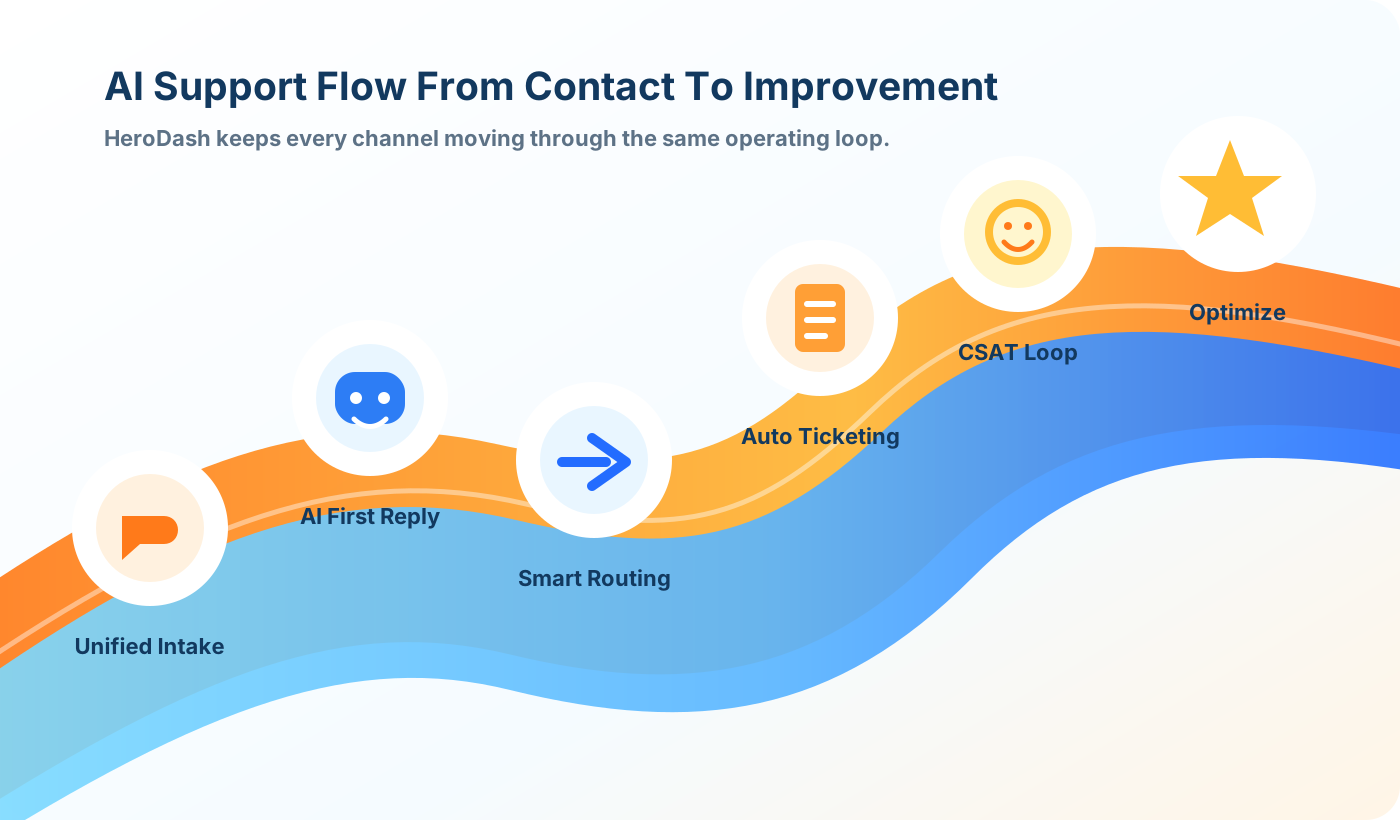
- HeroDash AI handles first-layer contacts, collects missing information, and routes complex issues to the right agents with context.
- Structured ticket data and automatic CSAT feedback give the team a clearer view of recurring issues, service quality, and global support performance.
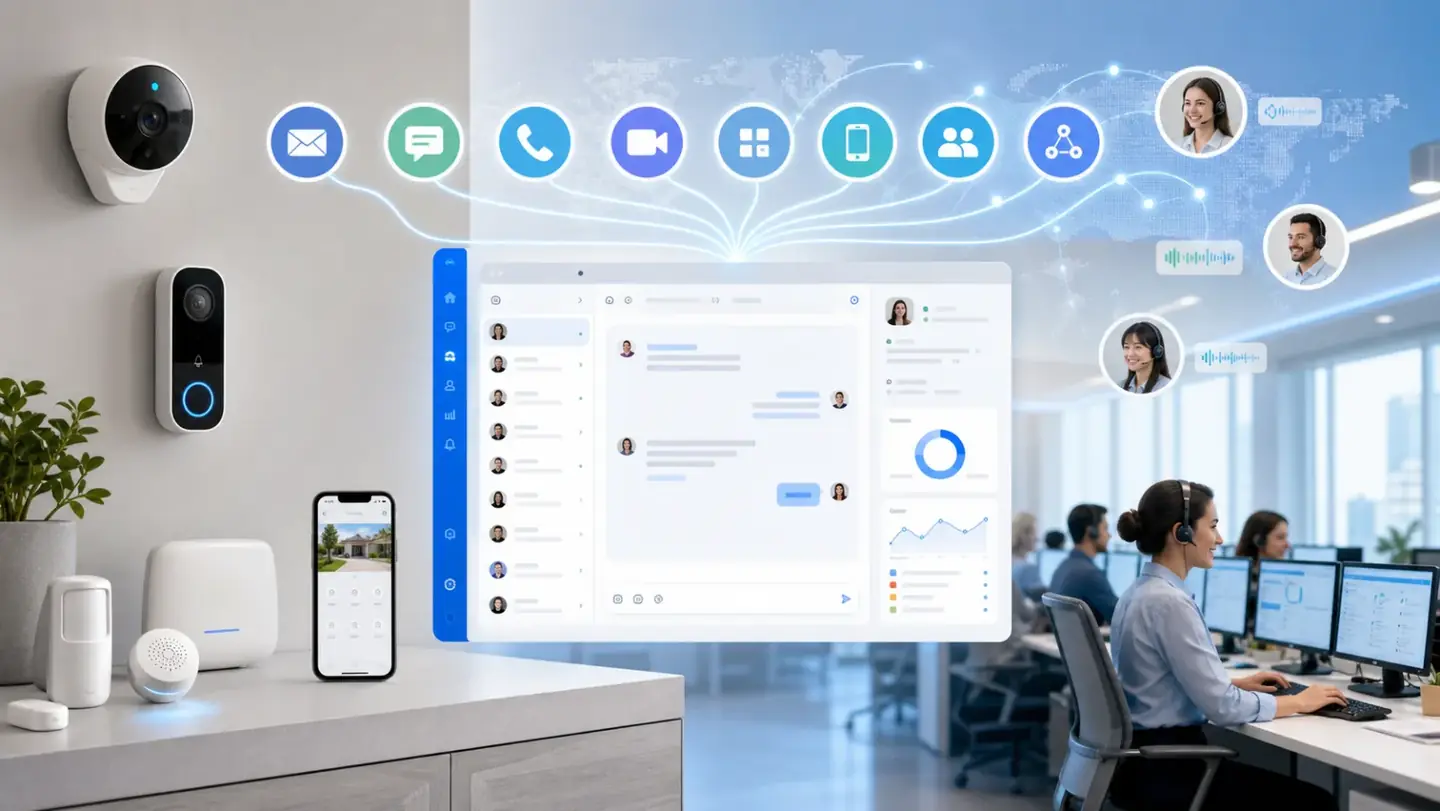
When your product works globally, your support has to as well
EZVIZ is one of the leading smart home security brands in the global market, with cameras, doorbells, sensors, and connected home devices sold across homes, offices, schools, and retail environments in dozens of countries.
The product side of global expansion is hard. The support side is harder.
When a smart camera customer has a problem, they do not wait for business hours and they do not limit themselves to one channel. They go wherever they think someone might answer: the brand’s website chat, an Amazon message, a Facebook DM, an email, a phone call. They might be in France, in the United States, in Saudi Arabia, or in Australia. They might speak English, or they might not.
For EZVIZ, this was not a hypothetical scenario. It was the daily reality of running global customer support for a connected hardware brand. The challenge was not volume alone. It was complexity: different channels, different time zones, different languages, and different inquiry types all arriving at the same time without one unified system to receive and process them.
What they needed was not another messaging tool. They needed an AI-powered customer service platform that could function as an intelligent layer across the entire operation, receiving contacts, understanding them, routing them correctly, and ensuring nothing fell through the cracks.
That is what HeroDash was built to do.
HeroDash support layer for EZVIZ
Three problems that made global support harder than it needed to be
Contacts scattered across eight platforms with no unified view
EZVIZ customers reached out through website live chat, Facebook, Instagram, WhatsApp, Amazon messages, email, phone, and WebCall. Each of these channels had its own backend. Agents were constantly switching between systems, losing context in the transitions, and inevitably missing messages that arrived on a platform they had not checked recently enough.
The result was exactly what you would expect: slower response times, duplicated effort, and customers who had to repeat themselves every time they were transferred or followed up. For a brand competing on the quality of its customer experience, this was a structural problem, not a staffing problem.
No consistent rules for handling contacts outside business hours
EZVIZ serves customers across multiple time zones simultaneously. Phone and live chat, the real-time channels, needed different handling rules depending on which country the contact was coming from and what time it was locally.
Without a configurable system for defining those rules by country and channel, the team was making judgment calls about what to do with after-hours contacts. Should they leave a message, create a ticket, queue for the next available agent, or request a callback?
The inconsistency created a poor customer experience and made quality monitoring nearly impossible. Different agents handled identical situations differently, and there was no reliable way to enforce a standard.
Inquiry data living in chat logs instead of structured records
When a customer contacted EZVIZ with a problem, the details of that interaction lived in a chat transcript or an email thread: what the issue was, what information was collected, how it was resolved, and what the customer needed next.
There was no structured way to tag inquiry types, record relevant product information, or build the kind of database that would let the team identify patterns, spot recurring issues, or conduct meaningful quality reviews.
Without structured data, every analysis required someone to manually read through transcripts. Every quality review was a sampling exercise. Every recurring product or support problem took longer to identify than it should have.
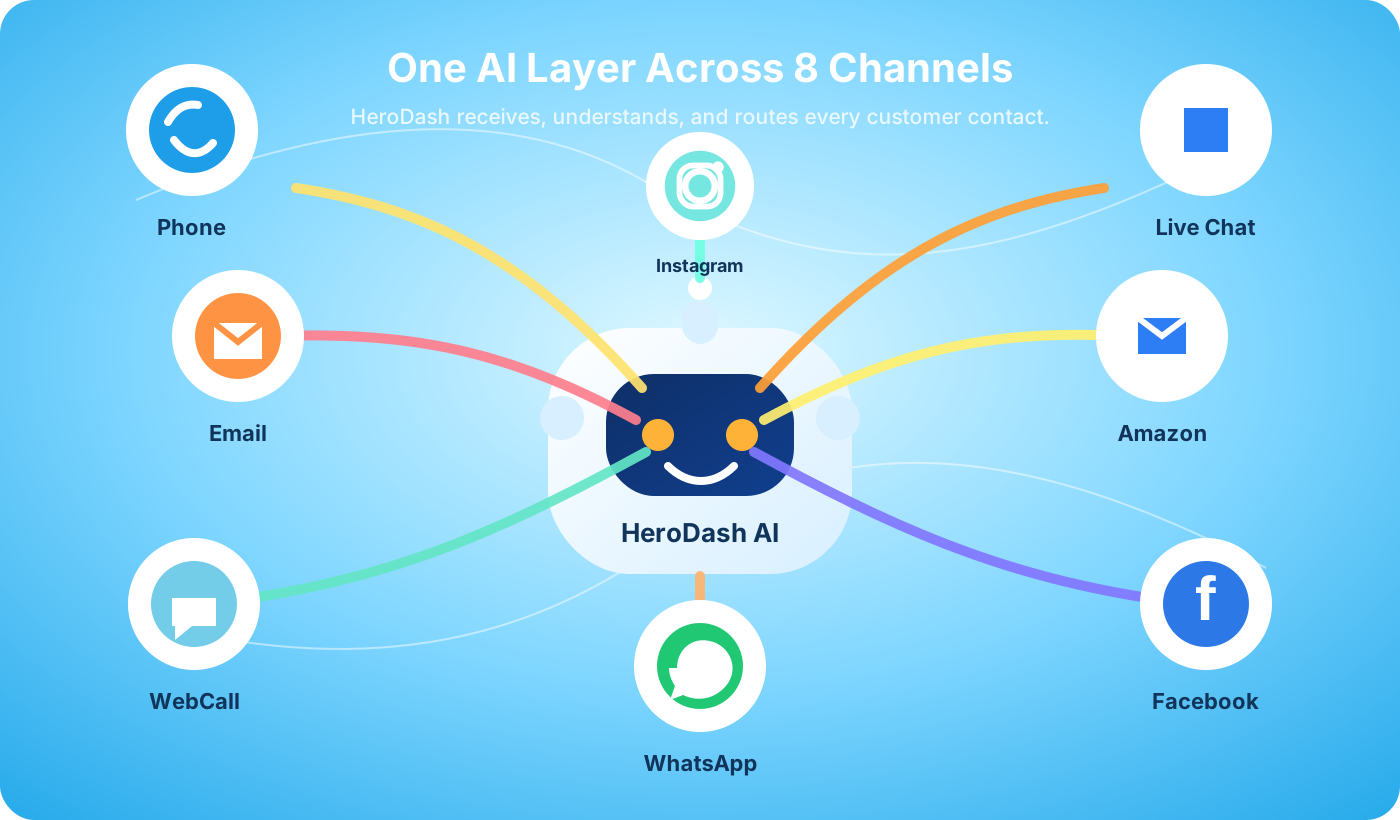
What HeroDash built for EZVIZ and how it actually works
The implementation was not a standard CRM setup. It was a full-stack AI customer service operation running across every channel EZVIZ uses, from first contact through resolution and satisfaction feedback.
Every channel, one place
Phone, WebCall, email, live chat, Amazon messages, Facebook, WhatsApp, and Instagram are all unified inside HeroDash. Agents see everything in a single interface. No switching. No missed messages because someone had not logged into a secondary platform. Context travels with the customer regardless of which channel they used.
For a team managing global contacts across multiple time zones, this alone eliminates a significant source of operational friction. The mental load of monitoring eight separate platforms disappears. The risk of messages going unanswered because they arrived on the wrong system disappears with it.
AI handles the first layer intelligently, not mechanically
For live chat and Facebook contacts, HeroDash’s AI agent functions as the first point of contact. It identifies what the customer is asking, assesses whether the inquiry is straightforward enough to handle directly, and responds immediately when it is.
Standard product questions, basic troubleshooting, usage guidance, and simple account inquiries can be resolved by AI without entering the human agent queue. Response is immediate. The customer gets an answer in seconds rather than waiting for an available agent.
When the AI determines that a contact needs human handling because the issue is complex, because the customer is frustrated, or because the situation does not fit a known pattern, it routes the contact to the appropriate agent based on channel, inquiry type, and routing rules. The agent receives the contact with full context already captured. They do not start from zero.
Email AI that collects information, not just replies
Email support for technical hardware products has a specific and persistent problem: customers describe their issue incompletely.
“My device is not working” tells a support agent almost nothing useful. Without the product model, purchase information, a description of the specific failure, and the customer’s location, the agent cannot diagnose anything. A back-and-forth that takes three or four exchanges to collect basic information makes the customer feel like they are filling out forms rather than getting help.
HeroDash’s email AI changes this. When an email arrives with incomplete information, the AI identifies exactly what is missing and generates a structured follow-up request, prompting the customer to provide the specific details needed to move the inquiry forward. When the customer responds, the AI extracts the relevant information and populates the corresponding fields in the ticket automatically.
The agent who picks up the ticket does not need to read through a long thread to understand the situation. The essential information is already organized and ready to work with.
Country-specific routing rules for real-time channels
For phone and WebCall contacts, EZVIZ now has configurable business hours templates set by country. During service hours, contacts enter the normal handling flow. Outside service hours, the system routes them according to preset rules: to voicemail, to a ticket queue, or to a scheduled callback path, consistently and without requiring human judgment in the moment.
The routing logic also applies to inquiry type. Different categories of contacts, including warranty claims, technical troubleshooting, billing questions, and general product inquiries, flow to the agents trained and configured to handle them. The right contact reaches the right agent automatically.
Structured data from every interaction
Every contact handled through HeroDash is recorded in structured ticket fields: inquiry type, product category, resolution type, handling time, and whatever custom fields EZVIZ’s operation requires. Chat logs and email threads still exist, but the essential information is also captured in a format that can be analyzed, filtered, and reported on.
This turns the support operation into a data source. Recurring issues surface quickly rather than after weeks of manual transcript review. Quality monitoring becomes systematic rather than anecdotal. The information that would previously have stayed buried in unstructured text is now available to the team in a form they can actually use.
Automatic satisfaction feedback after every resolved contact
When a ticket closes, HeroDash automatically sends a CSAT survey to the customer. For phone and live chat contacts, single-interaction ratings are also collected. The satisfaction data feeds directly into the team’s quality monitoring, giving supervisors a continuous read on how customers are experiencing the service instead of only a periodic sample.
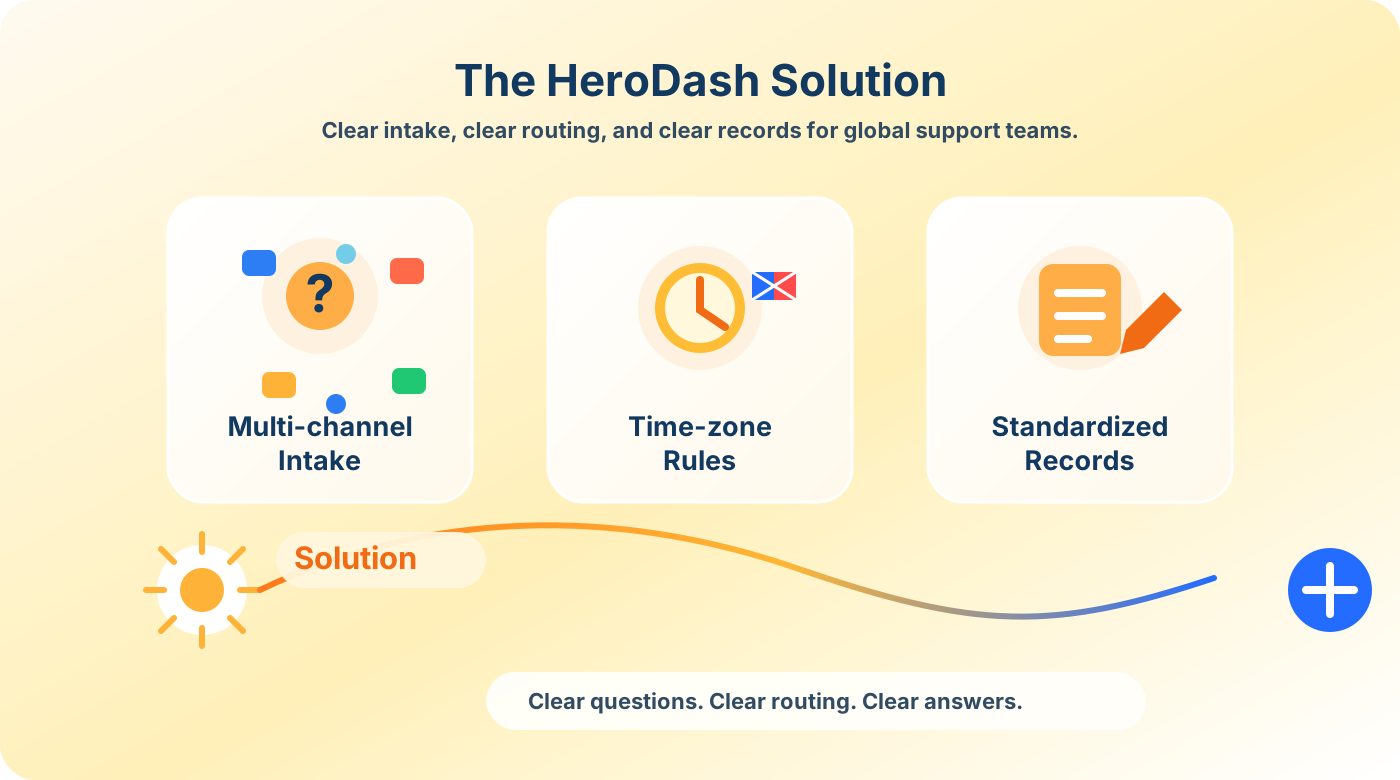
What the operation looks like now
The change is not just operational efficiency. It is a fundamentally different relationship between EZVIZ’s support team and the contacts they handle.
High-frequency, standard inquiries are resolved by AI before they reach a human agent. The human team’s time is concentrated on the contacts that actually require judgment, expertise, and relationship. Agents who were spending significant portions of their day on questions the AI can now answer are instead handling the complex cases where their capabilities matter most.
Routing is automatic and consistent. Contacts do not end up with the wrong agent because someone made a manual judgment call. After-hours contacts follow defined rules rather than whichever person happened to be monitoring at the time.
When a human agent picks up a contact, whether it came from email, phone, chat, or social media, they have complete context: the customer’s channel history, the information collected by the AI, the inquiry category, and the relevant product details. The conversation starts from understanding rather than from zero.
And the data that the operation generates is now structured and accessible: every inquiry type, every resolution path, every satisfaction score. The team can identify what is driving volume, where resolution times are longest, which product issues are generating repeat contacts, and what changes would have the most impact.
The support operation has become a source of intelligence about the customer experience, not just a system for processing contacts.
What this means for global smart home brands
EZVIZ’s challenge, with multiple channels, multiple markets, multiple languages, and complex technical products, is not unique to them. It is the standard operating environment for any connected hardware brand that has successfully expanded beyond its home market.
The brands that manage this well do not add more people every time complexity increases. They build systems that handle complexity at the infrastructure level, so that human capacity is reserved for the interactions where human judgment genuinely makes a difference.
That means AI that functions as a first-line colleague rather than a simple autoresponder. It means routing logic that puts the right contact with the right agent automatically. It means structured data that turns every interaction into operational intelligence. It means satisfaction feedback that closes the loop on every resolved contact.
That is not a vision of what customer support could look like. For EZVIZ, it is what the operation looks like now.
Managing global customer support across multiple channels and markets?
HeroDash helps smart home, ecommerce, and connected hardware brands unify AI triage, multilingual support workflows, structured ticket data, and quality monitoring across global channels.
If your team is managing phone, email, live chat, marketplace messages, and social support at the same time, the challenge is not only answering faster. It is building one operating layer that can receive the contact, understand it, route it, document it, and improve from it.
Learn how HeroDash unifies your operation, or talk to our team about what building this could look like for your brand.