Privacy note: To protect customer confidentiality, identifying details have been removed.
Key Takeaways
- HPDC was shipping heavy compressors on assumption — without confirming whether the address was valid or the receiving site could actually accept the freight. The reverse-logistics cost on a large compressor is not a small line item.
- The first fix happened before the product shipped: a two-layer address and delivery-conditions check on every order, so failed deliveries are caught in the warehouse, not on the road.
- Active freight monitoring surfaces delays before the customer notices — a proactive update, from HPDC’s team, beats a customer discovering the delay after days of silence.
- Results: delivery accuracy rose from 86% to ≥98%, customer satisfaction from 85% to ≥96%, with an average CSAT of 4.88/5 across a structured, dashboard-visible feedback loop.
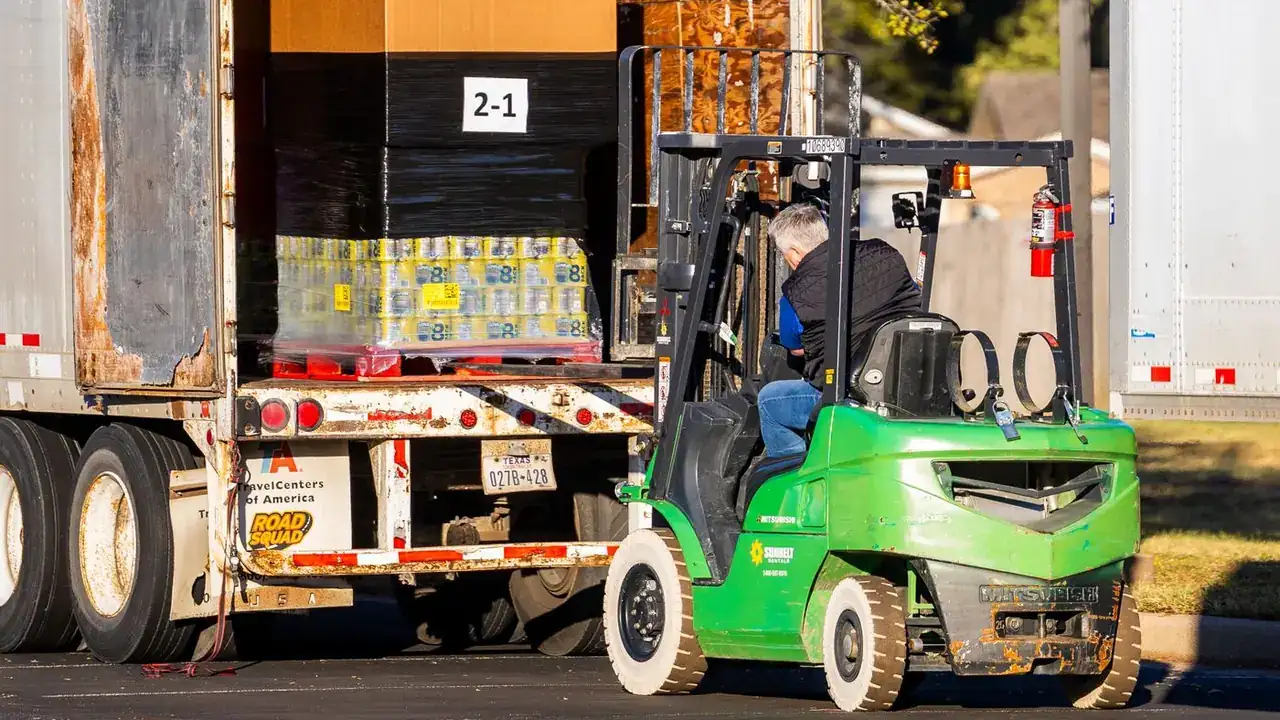
Industrial compressors are heavy, expensive, and nearly impossible to return without significant cost. HPDC was shipping them without confirming whether the delivery address was real or whether the receiving site could actually accept the freight. Here’s what the operation looks like now.
The problem with shipping heavy equipment on assumption
HPDC makes permanent-magnet variable-frequency compressors and silent oil-free scroll compressors — the kind of equipment that runs auto repair shops and commercial body shops in North America. These aren’t impulse purchases. They’re high-ticket, high-weight business investments, and when something goes wrong with the delivery, the cost doesn’t stay small. Last-mile delivery already accounts for roughly half of total shipping cost — and a meaningful share of freight deliveries fail on the first attempt. On heavy freight, each of those failures is a full round trip.
Three problems were eating into margins and generating a steady flow of complaints.
Failed deliveries at a rate carrier error alone couldn’t explain. North American addresses are complicated — PO Box versus commercial address, residential versus industrial zoning, state-level format variations — and HPDC’s process hadn’t been built to catch the problems before the truck left the warehouse. When a compressor arrived at an address that didn’t match the freight requirements, or when no one was there to receive it, the product came back.
Nobody was watching the shipment in transit. Large LTL freight can sit at transfer hubs for days before anyone notices. By the time a delay surfaced in HPDC’s system, it had usually already surfaced in a customer complaint. The auto shop waiting on a compressor to get back to work had been waiting without information for days before anyone reached out.
Feedback was scattered and unstructured. B2B buyers have specific technical questions during installation and initial use. Those questions were coming in through different channels with no unified system, no tagging, no way to identify patterns. The same issues kept repeating because there was no way to see them accumulating.
What changed — starting before the product ships
Callnovo’s approach to the HPDC account started earlier than most customer service operations go. The first intervention wasn’t in the complaint queue. It was at the point of order confirmation.
Normalize and validate the address
Every order is checked before dispatch: PO Box addresses are flagged, commercial-versus-residential classification is verified, state-specific format issues are corrected. Addresses that can’t be validated against delivery requirements don’t proceed until they’re confirmed.Confirm delivery conditions with the site
Does the site need a liftgate truck? Can a large freight vehicle actually access the location — wide enough entry, adequate clearance, appropriate surface? One call or email before dispatch, confirming the delivery can be received the way it’s being sent, eliminates that failure cost almost entirely.Only then, dispatch
The confirmation step is built into the standard order flow for every HPDC shipment — so a failed delivery is caught in the warehouse, not discovered on the road.For a heavy compressor on an LTL freight shipment, this isn’t a bureaucratic formality. When “does the site need a liftgate?” goes unanswered, the result is a compressor sitting on a truck that has to come back, and the full cost of that round trip landing on HPDC’s operation.
Active freight monitoring — before the customer notices anything is wrong
LTL shipments move through multiple transfer points. When a compressor sits at a hub longer than expected, the system flags it. The Callnovo team doesn’t wait for the customer to call — they open a tracking inquiry with the carrier, establish what’s happening, and update the auto shop before the auto shop has to ask. It’s the same proactive-monitoring model we run at scale — see the Latin America logistics call center case.
An auto shop that knows its compressor is delayed and knows when to expect it can plan around it. An auto shop waiting in silence for three days is calling to complain — and often escalating before anyone has had a chance to explain anything.
Technical support that actually knows the product

The agent assigned to HPDC’s account — Boris — went through specialized training on HPDC’s compressor line before handling a single contact. Not a product-literature review. Actual technical training: motor types, pressure specifications, installation sequences, common fault conditions, and the specific questions auto-shop mechanics ask when commissioning a new compressor.
HPDC’s North America operations director noted this directly:
Boris learned and understood our product features and performance — he understands buyer inquiries more accurately and provides better technical support.
HPDC North America Operations Director, Industrial Compressor Brand
For B2B buyers in a commercial setting, this distinction matters more than in consumer ecommerce. An auto-shop owner who calls with a technical question isn’t looking for reassurance; they’re looking for an answer they can act on. An agent who escalates every technical inquiry — or gives an answer that doesn’t match the buyer’s real situation — is adding friction to a relationship that already involves a significant commercial transaction.
Boris also built in a consistent pre-shipment habit the operations director highlighted: proactively confirming buyer names and mailing addresses during communication, before anything ships. Small, repeatable, and responsible for catching a class of errors that would otherwise surface as delivery failures or returned shipments.
The red and green channel — turning feedback into an asset
HPDC’s feedback had been arriving through scattered channels with no structure. Callnovo rebuilt it into a closed loop that routes positive and negative signals differently — and acts on each within a defined timeframe.
Every service interaction triggers an automatic 1–5 star CSAT survey the moment the call or chat closes. Two weeks after delivery, the team makes a warm call to every HPDC account — a structured follow-up about actual operating experience: How is the compressor performing? Any issues with noise, pressure, energy consumption? That window catches complaints that haven’t surfaced yet and collects genuine feedback from buyers using the equipment commercially.
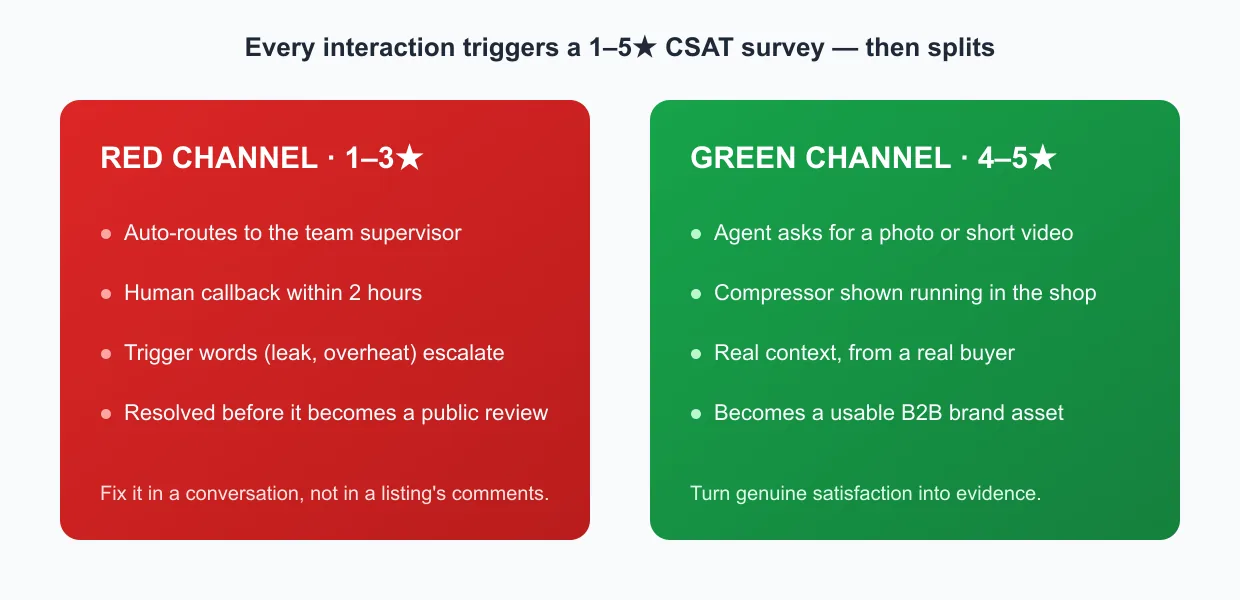
The red channel (1–3 stars) — any low score, or any contact containing trigger terms like “leak” or “overheat,” routes automatically to the team supervisor for a human callback within two hours. The goal is to resolve it in a direct conversation, before it becomes a product-listing comment every other potential buyer can read. Resolving fast matters: SQM Group finds customer satisfaction drops sharply with each additional contact a customer needs to close an issue.
The green channel (4–5 stars) — a strong score triggers a specific ask: a photo or short video of the compressor running in the shop. Not a generic review request — real, contextualized evidence of the product working in a commercial environment. These become usable B2B brand assets, from actual buyers running actual businesses.
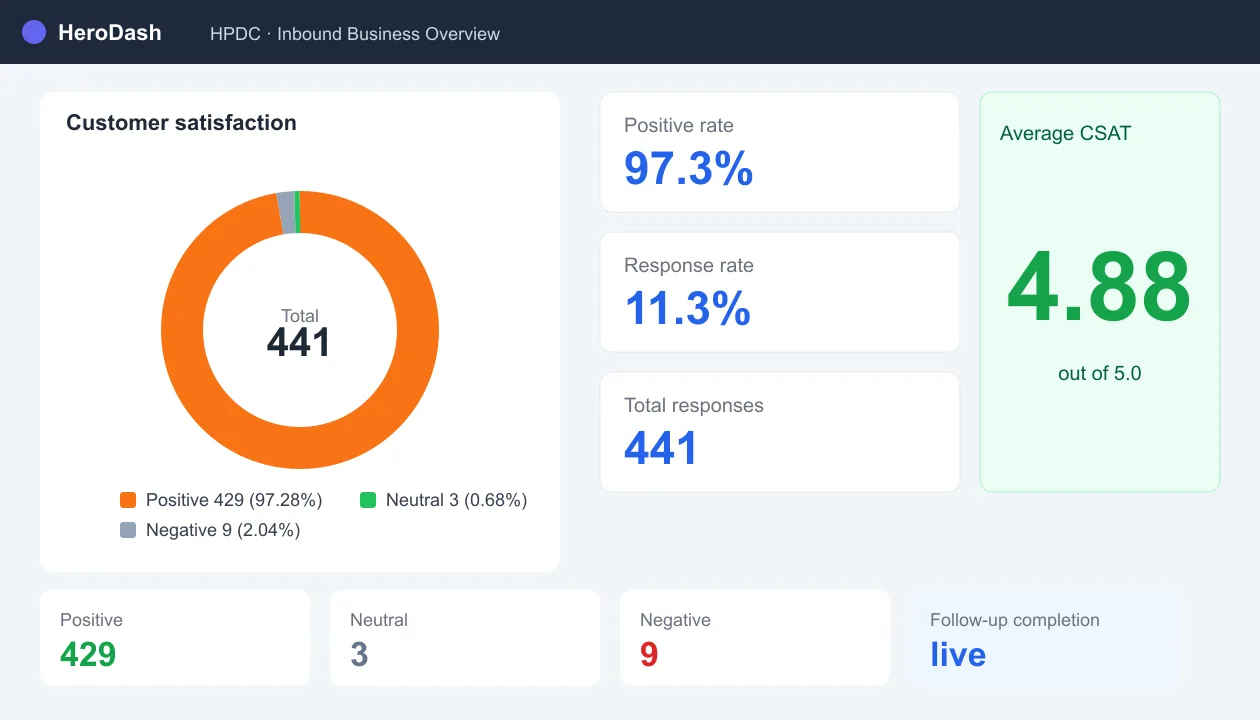
All of it is visible on a live dashboard — satisfaction trends, complaint categories, follow-up completion, review conversion — in real time, not in a monthly report that arrives after the damage is done.
The results
HPDC — traditional model vs. after Callnovo
Across 441 logged CSAT responses, HPDC’s average score is 4.88 out of 5 — 97.3% positive — while delivery accuracy rose from 86% to ≥98% and customer satisfaction from 85% to ≥96%.
In daily communication, Boris proactively confirms the buyer's name and mailing address to avoid unnecessary errors when we ship products or spare parts. As our business grows and sales volume increases, high-quality customer service provides strong support for the long-term development of our products.
HPDC North America Operations Director, Industrial Compressor Brand
What industrial and B2B brands should take from this
HPDC’s situation is specific to heavy industrial equipment, but the logic applies to any high-ticket, high-weight, technically complex category where delivery failures are expensive and B2B buyers have real technical expectations.
For this class of product, customer service isn’t a post-sale function. It’s a pre-sale function, a logistics function, and an intelligence function at the same time — confirming delivery can happen before the product leaves the warehouse, surfacing transit problems before they become complaints, and turning structured feedback into both early warnings and brand evidence.
If the answer to the first question is “we find out when it fails,” the cost of that discovery process is already built into your return rate. HPDC’s compressors were always good. The support operation just needed to match them.
FAQ
Why do heavy-freight deliveries fail so often?
Because the delivery is arranged on assumption. For a heavy compressor on an LTL freight shipment, the site may need a liftgate truck, and a large freight vehicle may not be able to access the location. When those conditions aren’t confirmed before dispatch, the result is a failed delivery and the full cost of a return trip. North American address complexity — PO Box vs commercial, residential vs industrial zoning, state-level format variations — adds another layer of avoidable failures.
Should delivery conditions be confirmed before shipping heavy freight?
Yes — for heavy freight it isn’t optional. One phone call or email before dispatch, confirming the address is valid and the site can actually receive the shipment the way it’s being sent (liftgate needs, vehicle access, clearance, surface), eliminates most failed-delivery cost. HPDC now runs a two-layer check — address normalization plus direct confirmation of delivery conditions — on every order before it moves.
How does proactive freight monitoring change the customer experience?
The customer still has the same delay, but they experience it completely differently. Instead of discovering a delay themselves after days of silence, they get a proactive update from the brand’s team — where the freight is, why it’s delayed, and the new estimated date. An informed customer can plan around a delay; a customer waiting in silence calls to complain and often escalates before anyone can explain.
What is the red/green feedback channel?
A closed-loop system that routes satisfaction signals differently. Low scores (1–3 stars) or contacts with trigger words like leak or overheat auto-route to a supervisor for a human callback within two hours — resolving the issue before it becomes a public review. High scores (4–5 stars) trigger a request for a photo or short video of the compressor running, which becomes a real B2B brand asset. Everything is visible on a live dashboard.
About Callnovo
Callnovo is a global multilingual customer support partner, building dedicated specialist teams for ecommerce, industrial, and B2B brands across 65+ languages on the HeroDash operations platform. For heavy and high-ticket products, that means support that starts before the product ships — verifying delivery, monitoring freight, and turning structured feedback into both early warnings and brand evidence.
Selling industrial equipment or high-ticket B2B products in North America? Explore Callnovo’s dedicated specialist support teams, the HeroDash operations platform, and our multilingual support — or talk to our team about what the right setup looks like for your product and customer base.
Sources
- Statista — last-mile share of total shipping costs
- SQM Group — first-contact resolution & customer satisfaction
Client details used with permission. Agent name used with permission. Performance metrics reflect results from an active Callnovo partnership.