Privacy note: To protect customer confidentiality, identifying details have been removed.
Key Takeaways
- FlexiRise didn’t build a new support operation for Germany — it moved the one that already worked in the US. Same system, new language.
- The US return rate fell from 32% to 18% in three months, driven by agents trained deeply enough on the product to resolve installation issues in a single call.
- That proven knowledge base, SOPs, and QA framework are what transferred to Germany — live in under a month, versus the months it takes to rebuild from scratch.
- For technical products, the knowledge base that answers a US installation question is ~80% of the way to answering a German one. The product doesn’t change at the border; the language does.
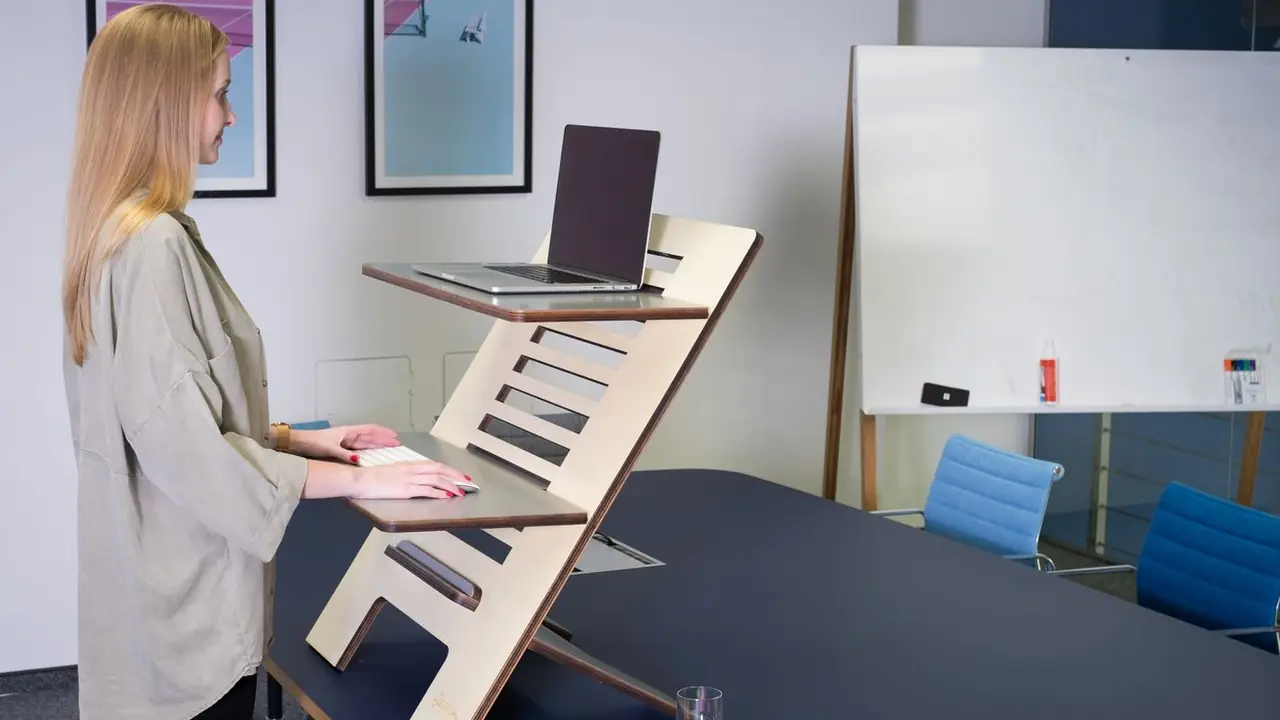
FlexiRise didn’t build a new support operation for Germany. They took the one that already worked in the US and moved it. Here’s what that looks like in practice — and why it worked.
The problem that started everything
FlexiRise makes electric standing desks in the $150–$200 range. The US Amazon channel was generating 500+ orders a month. By most measures, the business was working.
The return rate was 32%.
The product wasn’t defective. The issue was installation and operation. Standing desks are electromechanical products — motors, control panels, height presets, cable management. Buyers who ran into setup problems had questions that required real product knowledge to answer. FlexiRise had tried building an in-house English-language support team. After months of training, the team still couldn’t independently resolve installation and operation issues. Complex contacts kept escalating. The return rate kept climbing.
In February 2026, Callnovo took over the US English-language support operation. Three months later, the return rate was 18%.
That improvement — and everything that made it possible — became the foundation for what happened next.
What actually fixed the return rate
The 14-point reduction didn’t come from better scripts or faster response times. It came from agents who genuinely understood the product.
Before going live, Callnovo’s US team went through structured product training on FlexiRise’s desk lineup — motor types, weight-capacity parameters, installation sequences, common fault codes, and the troubleshooting logic for each failure mode. The knowledge base built during this period covered the exact scenarios generating returns: incorrect assembly steps, control-panel calibration, cable-routing errors, and height-memory configuration.
When a buyer called saying their desk wouldn’t reach the height they’d set, the agent knew whether it was a calibration issue, a memory-preset conflict, or a motor fault — and could walk them through the fix in a single call. Returns that had been inevitable became recoverable. It’s the same pattern across technical categories: a dedicated, product-trained team resolves issues a generalist pool would escalate.
FlexiRise US results (Feb–May 2026)
The full KPI picture from the first three months live:
| KPI | Target | Achieved |
|---|---|---|
| Avg. first response time | ≤ 60 sec | 42 sec |
| Phone answer rate | ≥ 95% | 97.3% |
| First-contact resolution (FCR) | ≥ 75% | 82% |
| Customer satisfaction (CSAT) | ≥ 90% | 94% |
| Return interception rate | ≥ 30% | 37% |
| Negative-review response time | ≤ 2 hrs | 1.3 hrs |
| Ticket closure rate | ≥ 95% | 98% |
That knowledge base, those SOPs, that troubleshooting framework — all of it was documented and live in the system, tested and refined across three months of real US contacts. This is what FlexiRise took to Germany.
Running a technical product across several markets? The system that earns these numbers in one country can move to the next — see how Callnovo plans multi-market support.
Three things that make Germany harder than the US
Entering Germany with a product like a standing desk isn’t just a language exercise. Three specific factors make the German market meaningfully more demanding than North America for this category.
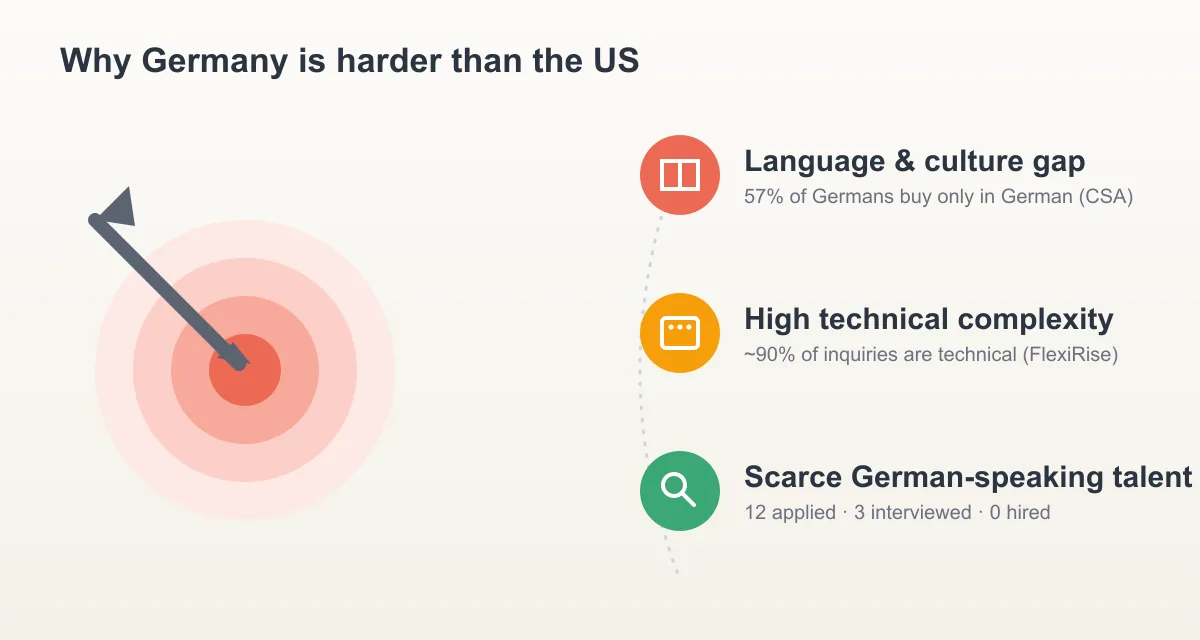
German consumers communicate differently — and expect you to as well. Native German isn’t a nice-to-have: CSA Research found that 57% of German-speaking consumers will only buy in their own language — and globally, 76% of shoppers prefer products with information in their language while 40% won’t buy from sites in other languages. A non-native response — whether from a translation tool or a non-fluent speaker — is detectable, and in Germany it reads as a signal the brand hasn’t taken the market seriously. Beyond language, the style is specific: “We’ll get back to you as soon as possible” is not an acceptable answer. A customer asking when their replacement part arrives expects a date, not an assurance.
The technical complexity is amplified. In FlexiRise’s own German contacts, roughly 90% of inquiries center on technical issues. German buyers frequently assemble products independently and expect precise troubleshooting, not a generic checklist. An agent who can’t diagnose whether a motor fault is electrical or mechanical — or who escalates every technical question — creates delays that cost returns. The market also has specific standards that matter: DIN EN 1335 for office furniture, weight-capacity certifications, and motor-compliance documentation. An agent who doesn’t know these exist can’t answer what sophisticated German buyers ask before and after purchase.
Native German-speaking talent is genuinely hard to find quickly. FlexiRise tried the standard approach first — posting a German-language support role on job boards. One month later: 12 applications, 3 interviews, 0 hires. None combined adequate language ability with customer-service experience. Their Germany market lead put it simply:
“By the time we found someone and got them trained, peak season would already be over.”
The decision: don’t build from scratch, transfer what works
FlexiRise’s answer wasn’t to find a new vendor and start over. It was to extend the existing partnership and move the proven system.
The logic was straightforward. Callnovo had already built a support operation for FlexiRise’s product that worked. The knowledge base existed. The troubleshooting SOPs existed. The quality standards and KPI frameworks existed. Building a new operation for Germany from zero would have meant rediscovering everything the US operation had already figured out over three months of live contacts.
Instead, the US system was translated and adapted. The product knowledge base was rendered into German and supplemented with Germany-specific content: DIN EN 1335 references, German-market assembly documentation, and a fault-code library localized for German buyers’ typical installation environment and terminology. From requirement confirmation to team live: under one month.
How the German team was built and trained
Callnovo sourced candidates from its European talent network, screening specifically for native German speakers with customer-service experience in office furniture or mechanical products. FlexiRise participated directly in interviews — the same approach used for the US team, where brand-side involvement in selection had been a significant factor in quality.
Training ran on two parallel tracks:
FlexiRise led product training
Desk structure, installation sequences, motor systems, common fault scenarios, parts identification — the knowledge that separates an agent who resolves a technical inquiry independently from one who escalates everything.Callnovo ran language & soft-skills certification
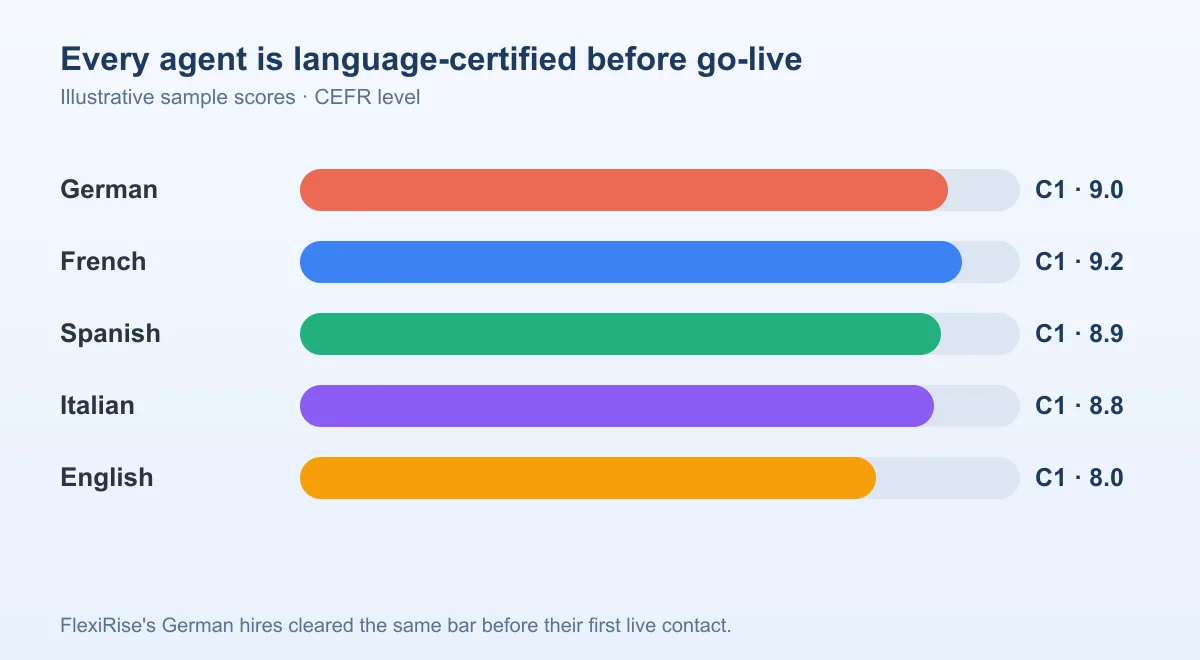
German technical-vocabulary verification, communication-style calibration for the German market, and the precision-over-reassurance approach German customers expect.Certified in one week
One week from training start to certification. Two native German-speaking agents live on June 24, 2026.Language certification isn’t a formality. Every Callnovo agent passes a structured language assessment before their first live contact — and the German hires cleared the same bar.
The system that ties it together
Both the US and Germany operations run through HeroDash — Callnovo’s customer service platform — so the channel-fragmentation problem that usually accompanies multi-market expansion simply doesn’t exist for FlexiRise.
A buyer who emailed about a motor issue last week and is now calling about a replacement part doesn’t have to re-explain. The agent already has it. The same retrieval logic that has been reducing escalations in the US since February now runs in German.
What this means for brands expanding into Europe
FlexiRise’s path — US first, Germany second, same system — reflects a repeatable logic any brand can apply.
The instinct when entering a new market is to treat it as a new problem: new vendor, new team, new setup, new everything. That instinct is expensive and slow. Every new setup repeats the same learning curve — the same early errors, knowledge gaps, and escalation patterns that take weeks of live contacts to resolve.
For technical products specifically — anything with installation complexity, mechanical components, or calibration requirements — this matters even more. The knowledge base that resolves a US installation question is 80% of the way to resolving a German one. The product doesn’t change at the border. The language does, the communication style does, and some market-specific standards do. Everything else is already solved.
FAQ
Why do German customers need native German-language support?
Native-language support is an expectation, not a convenience. CSA Research found that 57% of German-speaking consumers will only buy in their own language, and globally 40% of shoppers won’t buy from sites in other languages. A non-native or machine-translated reply is easily detected, and in the German market it signals the brand hasn’t taken the market seriously — which directly affects trust, reviews, and returns.
Is it faster to build a new support team for Germany or transfer an existing one?
Transferring a proven system is far faster. The product knowledge base, troubleshooting SOPs, and QA frameworks already exist and only need translation plus market-specific additions. FlexiRise went from decision to live German agents in under one month by reusing its US system — versus the months of live contacts it takes to rediscover that knowledge from scratch.
How long does it take to launch German customer support this way?
FlexiRise confirmed requirements, sourced and interviewed native German-speaking agents, translated and localized the knowledge base, and went live in under a month — with one week from training start to certification. Two native German-speaking agents went live on June 24, 2026.
What German standards matter for selling office furniture like standing desks?
DIN EN 1335 (office furniture), weight-capacity certifications, and motor-compliance documentation are the standards sophisticated German buyers ask about before and after purchase. Agents need to know these exist and be able to reference them accurately.
How does one support platform cover both the US and Germany?
Both operations run through HeroDash. Amazon messages, email, phone, WhatsApp, and social comments route into a single ticket pool, the US and German knowledge bases live in the same system, and FlexiRise’s operations team sees both markets in one place — no separate reporting, no added management overhead.
About Callnovo
Callnovo is a global multilingual customer support partner, helping ecommerce and consumer-product brands run native-language support across 65+ languages on the HeroDash platform. For brands expanding into Europe, that means transferring a proven support system — knowledge base, SOPs, and QA — into a new market instead of rebuilding it.
Expanding into European markets and thinking about how to build support that doesn’t start from scratch in every country? Explore Callnovo’s multilingual support teams, the HeroDash unified operations platform, and our managed support model — or talk to our team about what expansion looks like for your product category.
Sources
- CSA Research — Can’t Read, Won’t Buy (consumer language preference)
- EN 1335 — Office furniture standard (office work chair)
Performance metrics reflect results from an active Callnovo partnership. Client details used with permission.