Privacy note: To protect customer confidentiality, identifying details have been removed.
Key Takeaways
- Two facts didn’t fit together. BW’s products ranked top-ten on Amazon, Walmart, Wayfair, and TikTok Shop — but its CSAT was 3.8. The support experience felt like a budget product even when the product didn’t.
- Three vendors, three capability tests. Peak-season scaling, management visibility, and product knowledge across a complex line. Two vendors failed the same tests in different ways.
- The decisive gaps weren’t price. A remote vendor had no talent bench for peak season; a physical vendor kept the operation a black box. Callnovo cleared all three.
- CSAT moved from 3.8 to 4.9 — not by finding better agents, but by building an operation with the training, visibility, and scaling infrastructure to deliver consistently.
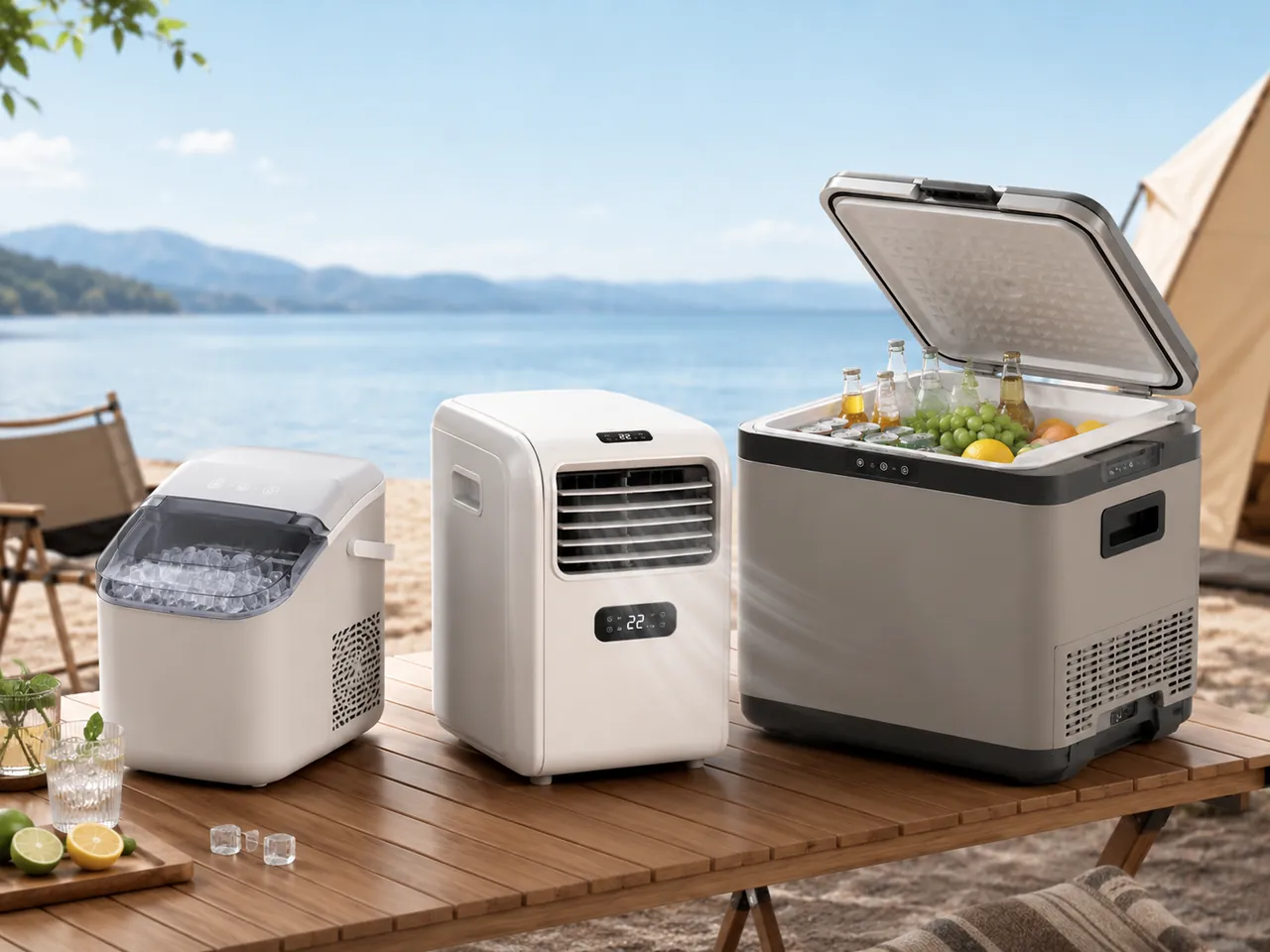
BW makes ice makers, portable air conditioners, and car refrigerators. Annual revenue hit $300M. Their products were sitting in the top ten of their categories on Amazon, Walmart, Wayfair, and TikTok Shop simultaneously. Their CSAT score was 3.8.
Those two facts don’t fit together — and BW knew it.
The gap between product performance and brand perception
BW’s products were genuinely competitive. Across ice makers, portable air conditioners, and car refrigerators, the brand was placing in the top-ten bestseller rankings across multiple major platforms at once. Revenue had crossed $300 million annually. By the metrics that most ecommerce operations track, BW was succeeding.
But BW was trying to do something harder than sell products at volume. They were trying to move upmarket — to shift from being perceived as a value-priced white-label manufacturer to being recognized as a premium brand. And in that effort, one thing was working against them consistently: the customer service experience felt like a budget product even when the product didn’t.
The in-house team back in China handled basic email queries. Response times were slow. Complex technical questions — troubleshooting a portable AC that wasn’t cooling, diagnosing an ice maker that wasn’t producing — were beyond what the team could handle. Phone support in English, which North American customers expect when an appliance goes wrong, didn’t exist. The result was a CSAT score of 3.8 that pulled against everything the product side was building.
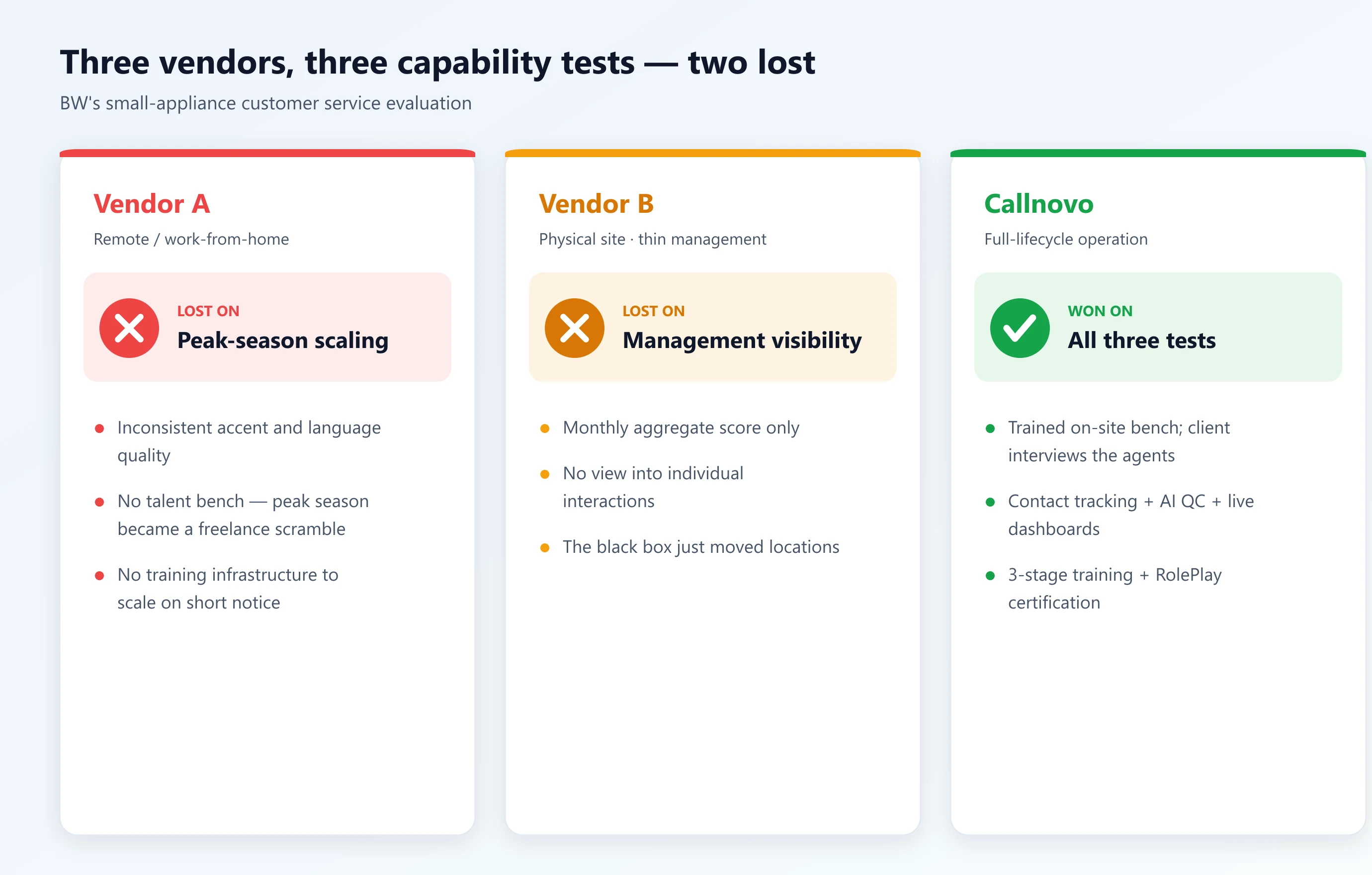
BW ran a formal vendor evaluation to fix it. Three providers. Three specific capability tests. Two of them failed the same tests in different ways.
The first test: peak-season scaling
Small appliances are a seasonal category. Ice makers and portable AC units peak in summer. Car refrigerators peak around travel season. For BW, selling across multiple platforms in North America, peak season meant inquiry volume that could multiply quickly and without much warning.
Vendor A offered a remote work model — agents working from home, lower unit costs, presentable on paper. The test period revealed two problems the cost numbers hadn’t shown.
First, accent and language quality was inconsistent. Remote hiring pools aren’t filtered the same way in-center recruiting is, and the variability showed up in customer-facing interactions — compounding the exact “budget brand” perception BW was trying to escape.
Second, peak-season scaling in a remote model meant recruiting freelance part-time workers on short notice. There was no talent bench. There was no training infrastructure to bring new people up to standard quickly. When peak season arrived, the scaling plan was essentially: hope enough qualified people respond to a job posting in time. For a brand trying to hold consistent quality during its highest-stakes weeks, that isn’t a plan.
Callnovo operates from physical centers — including a Philippines call center with a trained, full-time, on-site team. When BW needed to scale for peak season, Callnovo drew from an existing trained talent pool rather than starting a recruitment cycle. BW participated directly in the hiring process — interviewing and selecting the agents who would work their account — which addressed the quality-consistency problem the remote model had left unresolved.
You can't hire quality in a week. Either the trained bench exists before peak season or it doesn't — once the volume hits, there's no catching up.
Neil Fernandez, Operations Manager, Callnovo
The second test: management visibility
BW’s operations team had a frustration that went beyond service quality: they couldn’t see what was happening. Which calls were being handled. What was being said. Which issues were recurring. What the satisfaction data looked like in real time. The customer service operation was a black box — expensive to run, impossible to improve, and disconnected from the product and operations teams who needed the data it was theoretically generating.
Vendor B had a physical operation, which cleared the first concern. But the management infrastructure was thin. BW could get an aggregate satisfaction score at the end of the month. They couldn’t see individual interactions. They couldn’t identify which product issues were generating disproportionate contact volume. They couldn’t tell when an agent had made a commitment they shouldn’t have. The black box problem wasn’t solved — it was just moved to a different location.
Callnovo’s approach here was structural rather than cosmetic.
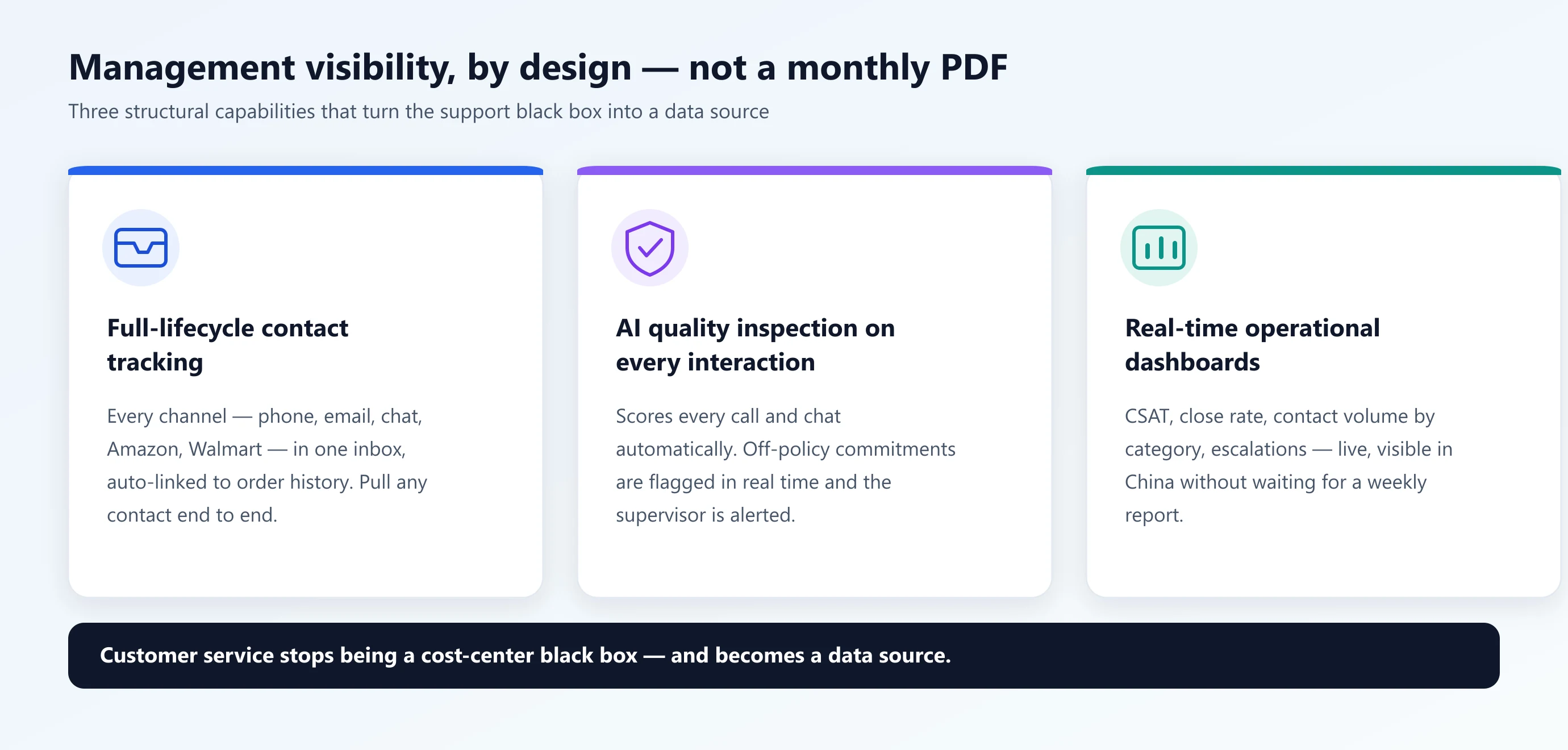
Full-lifecycle contact tracking. Every contact across every channel — phone, email, live chat, Amazon messages, Walmart messages — flows into a unified inbox and is automatically linked to the customer’s order history. BW’s team can pull the complete history of any contact at any time, from initiation through resolution. No customer has to repeat their situation; no interaction disappears into an untracked channel.
AI quality inspection on every interaction. The HeroDash AI quality system scores every phone call and every chat automatically across multiple dimensions. When an agent makes a commitment outside approved parameters — a delivery timeline they can’t guarantee, a refund promise outside policy — the system flags it in real time and alerts the supervisor. Quality problems are caught during the interaction, not discovered weeks later.
Real-time operational dashboards. CSAT scores, ticket close rates, contact volume by category, escalation rates — all of it updates continuously and is visible to BW’s team in China without waiting for a weekly report. When a specific product issue starts generating unusual contact volume, the pattern is visible the same day.
Before, customer service was a cost center — it just spent money. Now it's a data source. The support team is feeding information back to our product and operations teams that we couldn't get any other way.
Operations Lead, BW
The third test: product knowledge across a complex line
This was the test BW was most skeptical about. Their product line spans ice makers, portable air conditioners, car refrigerators, and related categories — each with different failure modes, different troubleshooting logic, and different common questions. A portable AC that isn’t cooling and an ice maker that isn’t producing ice are completely different diagnostic conversations. An agent who can handle one doesn’t automatically understand the other.
Traditional training — give agents the manual, have them memorize it, put them on calls — doesn’t work for a product line this broad. BW had watched it fail before. Agents could recite specs but couldn’t actually help a customer diagnose a real problem.
Callnovo’s training for BW’s account ran in three stages, each building on the last.
AI-assisted course development
Product manuals, repair videos, and technical documentation were processed through HeroDash’s AI tools into interactive question-and-answer training cards. Agents worked through scenario-based simulations — the AI presenting a customer situation, the agent determining the diagnostic path — instead of reading static documentation.
SOPs for high-frequency issues
The most common problems — “ice maker not producing,” “portable AC not cooling,” “car refrigerator temperature inconsistent” — were each broken into a standard troubleshooting checklist, with standard language for each step and clear criteria for escalation. Agents don’t improvise; they work a validated sequence.
Multi-channel RolePlay certification
Agents passed RolePlay certification covering phone, live chat, and email — simulating complaints, technical disputes, and emotional escalation. Scores had to reach a defined threshold before any agent went live on BW’s account. Those who didn’t clear it went through targeted training until they did.
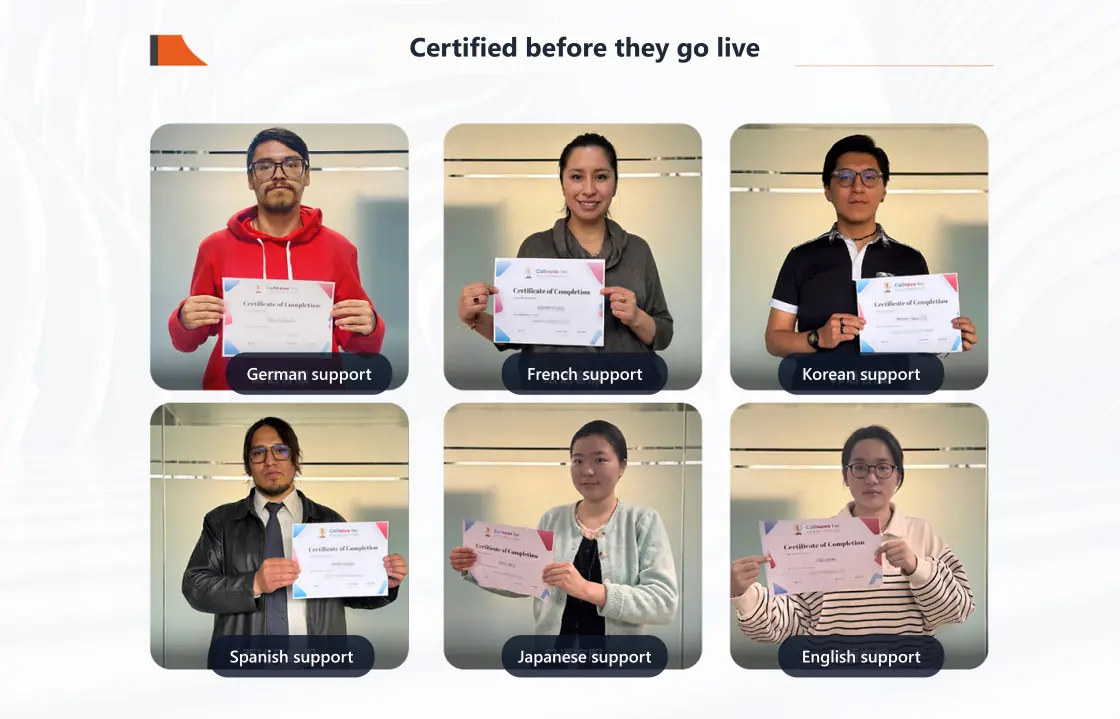
The result was agents who could handle the diagnostic conversation for any product in BW’s line — not by memorizing facts about each product, but by understanding how to work a troubleshooting sequence in a way that actually moved toward resolution.
What changed — and what the data showed
CSAT moved from 3.8 to 4.9.
BW — before vs. after Callnovo
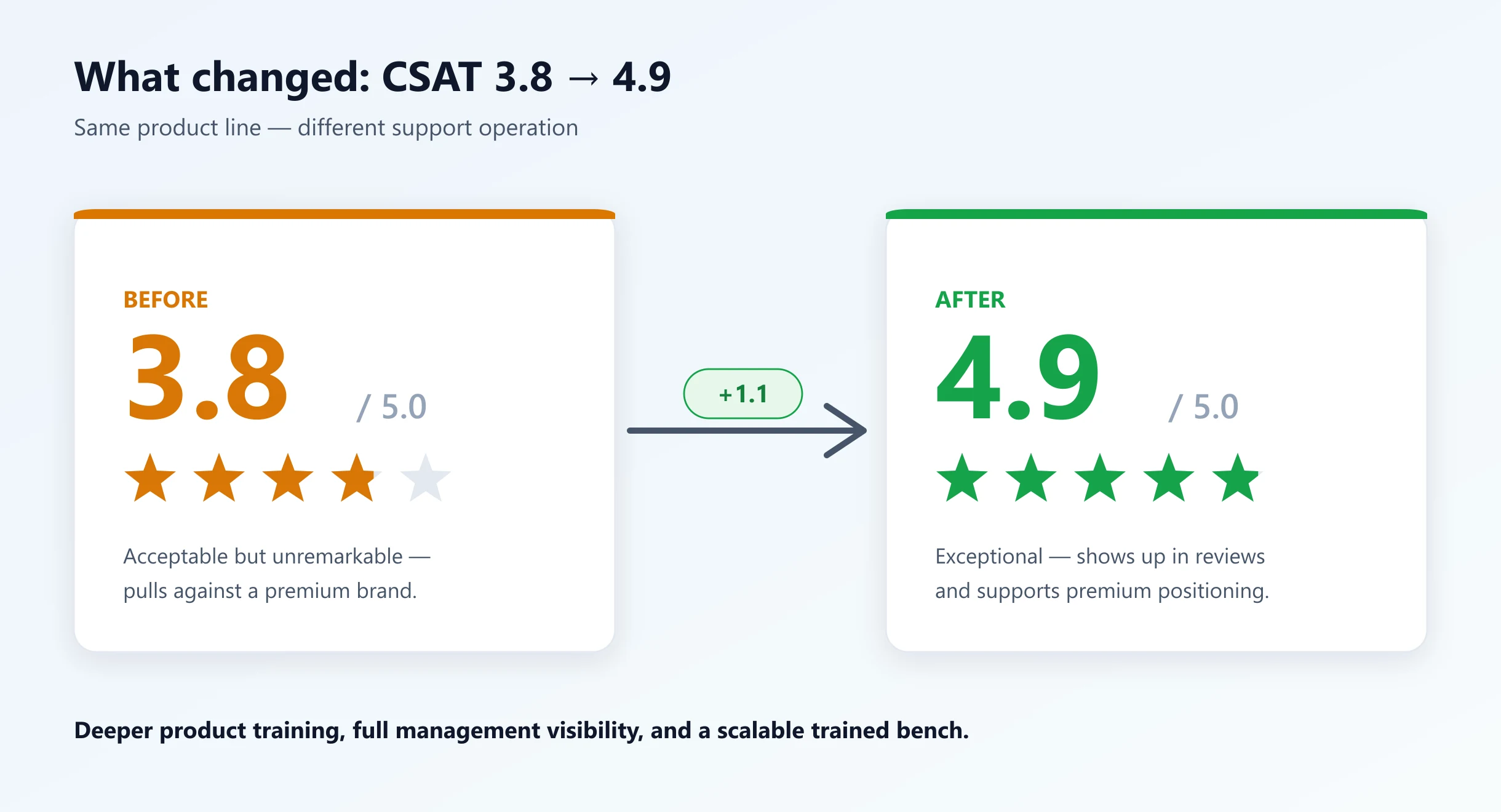
That’s not a small movement. On a five-point scale, 3.8 is “acceptable but unremarkable” — the kind of score that doesn’t create loyalty or drive recommendations. 4.9 is “exceptional” — the kind that shows up in product reviews, gets mentioned by customers who refer friends, and supports a premium positioning in a way that 3.8 actively undermines.
The underlying change wasn’t mysterious. Customers who called with a technical problem got an agent who could actually diagnose it. Customers who called frustrated got an agent who could handle the emotional dimension without escalating it. Customers who asked about a product’s performance got an accurate, informed answer rather than a read-back of the spec sheet.
The data BW’s team was now receiving also changed how the company operated beyond support. When a specific failure mode started appearing consistently in contact records — a particular issue with one ice maker model’s water intake — the product team could see it in the dashboard before it became a reviews problem. That feedback loop, which hadn’t existed before, started producing product and documentation improvements that reduced repeat contact volume.
What small-appliance brands should take from this
BW’s situation is common among brands that have achieved real scale in North American ecommerce but haven’t yet built support infrastructure that matches their product ambitions. The gap shows up most clearly when a brand is trying to move upmarket — because premium brand perception depends on the complete customer experience, not just the product. Most customers now say the experience a company provides matters as much as its products and services.
A customer who buys a $200 portable AC and has a good product experience but a frustrating support experience doesn’t update their opinion of the product upward. They update their opinion of the brand downward — and PwC finds that one bad experience is enough to push about a third of consumers away from a brand they love. The support interaction is part of what the customer is paying for when they choose a premium-positioned product over a cheaper alternative.
Three questions worth asking about your current operation if you’re in a similar position:
- Can your agents diagnose your most common product failures independently, without escalating to your internal team? If most technical contacts are being escalated, the training isn’t deep enough — and your internal team is absorbing support work that should stay at the front line.
- Do you have real-time visibility into your support operation? A monthly summary tells you what happened. A live dashboard tells you what’s happening now — which is what you need to catch quality problems before they become review problems.
- When peak season arrives, can your support capacity scale in days rather than weeks? A scaling plan that depends on recruiting new staff from scratch is not a plan for a four-day Prime Day or a summer peak. It’s a hope.
BW’s CSAT didn’t move from 3.8 to 4.9 because they found better agents. It moved because they built a support operation with the product knowledge, the management visibility, and the scaling infrastructure to deliver consistent service across a complex product line at North American volume. That combination is what “premium brand” customer service actually requires — and it’s available to any brand willing to build it properly.
FAQ
How should you evaluate an outsourced customer service vendor?
Evaluate vendors against the capabilities that actually break in production, not just price. BW tested three: peak-season scaling (can capacity grow in days from a trained bench, not a freelance scramble?), management visibility (can you see individual interactions and live metrics, or only a monthly aggregate?), and product knowledge (can agents diagnose your most common failures without escalating?). Two of the three vendors failed one of these outright.
Why do remote work-from-home support vendors struggle at peak season?
Remote models often lack a trained talent bench and the training infrastructure to bring new agents up to standard quickly. When volume spikes, scaling means recruiting freelance part-time workers on short notice — essentially hoping enough qualified people respond to a job posting in time. Accent and language quality also tend to be less consistent, because remote hiring pools aren’t filtered the way in-center recruiting is.
What does management visibility mean in customer service outsourcing?
It means seeing what’s actually happening in your support operation in real time: individual interactions across every channel, live CSAT and close-rate dashboards, and automatic flags when an agent makes a commitment outside policy. Without it, customer service is a black box — you get a monthly aggregate score but can’t identify recurring product issues or catch quality problems before they become review problems.
How do you train support agents on a complex, multi-category product line?
Callnovo used a three-stage approach for BW: AI-assisted, scenario-based course development instead of static manuals; standardized troubleshooting SOPs for high-frequency issues such as a portable AC not cooling; and multi-channel RolePlay certification across phone, chat, and email that agents had to pass before going live. The goal is agents who can work a validated diagnostic sequence, not memorize spec sheets.
How much can outsourced customer service improve CSAT?
In BW’s case, CSAT moved from 3.8 to 4.9 on a five-point scale after switching to a support operation with deeper product training, full management visibility, and a scalable trained bench. The gain came from agents who could actually diagnose technical problems and handle emotional escalation — not from simply finding better agents.
About Callnovo
Callnovo builds and staffs dedicated, multilingual customer-support teams for cross-border brands, backed by the HeroDash platform — which pairs unified omnichannel handling with AI quality inspection on every interaction across 65+ languages. From physical centers with trained, full-time agents, Callnovo scales support for seasonal peaks without sacrificing the quality consistency a premium brand depends on.
Selling small appliances or consumer hardware in North America and dealing with the gap between product quality and customer service quality? Explore HeroDash quality monitoring, see how dedicated specialist teams fit your operation, or talk to our team about what building the right support operation looks like for your product line.
Sources
- PwC — Experience is everything: Here’s how to get it right
- Salesforce — State of the Connected Customer
Client identity partially anonymized at their request. Performance metrics reflect results from an active Callnovo partnership.