Key Takeaways
- A weak apology makes customers feel dismissed, even when the agent completes the task correctly.
- The best apology language pairs acknowledgment with action, ownership, and a clear timeline.
- For outsourced ecommerce support, QA has to catch apology patterns before they become review-score problems.

An apology is not the recovery. It is the handoff into recovery.
Consider a common ecommerce support moment: a customer ordered a birthday gift, paid for expedited shipping, and received the package two days late with a damaged box. The agent refunds the shipping fee, sends a replacement, and closes the ticket correctly.
Then the customer reads the message:
“We apologize for the inconvenience. Your replacement has been processed.”
Operationally, the task is complete. Emotionally, the customer still feels like a ticket number. The message never acknowledges the missed birthday, never explains when the replacement will arrive, and never gives the customer confidence that the brand understands what actually went wrong.
This is where ecommerce customer service apology mistakes cost money. Not because agents are unkind. Because the support operation has trained them to complete tasks, not recover trust.
Here are nine apology mistakes ecommerce teams make every day, and the specific replacement language that works better.
Mistake 1: Apologizing without doing anything
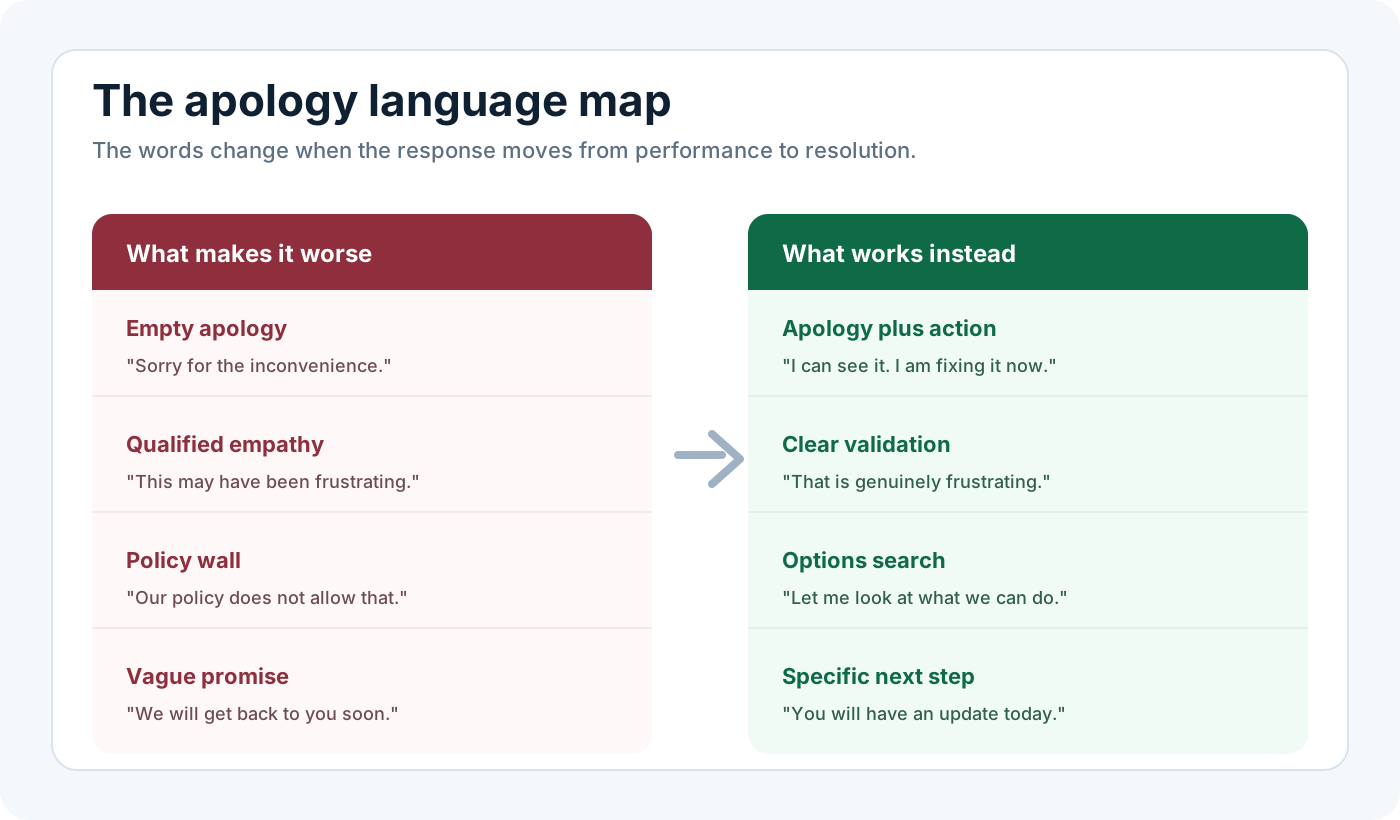
“We’re so sorry for the inconvenience.”
This sentence appears in more customer service interactions than almost any other. It also does very little.
An apology with no action attached is not an apology. It is an acknowledgment that something went wrong, delivered in a tone that suggests nothing is going to change.
Customers who receive this response do not feel better. They feel dismissed. The company knows there is a problem. The company is sorry about it. The company is apparently not doing anything about it.
What to say instead: “I can see what happened here, and I am going to fix it right now. Give me two minutes and I will have this sorted for you.”
The difference is not the apology. It is the action that follows.
Mistake 2: Implying the customer is overreacting
“We understand that this may have been frustrating for you.”
“May have been” does a lot of damage quietly. It introduces uncertainty about whether the customer’s frustration is legitimate. It suggests the agent is not sure the situation was actually a problem. It puts the customer in the position of having to defend their own emotional response.
In ecommerce customer service, where the customer is already irritated enough to contact support, this phrasing accelerates the conversation toward a complaint rather than a resolution.
What to say instead: “That is genuinely frustrating, and I completely understand why you contacted us. Here is what I am going to do.”
Validate first. Act second. No qualifiers.
Mistake 3: Completing the task and missing the moment
Back to the late birthday gift.
The agent refunded the shipping fee and created a replacement order. What the agent did not do was notice that the issue was not only a late parcel. It was a missed occasion.
That distinction matters. Customers do not always complain because a process failed. Sometimes they complain because the failure affected something personal: a birthday, a holiday, a trip, a care package, a school event, or a family visit.
What to say instead: “I am sorry this missed the date it was meant for. I am replacing it today, and I will send the tracking link before this chat closes.”
That sentence still moves the ticket forward. It also shows the customer that the agent understood the real loss.
Mistake 4: Using policy as a wall instead of a starting point
“Unfortunately, our policy does not allow us to do that.”
Policy exists for good reasons. It also makes for terrible customer service when it becomes the first and last thing a customer hears.
When a customer contacts support with a request that falls outside standard policy, they do not want to hear about the policy first. They want to know if their problem can be solved. Policy is an internal constraint. The customer’s problem is what they care about.
Citing policy without offering an alternative leaves the customer with nowhere to go. They have been told no, told why, and given nothing to do with that information except feel rejected.
What to say instead: “Our standard process does not cover this directly, but I am going to check what options we still have. If I cannot approve it myself, I will explain the next escalation step.”
Even when the answer is ultimately no, framing it as a genuine attempt to find a solution changes how the customer experiences the interaction.
For ecommerce brands, this is why support macros should be reviewed inside the broader quality monitoring process, not treated as static copy that agents paste forever.
Mistake 5: Questioning whether the problem is real
“Can you describe exactly what happened?”
On its own, this is a reasonable question. In practice, when it is the first response to a complaint before any acknowledgment of the customer’s experience, it reads as skepticism.
The customer has just told you something went wrong. Asking them to prove it before acknowledging it feels like an interrogation.
This is particularly damaging in ecommerce customer service outsourcing contexts, where the agent may not have visible history with the customer and the customer knows they are talking to someone with no prior relationship to them.
What to say instead: “That sounds like it should not have happened. I am going to pull up your order and take a look at what is going on.”
Acknowledge first. Investigate second. The customer does not have to prove anything before you take them seriously.
Mistake 6: Explaining whose fault it is
“This was actually handled by our fulfillment partner, so the delay was on their end.”
The customer does not have a relationship with the fulfillment partner. They have a relationship with the brand.
When something goes wrong, they do not care which internal department or external vendor is responsible. They care whether it gets fixed.
Explaining the internal chain of responsibility reads as deflection. Even when it is technically accurate, it positions the brand as a bystander to its own customer’s problem rather than the party responsible for solving it.
What to say instead: “I can see there was a delay on this order. I am going to find out exactly where it is right now and get you a clear update.”
Own the resolution regardless of where the fault sits. That is what customers remember.
Mistake 7: The “but” that cancels everything before it
“I completely understand your frustration, but our records show the order was delivered.”
Everything before “but” disappears when customers read it. The acknowledgment of frustration is immediately canceled by the word that follows.
What the customer hears is simple: “I hear you, and you are wrong.”
This is one of the most common ecommerce customer service mistakes and one of the easiest to fix. “But” creates opposition. “And” creates collaboration.
What to say instead: “I completely understand your frustration, and our records show the order was marked as delivered, so I am going to help figure out what happened.”
Same information. Completely different experience.
Mistake 8: Vague reassurance with no timeline
“We will look into this and get back to you soon.”
“Soon” means nothing and promises nothing.
A customer who receives this response has no idea whether “soon” means two hours or two weeks. They will follow up. Your team will handle a second contact that should not have been necessary. The customer will feel like they are chasing you rather than being helped by you.
Vague timelines usually happen when agents do not know exactly when something will be resolved, which is understandable. The answer is not to guess. It is to be specific about what happens next, even if you cannot be specific about the final resolution time.
What to say instead: “I am escalating this right now. You will have an update from me by end of business today. If it takes longer than that, I will contact you proactively before then so you are not waiting without information.”
Specific. Committed. No follow-up contact required.
This is where tools like HeroDash help: the promise, owner, deadline, and next action need to live in the ticket record, not only in the agent’s memory.
Mistake 9: Repeating the apology instead of moving forward
“Again, we sincerely apologize for this experience. We truly are sorry for any inconvenience caused. We want you to know how sorry we are.”
Repeated apologies read as mechanical. They signal that the agent has run out of things to say and is filling space with sentiment rather than substance.
In customer service outsourcing contexts, this pattern often appears when agents have been trained to apologize but not trained on what to do after the apology.
One genuine apology, followed by a clear action, is worth more than five repeated apologies with nothing attached.
What to say instead: “I am sorry this happened. Here is what I am doing about it right now: [specific action]. Is there anything else I can help with while I have you?”
Apologize once. Act immediately. Move forward.
The operating system behind a useful apology
Look at these nine mistakes together and one thing becomes clear: weak apologies are usually operational problems, not personality problems.
Apologizing without acting. Validating without meaning it. Completing the task without noticing the person. Explaining rather than solving. These are the behaviors of a team that has been trained on what to say, but not why the language matters.
The fix is not to ask agents to sound warmer. The fix is to connect apology language to the workflow that follows.
Acknowledge the real issue
Name what happened in the customer’s terms, not only in the company’s process language.
Act while the customer is present
Start the refund, replacement, investigation, or escalation before the reply becomes generic reassurance.
Commit to the next update
Give a clear owner and time window, even if the final resolution is not ready yet.
Learn from the pattern
Tag repeated apology failures in QA so coaching happens before the same language hits more customers.
A clear SOP that connects apology to action
Every acknowledgment of a problem should be followed by a specific next step, with a timeline attached.
Not “we will look into it.” Instead: “I am doing X right now, and you will hear from me by Y.”
For brands building or refining an outsourced support model, this belongs in the SOP and the escalation matrix. Our managed customer support model is built around exactly that kind of operational discipline.
Emotion-awareness training
Agents need to notice when an interaction is more than transactional.
The late-gift example matters because nobody needs a long speech from support. The customer needs one sentence that proves the agent understood why the delay mattered, followed by action that reduces the damage.
Quality monitoring that catches patterns early
An agent who repeatedly uses “but” after an acknowledgment, or who never follows an apology with an action, needs feedback in real time, not in a monthly review after hundreds of customers have already experienced the same interaction.
For ecommerce brands managing customer service outsourcing across multiple languages and markets, this is where platform-level QA monitoring makes the difference.
Patterns that would take weeks to surface through manual review become visible faster, which means they get corrected before enough customers experience the same interaction to mention it in review scores.
At Callnovo, multilingual support teams and HeroDash reporting help operations teams tag issues, review customer conversations, and turn support patterns into coaching actions. The goal is not to make agents sound nicer. The goal is to make recovery consistent.
An apology is the moment a customer decides whether to trust a brand again or start looking for alternatives.
Getting it right is not soft skills training. It is retention strategy.
FAQ: Ecommerce apology scripts
What is a good customer service apology?
A good customer service apology names the specific problem, acknowledges the customer’s experience, explains the next action, and gives a realistic timeline.
Should ecommerce agents say sorry for the inconvenience?
Agents can say sorry, but the phrase should not stand alone. It should be followed by a specific action, such as replacing an item, checking shipment status, or escalating the case.
How should support teams apologize when they need more time?
The agent should be specific about the next update rather than promising a vague timeline. A stronger response is: “I am escalating this now, and I will update you by end of business today.”
How can QA improve apology language?
QA should review whether agents acknowledge the real issue, avoid blame shifting, give a concrete next step, and follow up when they promised to do so.
Where should apology rules live in an ecommerce support operation?
Apology rules should live in the SOP, macro library, escalation playbook, and QA scorecard so agents learn both what to say and what action must follow.
Need ecommerce support that knows what to say next?
Explore Callnovo’s ecommerce customer service operations, quality monitoring, or talk to our team about building apology, escalation, and QA habits into your customer experience.