Key Takeaways
- Customer support data is sensitive by design. A modern support platform can touch identity details, order records, shipping status, recordings, ticket history, and AI processing context.
- HeroDash protects data at the workspace level, not only at the policy level. Masking, role access, MFA, encryption, backups, and audit trails are designed into how support work happens.
- AI support does not remove privacy obligations. If AI is helping agents summarize, classify, route, or respond, the platform still needs clear controls over what data is visible, stored, and traceable.
- Security is part of brand trust. For companies expanding into Europe and other regulated markets, the way customer data is handled can affect both compliance posture and customer confidence.

Most brands evaluate customer service platforms by channel coverage, AI capability, response speed, and cost. Those are useful questions. They are not the whole risk picture.
The question that matters just as much is simpler: what happens to customer data once it enters the support system?
That data may be seen by agents, supervisors, QA reviewers, administrators, and AI tools. It may appear in call recordings, ticket notes, screenshots, message transcripts, and escalation records. If the platform is not designed carefully, the support operation can become one of the busiest data exposure points in the business.
HeroDash was built for customer support operations where AI and human agents work together. That makes security more important, not less. The platform has to protect data while still letting teams resolve issues quickly.
Quick Vocabulary
| Term | What it means in support operations |
|---|---|
| PII | Personally identifiable information such as names, phone numbers, emails, addresses, and ID numbers. |
| MFA | Multi-factor authentication, which requires more than a password to access an account. |
| RBAC | Role-based access control, where permissions depend on the user’s job function. |
| TLS | Encryption that protects data while it moves between systems. |
| AES-256 | A strong encryption standard commonly used to protect stored data. |
| Audit trail | A record of who accessed or changed sensitive information, and when. |
What Actually Flows Through a Support Platform
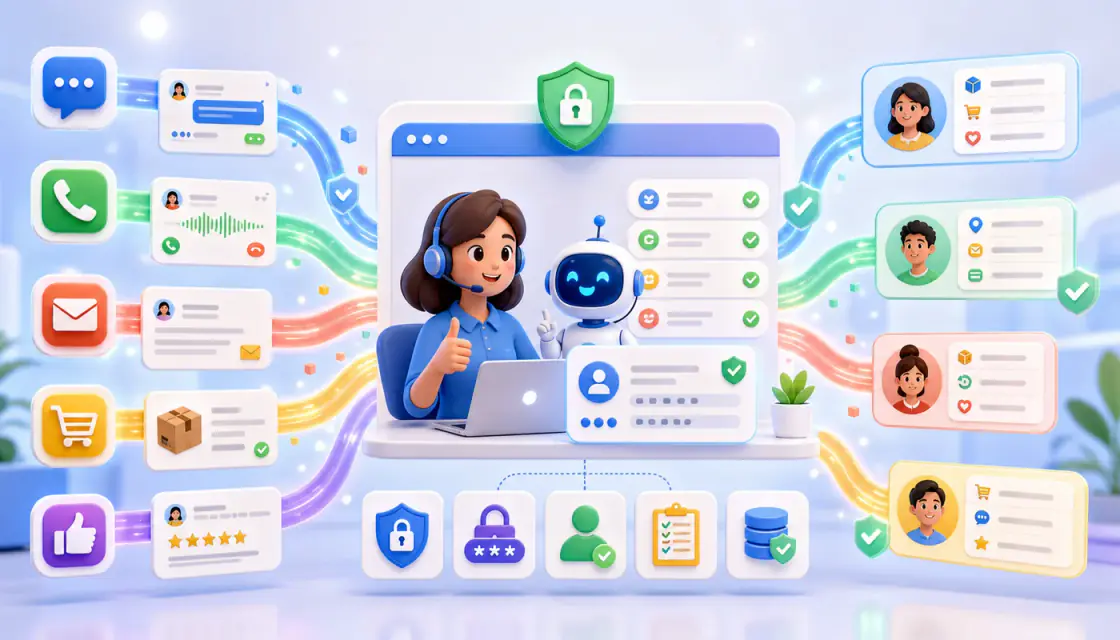
A support platform is not just a messaging inbox. It is where customer inquiries, order information, post-sale status, call recordings, ticket histories, AI-assisted processing, and human collaboration converge.
Every customer interaction can involve names, phone numbers, email addresses, shipping addresses, order numbers, identification details, return requests, payment status, logistics status, and warranty context. The same customer may contact the brand through chat today, email tomorrow, and phone next week. The platform needs continuity, but continuity creates data concentration.
For brands expanding internationally, this data is not only operationally sensitive. In markets governed by privacy rules such as GDPR, it is legally sensitive. The official EU data protection framework sets expectations around how personal data is collected, accessed, protected, retained, and deleted. A support platform has to help the brand meet those expectations instead of adding another unmanaged risk layer.
HeroDash’s Security Foundation
HeroDash is designed around ISO/IEC 27001-aligned security management practices and built to support GDPR-aware customer support operations. For buyers, those two signals matter in different ways.
ISO/IEC 27001 is the international standard for information security management systems. It is about whether an organization manages information security through an intentional system: policies, risk controls, access governance, monitoring, and continual improvement.
ISO also distinguishes implementing an ISO management system standard from independently verified certification. If certification status is material to a procurement review, buyers should request the current certificate and scope from the vendor.
GDPR is different. It is a privacy regulation that affects how personal data is processed for people in the European Union and related markets. It does not simply ask whether a tool is “secure.” It raises questions about lawful processing, access control, transparency, security of processing, retention, and data subject rights. Article 32 of the GDPR specifically addresses the “security of processing,” including appropriate technical and organizational measures.
Final GDPR compliance depends on the brand’s legal basis, data processing agreement, retention settings, consent workflow, and data-subject request process. A support platform can provide important controls, but it does not replace legal governance by the brand.
In product terms, that means HeroDash security cannot live in a PDF. It has to show up in the workspace itself: what agents can see, what supervisors can change, how recordings are handled, what AI can process, and what evidence exists after a sensitive action happens.
Controls Buyers Should Review
| Control | What it protects | Evidence buyers can request |
|---|---|---|
| Masked-by-default workspace | Customer PII during routine service handling | Screenshots of masked views and role-based exception rules |
| Least-privilege access with MFA | Agent, QA, supervisor, and admin accounts | Role matrix, MFA policy, and access removal workflow |
| Recording consent and QA privacy | Calls, screen captures, and coaching records | Consent prompt configuration, retention settings, and QA masking rules |
| Encryption, backups, and network controls | Data in transit, data at rest, and platform availability | Encryption standards, backup schedule, and access control overview |
| Audit trails | Sensitive access, permission changes, and system actions | Sample audit logs showing timestamps, users, and action types |
Customer Information Is Masked by Default
The agent workspace is where customer information is most concentrated. It is also where privacy protection needs to be designed in from the start.
In HeroDash, masking of sensitive customer information is enabled by default. Names, phone numbers, email addresses, and identification numbers can display as masked text in the agent workspace. Agents can still do the work they need to do - look up an order, confirm a delivery issue, process a return, or escalate a case - without being exposed to the customer’s full personal details as part of routine handling.
Only authorized personnel can view unmasked information, and that access is recorded in the audit trail. This reduces internal exposure risk and makes access boundaries enforceable at the interface level, not just in an employee handbook.
| Support task | Normal data visibility | Exception path |
|---|---|---|
| Order status check | Masked identity fields plus order context | Unmask only if identity verification requires it |
| Return or replacement | Masked contact details plus SKU and case history | Supervisor or authorized role reviews sensitive detail |
| QA review | Conversation and handling quality | Sensitive fields blurred or masked where configured |
| Escalation | Product, issue, evidence, prior steps | Unmasked data only when required for resolution |
Access Follows Least Privilege
Information security is not only about preventing external attacks. It is also about preventing internal access from becoming broader than the job requires.
HeroDash assigns accounts and roles according to the principle of least privilege. Agents, supervisors, administrators, and QA reviewers each receive access scoped to what their role actually needs. A frontline agent should not have the same visibility as a system administrator. A QA reviewer should not inherit unnecessary account management permissions just because they need to inspect service quality.
Multi-factor authentication is enabled by default for agent accounts, reducing the risk of account compromise. When an employee changes roles or leaves the organization, access can be revoked immediately so permissions do not linger beyond the point where they are needed.
This matters in BPO and outsourced support environments because teams are often distributed across locations, schedules, languages, and account assignments. Permission drift is easy to miss unless access control is treated as an operating system, not a one-time setup task.
Call Recording and QA Need Privacy Controls Too
Call recordings are essential for quality assurance, dispute resolution, and agent coaching. They are also sensitive data.
HeroDash supports pre-call consent disclosure. A voice prompt can inform the caller that the conversation may be recorded and obtain acknowledgment, with the consent record archived alongside the recording itself. This can be configured according to the markets and regulatory requirements relevant to each business.
QA review often extends beyond audio. Teams may need screen monitoring, operation screenshots, and session playback to understand how an agent handled a case. To reduce secondary exposure, HeroDash supports blurring of sensitive information in agent screen monitoring captures. The goal is to preserve the value of QA review while reducing how much personal data becomes visible during the review process.
Backup, Encryption, and Network Access Controls
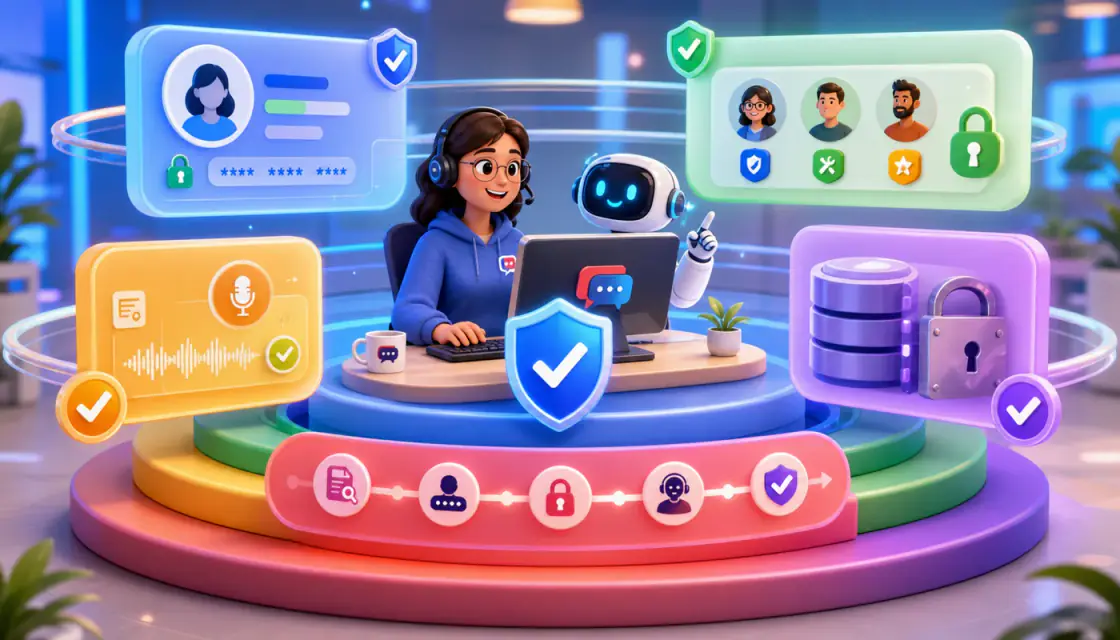
A support platform holds a large volume of historical conversations, ticket records, service progress, and customer communications. Losing that data can harm operations. Exposing it can harm trust.
HeroDash runs daily data backups to support recoverability in the event of an incident. Data in transit is protected with TLS 1.3+ encryption. Sensitive data at rest is protected with AES-256 encryption. TLS certificate validity is checked continuously, with renewal completed before expiration.
At the network level, HeroDash systems are deployed on cloud infrastructure with cloud security groups and network access control lists that restrict access to authorized sources. This reduces platform exposure and helps limit the paths available to unauthorized access attempts.
Making Key Actions Traceable
In customer service operations, many security questions are not only about whether something happened. They are about whether the organization can reconstruct what happened afterward.
Who viewed a customer’s unmasked information? Who changed a permission? Who accessed a recording? Who handled a specific ticket? Who exported or reviewed sensitive data, and when?
HeroDash maintains traceability across privacy information access, permission changes, recording archives, and system operations. This matters for internal management reviews, customer audits, regulatory conversations, and incident analysis.
It is difficult to create credible evidence after the fact. A support platform needs to capture that evidence as part of normal operation.
Why This Matters More as Brands Expand Internationally
For brands selling mainly in one home market, customer service security can feel like a background IT concern. For brands expanding into Europe and other regulated markets, it becomes a foundational requirement.
GDPR is not just a compliance checkbox. It reflects what many customers expect from any brand handling their personal information: explain what you collect, limit who can see it, protect it properly, and be able to show how it was handled.
A brand that can clearly explain how customer data is protected, accessed, reviewed, and retained builds trust faster than one that cannot. As businesses expand into more markets and more channels, the security capability of the customer service platform stops being a background detail. It becomes part of the foundation the expansion is built on.
For a deeper view of Callnovo’s broader security posture, see our security and compliance page and our article on how we secure 2,500+ endpoints across global operations.
Questions Worth Asking Any Customer Service Platform
| Buyer question | What a strong answer should include |
|---|---|
| What can frontline agents see by default? | Masked-by-default PII with exception-based access. |
| How are roles separated? | Role-based permissions for agents, QA, supervisors, admins, and security reviewers. |
| What happens when an employee leaves? | Immediate account deactivation and permission revocation. |
| How are recordings handled? | Consent disclosure, controlled access, retention settings, and traceable review. |
| What can be audited later? | Unmasking, permission changes, recording access, ticket handling, and system operations. |
| How is data protected technically? | Encryption, backups, network access controls, MFA, and monitoring. |
The answers to these questions say more about whether a platform is ready for your data than a feature demo can.
FAQ
What customer data usually flows through a support platform?
A support platform can handle names, phone numbers, email addresses, shipping addresses, order numbers, ticket histories, call recordings, payment or logistics status, and AI-assisted processing records.
How does HeroDash reduce agent exposure to personal data?
HeroDash masks sensitive customer information by default and limits unmasked access to authorized personnel. Sensitive access can be recorded in audit trails, making exceptions visible and reviewable.
Does HeroDash support GDPR-aware customer support operations?
HeroDash is designed with GDPR-aware controls such as access management, auditability, data security, transparency support, and configurable recording consent workflows. Final GDPR compliance depends on the brand’s legal basis, DPA, retention settings, consent workflow, and data-subject request process. This article is operational guidance, not legal advice.
Sources
- ISO - ISO/IEC 27001 information security management systems
- European Commission - Legal framework of EU data protection
- EUR-Lex - General Data Protection Regulation (EU) 2016/679
Want the full picture of HeroDash security and compliance? Visit our security and compliance page for security controls, data handling, and regulatory alignment details.